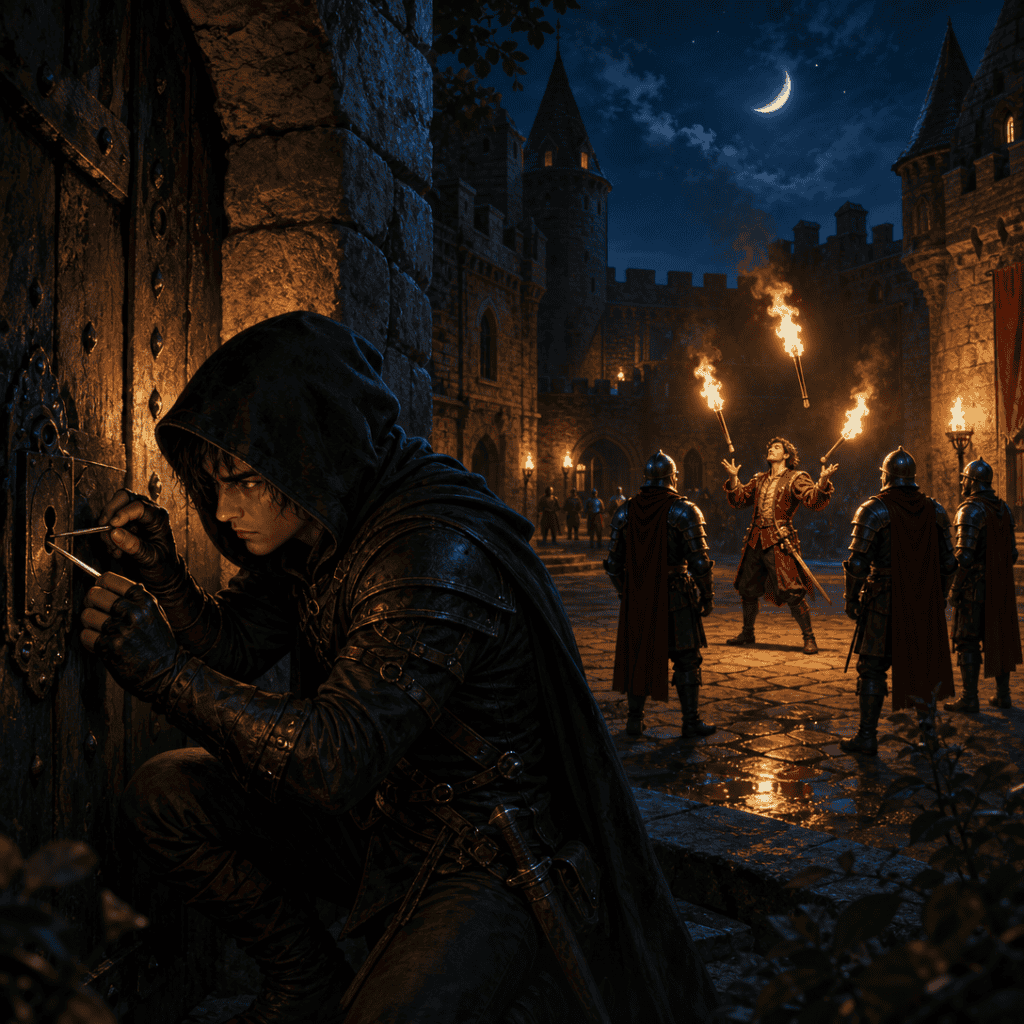

Running D&D stealth and infiltration scenes well is harder than it looks, and the biggest reason is what we’ll call the loud-player problem. Every group has a player whose character isn’t built for stealth — the paladin in plate, the barbarian with a 10 in Dexterity, the wizard whose only sneaking-relevant stat is “low Charisma.” Traditional infiltration design tells these players to stay back and be quiet. Functionally, that’s telling them to stop playing for forty minutes. This guide covers how to keep the loud player engaged, five alternate roles they can fill during stealth scenes, and how to pace infiltration so every player has focal moments.
The Loud-Player Problem
Look at any heist or infiltration session. The rogue gets the first hour. Sleight of hand on the lock. Stealth check past the guards. Disarm the trap. Find the safe. The rogue’s player is having the best night of their D&D life.
The other players are watching. The barbarian, who rolled a 6 on her first stealth check, is now “covering the rear” — meaning standing still in a doorway while everyone else does the actual session. The paladin can’t stealth at all. The wizard might cast invisibility on someone but is otherwise just a tagalong.
This is fine for one short scene. It is not fine for an entire session. Stealth-heavy adventures regularly produce 2-3 hour sessions where one player has 90% of the spotlight and everyone else has watched. Players don’t always say it out loud, but they remember those sessions. They don’t ask for stealth one-shots again.
Worse: at small tables (2-3 players, the Anvil N Ink target), the problem is more acute. With only three players, losing one to “be quiet” during the entire infiltration phase loses 33% of your table’s energy. There’s no room for that.
Why Traditional Stealth Design Fails Small Tables
The stealth-as-rogue-spotlight design comes from heist movies and big-table D&D. In a heist movie, the rogue character is the protagonist. In a 5-6 player D&D group, the rogue’s spotlight scene is balanced by the cleric’s spotlight scene, the bard’s spotlight scene, and so on across the session.
At a 2-3 player table, every minute of one character in the spotlight is a minute another character is mostly not playing. Stealth scenes are gravity wells — they pull all the focus toward the stealthy character. The fix isn’t to remove stealth scenes. It’s to redesign them so multiple players are doing things during the scene.
Five Non-Stealth Roles for the Loud Player
The loud player isn’t bad at stealth — they’re built for something else. Give them that something else, in the same scene as the stealth.
1. The Distraction
Loud-player territory. While the rogue infiltrates, the loud player draws attention somewhere else: starting a brawl in the tavern across the courtyard, performing a public scene, “accidentally” releasing horses. The DM tracks this as a parallel scene with its own checks and stakes — Persuasion, Performance, Athletics, even combat — happening at the same table as the stealth.
2. The Inside Plant
The loud player is already inside. They got hired as a guard last week. They’re a guest at the party. They’re working as a stable hand. The infiltration plan involves the rogue reaching them and being handed the next step. The loud player’s contribution isn’t sneaking; it’s having gotten in legitimately and now navigating the inside as a friendly face.
3. The Wagon Driver / Extraction
The loud player is waiting outside with the wagon, the rope, the boat, the disguised carriage. Their job is to recognize the moment something has gone wrong (signal, gunshot, fire, magical pulse) and react instantly. This sounds passive, but it isn’t — the wagon driver runs encounters during the wait (suspicious patrol, nosy neighbor, drunk townsfolk), and their snap decisions when the extraction goes hot determine whether everyone gets out alive.
4. The Hostage Pretender
The loud player allows themselves to be caught — on purpose. Maybe drunk on the doorstep. Maybe pretending to be a courier with the wrong papers. Once “captured,” they’re inside, where the guards don’t suspect them. This works especially well when the loud player has high Charisma but bad Stealth — they’re playing a role, not sneaking.
5. The Conversation Cover
The loud player is loudly chatting up the guards while the rogue picks their pocket for the key. Persuasion, Deception, Performance — all checks the loud player makes WHILE the rogue is making their stealth checks. Both players roll. Both players have stakes. The loud player’s failure makes the rogue’s check harder; the rogue’s failure ends the loud player’s conversation.
Pacing D&D Infiltration: Not All Stealth All the Time
The mistake most DMs make with infiltration is running it as one long scene. Don’t. Break the infiltration into chapters, each with a different focal player.
Chapter 1: Approach. The face’s scene. Talking past the gate. Bribing the dock worker. Fast-talking the receptionist. Loud-player friendly.
Chapter 2: Reconnaissance. Brief stealth chapter. Rogue’s first spotlight. Maps the territory.
Chapter 3: Diversion + Penetration. Parallel scenes. Loud player creates the diversion; rogue exploits it.
Chapter 4: The Score. The actual heist objective. May involve all players (combat with a guard, magical lock requiring the wizard, etc.).
Chapter 5: Extraction. Combat-friendly. Things go wrong. The wagon driver’s moment, or the muscle’s moment, or both.
Each chapter is 15-25 minutes. Each one centers a different player. The rogue still has more total spotlight time, but no other player goes a full hour without doing something meaningful.
Combat as Plan B
If the stealth fails, the session shouldn’t end. Combat is the productive failure mode — the moment when the loud player’s actual build pays off. Design the infiltration so that getting caught leads to a combat encounter the loud player is built for, not a TPK.
The trick: the alarm doesn’t bring twenty guards. It brings four guards over five rounds, plus one captain after round two. The party has time to fight, retreat, and improvise. The session continues with combat instead of stealth, which means everyone gets to play.
This is also why the wagon-driver role above is so valuable. When stealth fails, the wagon driver becomes the cavalry, the escape route, and the combat hero in one shift.
Common Pitfalls
One stealth check decides the mission. Don’t. A single failed roll shouldn’t end the session or burn 90 minutes of player work. Build infiltration as multiple checks across multiple scenes — failure on any one is a complication, not a catastrophe.
Punishing stealth failure with character death. The stakes of “I rolled a 4” shouldn’t be “your character dies.” Failure should mean alarm, complication, or combat — not loss of character. Save death stakes for genuinely high-risk moments the players have agreed to.
Letting the loud player tune out. If you notice the loud player’s eyes glazing over, that’s a DM problem, not a player problem. Bring them in. Give them a parallel scene. Even a minor improvised moment (“the guard at the back gate is whistling — what does the song sound like to you?”) keeps them engaged.
Forgetting that loud players can be quiet sometimes too. Some players who claim to hate stealth scenes actually enjoy them when they’re given a meaningful role. Don’t assume the loud player will always reject stealth — ask. Sometimes the barbarian wants to try sneaking just once.
Published D&D Heists That Handle This Well
The Score is built for parallel-role infiltration. The structure assumes one stealth specialist and one or two non-stealth roles, with explicit chapters for distraction, conversation cover, and extraction. Two hours, 2-3 players, level 2-3.
The Merchant’s Vault uses urban terrain to give the loud player constant ambient activity (street performers, market chaos, suspicious patrols). The Winter Ball Heist takes the parallel-role structure into a holiday setting where the loud player is an invited guest at the ball while the rogue infiltrates the vault.
For the broader heist pillar, see D&D Heist Adventure. For more on building heist crews where every player has a role, see Heist Crew Roles for 2-3 Player Tables.
Frequently Asked Questions
What is the loud-player problem in D&D stealth scenes?
The loud-player problem describes the situation where one or more players have characters built for combat or social play but find themselves locked out of stealth-heavy scenes because their characters are bad at sneaking. They check out of the session for 30+ minutes while the rogue handles infiltration. The fix is parallel roles, not silence.
What’s the best class for infiltration in D&D 5e?
Rogue is the obvious answer, but Bard and Ranger (especially Gloom Stalker) are nearly as effective. For non-stealth infiltration roles, Sorcerers and Bards excel as faces and distractions, while Fighters and Paladins make excellent extraction muscle.
How do you handle a player whose character can’t stealth at all?
Give them a non-stealth role in the same scene. Distraction, inside plant, wagon driver, hostage pretender, conversation cover. None of these require the character to sneak, but all of them keep the player engaged in the infiltration.
How long should a D&D stealth scene last?
15-25 minutes per chapter, with multiple chapters in an infiltration. A single stealth scene that runs longer than 25 minutes will start to lose non-rogue players regardless of how well it’s designed.
What if stealth fails?
Combat is the productive failure mode. Design encounters so that getting caught triggers a 4-5 round combat with realistic enemy numbers, not a TPK from twenty guards converging instantly. The loud player who was sidelined during stealth becomes the hero of the combat scene.
Run an Infiltration Session That Doesn’t Lose Half the Table
Stealth scenes don’t have to be solo rogue performances. With parallel roles, chaptered pacing, and combat as a productive failure mode, infiltration can be one of the most engaging session formats for small groups — provided every player has something to do besides “stay back and be quiet.”
Read the full review of The Score — Anvil N Ink’s small-group heist one-shot built for parallel-role infiltration. Two hours, 2-3 players, level 2-3.
For the broader heist pillar, see D&D Heist Adventure. For crew composition guidance, see D&D Heist Crew Roles for 2-3 Player Tables.
Stealth is a team sport. The team just doesn’t all have to sneak.