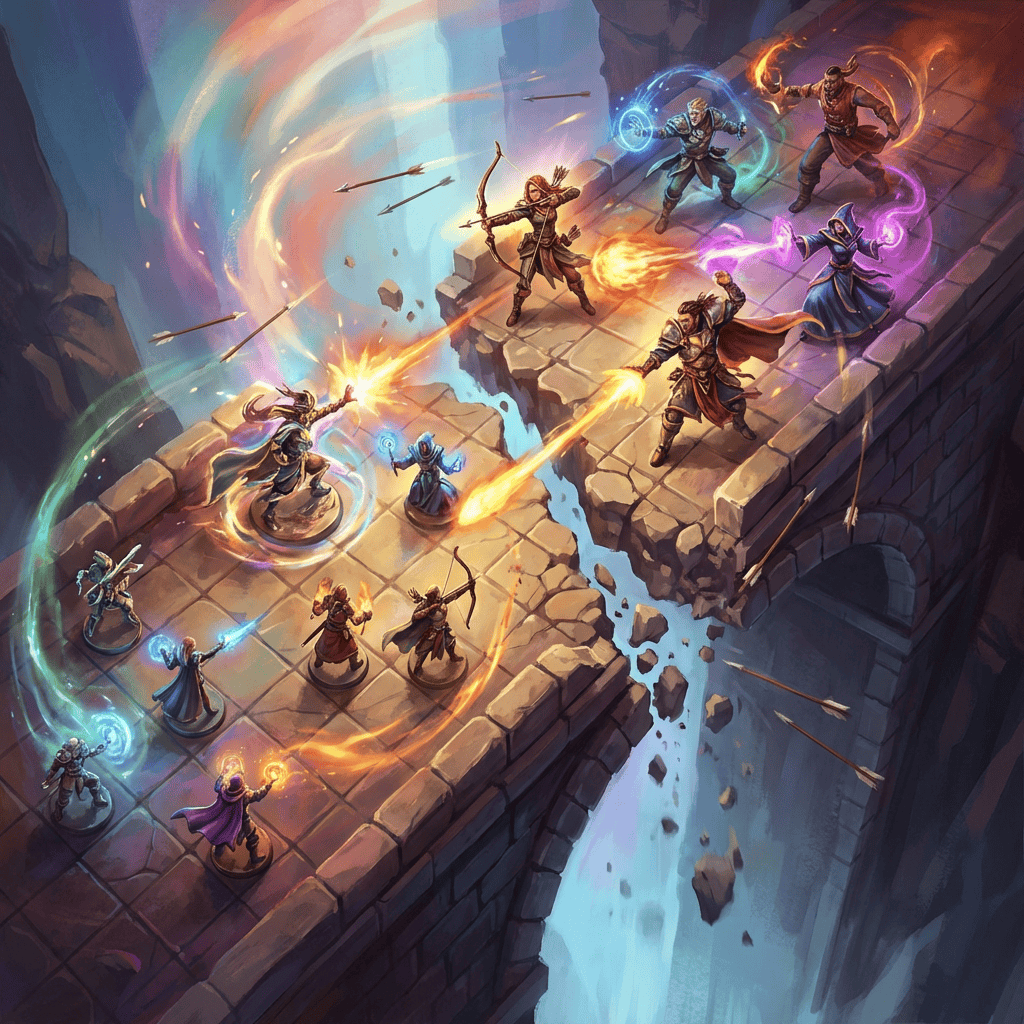

D&D Combat Encounter Design: 7 Tips for Fights Players Actually Remember
D&D combat encounter design should produce the most exciting moments of your session — the desperate last stand, the clever tactical maneuver, the clutch critical hit that turns the tide. Instead, most combat encounters produce the same loop: roll initiative, stand in a room, trade attacks until one side drops. Players check their phones between turns. The DM tracks hit points mechanically. Everyone waits for combat to end so the adventure can continue.
The problem isn’t D&D’s combat system. The problem is that most encounters are designed as math problems — balance the CR, place the monsters, let the dice decide. A mathematically balanced encounter can still be phenomenally boring if there’s nothing interesting happening beyond “reduce the enemy’s hit points before they reduce yours.”
This guide gives you seven techniques for designing combat encounters where the environment matters, objectives go beyond killing, and every round presents meaningful decisions. These techniques work for any party size but are especially critical for small group combat where fewer players means fewer actions per round and less margin for error — making tactical depth essential rather than optional.
Why Most Combat Encounters Feel the Same
Strip away the monster names and damage types, and most D&D combat encounters are functionally identical. Players and monsters stand in a space. They take turns attacking each other. Whoever runs out of hit points first loses. The space doesn’t matter. The monster’s personality doesn’t matter. The stakes don’t matter beyond “don’t die.”
This sameness comes from designing encounters around a single variable: combat difficulty. DMs calculate challenge ratings, balance action economy, and ensure the fight is “fair” — then stop designing. But difficulty is the floor of good encounter design, not the ceiling. A fight can be perfectly balanced and perfectly boring. What transforms an encounter from balanced to brilliant is everything that happens AROUND the combat: the terrain, the objectives, the enemy behavior, the time pressure, and the consequences.
Every technique in this guide adds a design layer beyond difficulty. Together, they ensure that no two encounters in your adventure feel alike — even if they use identical monsters. This multi-layered approach is what makes combat memorable in adventures like The Bandit’s Keep, where stealth, environment, and objectives transform standard bandit fights into tense tactical puzzles.
Tip 1: Give Every Fight an Objective Beyond “Kill Everything”
The single most impactful change you can make to your D&D combat encounter design is adding an objective that isn’t “defeat all enemies.” When killing everything is the only win condition, combat becomes a war of attrition — and attrition is boring because the outcome is usually apparent within the first two rounds.
Alternative objectives transform the tactical landscape entirely. Protect the unconscious NPC until the healer arrives (protection encounter). Reach the lever on the far side of the room before the portcullis closes (race encounter). Grab the artifact and escape through the window (heist encounter). Survive five rounds until reinforcements arrive (endurance encounter). Hold the bridge while civilians cross (defense encounter). Each objective creates different tactical priorities, movement patterns, and decision points.
The best objectives create tension between fighting and achieving. Enemies guard the lever, so players must decide whether to clear them first or dash through the attacks. The artifact is across a room full of enemies, and fighting them all takes too long — but ignoring them means taking damage. These competing pressures generate the “what do I do?” moments that make combat genuinely engaging.
The Other Side of the Door builds its entire combat system around non-standard objectives — players defend a position against waves of attackers, making every fight about holding ground rather than killing enemies. The shift in objective completely changes how players think about combat tactics.
The Objective Stack
Layer two objectives for maximum tactical depth. Primary: reach the signal fire and light it. Secondary: keep the enemy commander alive for interrogation. Now players must cross the battlefield (movement objective) while using non-lethal force against a specific target (restraint objective) — all while other enemies try to kill them. Stacked objectives prevent combat from simplifying into “attack the nearest enemy” because the nearest enemy might not be the most important problem.
Tip 2: Design the Battlefield Before the Monsters
Most DMs design encounters by choosing monsters first and placing them in a generic room. Flip that process. Design the battlefield first — the terrain, the hazards, the interactive elements, the movement challenges — then choose monsters that use the battlefield interestingly.
A rope bridge over a chasm turns every forced-movement effect into a potential kill. A library full of flammable books makes fire spells devastating — for both sides. A flooded chamber where the water rises each round creates escalating urgency. A room with balconies and ladders creates vertical combat where position matters as much as damage output. The battlefield provides tactical texture that monsters alone cannot.
Interactive elements are especially important. Objects the players can manipulate during combat — chandeliers they can drop, barricades they can topple, doors they can slam, oil they can ignite — give creative players options beyond their character sheet abilities. When a fighter pushes a bookshelf onto three enemies, that moment is more memorable than any critical hit because the player saw an opportunity in the environment and seized it.
This environment-first approach connects directly to dungeon design principles — every combat room should serve as both a fight space and an environmental storytelling space. The ruined temple’s collapsed pillars provide cover AND tell the story of what destroyed the temple. The wizard’s lab has explosive components on the shelves that serve as both hazards AND evidence of the wizard’s research.
The Three-Element Battlefield
Every combat space needs at least three tactical elements: one that benefits the players (cover position, high ground, escape route), one that benefits the enemies (defensive position, ambush point, reinforcement entrance), and one that’s dangerous to everyone (environmental hazard, unstable terrain, spreading fire). This three-element minimum ensures the battlefield influences tactical decisions rather than serving as a flat arena with walls.
Tip 3: Make Enemies Behave Like Characters, Not Game Pieces
Monsters in most encounters fight like software — attack the nearest target, use abilities on cooldown, fight until dead. This behavior is predictable and boring because it never surprises the players. Real opponents — intelligent ones, instinctual ones, desperate ones — behave in ways that create unexpected tactical situations.
Intelligent enemies use tactics. They focus fire on the healer. They retreat when wounded and return with reinforcements. They set ambushes, use terrain advantages, and attempt to separate the party. They negotiate mid-combat when the fight turns against them. They flee when defeat is certain rather than fighting to the last hit point. These tactical behaviors force players to adapt rather than executing the same combat routine every fight.
Even unintelligent monsters have behavior patterns. Pack predators surround isolated targets. Territorial beasts fight fiercely near their nest but break off if the intruders retreat. Swarm creatures avoid area effects after witnessing one. Ambush predators flee if their surprise attack fails. These behavioral patterns make each creature type feel distinct even before considering stat blocks.
In The Bandit’s Keep, the 20+ bandits aren’t identical enemies with identical behavior. Guards patrol. Sentries alert others. The boss negotiates. Some bandits are scared recruits who surrender quickly. This behavioral variety turns what could be twenty identical combat encounters into a dynamic infiltration where different enemies require different approaches.
The Behavior Card
For each enemy type in your encounter, write a three-line behavior card. Line one: what they do on the first round (their opening tactic). Line two: what they do when things go well (aggressive behavior). Line three: what they do when things go badly (defensive behavior or retreat condition). Three lines per enemy type gives your combat encounters dramatically more personality than “attacks nearest target” without requiring complex AI tracking.
Tip 4: Use Reinforcements and Waves to Control Pacing
A single group of enemies creates a single tactical problem. Reinforcements and waves create evolving tactical problems that prevent combat from becoming static. The fight your players plan for in round one shouldn’t be the same fight they’re dealing with in round four.
Reinforcements work best when they arrive from unexpected directions and change the tactical situation. The three enemies in the room are manageable — until four more arrive from the corridor behind the party. Now the fighters are caught between two groups. The rogue who was safely attacking from range is suddenly in melee. The carefully established formation crumbles and players must adapt instantly.
Waves work differently from reinforcements. Waves are expected — players know more enemies are coming and must manage resources across multiple groups. Do they burn their powerful abilities on wave one and hope nothing tougher arrives? Do they conserve resources and accept a longer, riskier fight with wave one? This resource management adds a strategic layer that single encounters lack.
Reinforcements and waves are particularly effective for D&D combat encounter design in small group games. Rather than throwing one overwhelming force at two players, send smaller groups in sequence. Each wave is survivable, but the cumulative resource drain creates genuine danger. Players feel heroic defeating wave after wave while still experiencing real tension about whether their resources will hold out.
The Complication Wave
The most interesting waves don’t just add more enemies — they add complications. Wave one is standard combat. Wave two introduces a non-combatant who needs protection (now it’s a protection encounter). Wave three introduces a fire that’s spreading across the room (now it’s a timed escape). Each wave changes the rules of the fight, preventing players from settling into a routine and demanding constant tactical reassessment.
Tip 5: Create Encounters That Reward Non-Combat Solutions
Not every encounter featuring enemies needs to be resolved through combat. The most memorable encounters in D&D are the ones where players find a way to avoid, redirect, or resolve a fight through creativity — and the encounter design supports those solutions.
A room full of bandits can be fought. It can also be snuck past. Or bribed. Or tricked with a disguise. Or turned against itself by exploiting internal rivalries. Or avoided entirely by finding an alternate route. Each of these solutions should be viable within your D&D combat encounter design — not as exploits the players discover, but as intentional paths you’ve prepared.
This doesn’t mean every fight should be avoidable. Some encounters are dramatic necessities — the climactic boss fight SHOULD be a fight because the narrative demands it. But mid-adventure encounters benefit enormously from non-combat solutions because they reward player creativity, conserve resources for the encounters that matter, and prevent the “combat fatigue” that makes long dungeon crawls tedious.
The Merchant’s Vault demonstrates this beautifully. Most encounters in the adventure CAN be fought, but combat creates noise that attracts attention, burns resources needed later, and risks alerting the rival thieves. Players who find non-combat solutions are rewarded with better positioning for the encounters that genuinely require fighting. This design philosophy draws from the same principles behind social encounter design — giving players meaningful choices about HOW they engage with obstacles.
The Three-Solution Minimum
For every encounter with enemies, plan at least three resolution paths: combat (fight through), stealth (sneak past), and social (talk, bribe, or trick through). You don’t need detailed plans for each — just a quick note on what happens if the players attempt each approach. “Guards can be bribed for 50gp, distracted by a commotion, or fought (2 guards, CR 1/2 each)” takes one line and triples the encounter’s player agency.
Tip 6: Design Combat Around Terrain Transitions
Static battlefields produce static fights. Terrain transitions — moments when the battlefield itself changes — produce dynamic fights where tactics evolve in real time and players must constantly reassess their approach.
The simplest terrain transition is movement between areas. A fight that starts in a corridor, spills into a great hall, and concludes on a collapsing balcony is three fights in one — each with different tactical considerations. Corridor combat favors choke points and ranged attackers. Great hall combat favors mobility and flanking. Balcony combat introduces height advantages and falling hazards. The fight evolves because the space evolves.
Environmental transitions are even more impactful. A room that floods over six rounds transforms from standard combat to wading combat to swimming combat — each phase changing movement rules, weapon effectiveness, and available tactics. A forest fire that advances across the grid each round shrinks the available combat space, pushing enemies and players together. Rising or falling temperatures that affect spellcasting, ice that forms or melts, darkness that spreads or retreats — any environmental change that affects gameplay creates a terrain transition.
Terrain transitions are fundamental to adventures with time pressure mechanics. The sinking tower doesn’t just impose a narrative deadline — each floor’s increasing tilt changes how combat works physically. Enemies slide. Cover shifts. The floor itself becomes a hazard. Combat and environment merge into a unified challenge.
The Phase-Change Encounter
Design your major combat encounters with two to three phase changes. Phase one: standard combat conditions. Phase two (triggered by time, enemy action, or environmental shift): the battlefield changes in a way that disrupts established tactics. Phase three: a final change that creates urgency and pushes toward resolution. A three-phase encounter feels like three encounters in terms of tactical variety while requiring only one setup. This is the most time-efficient way to create memorable D&D combat encounter design.
Tip 7: Connect Combat to the Story
Combat that exists in a narrative vacuum — fights that could be removed without affecting the adventure’s story — feel like padding. Combat that advances the story, reveals information, or creates emotional stakes feels essential. The difference isn’t the fight itself but its connection to everything around it.
Story-connected combat reveals information during the fight. The enemy shouts something that reveals the villain’s plan. A dying opponent offers information in exchange for mercy. The room’s contents — visible during combat — answer a question the players have been asking since the adventure started. These mid-combat revelations make fights feel like active story moments rather than interruptions to the narrative.
Story-connected combat also creates consequences that extend beyond the encounter. The noise alerts enemies elsewhere. The fire the players started to gain advantage spreads and destroys evidence they needed. The enemy they killed was the only person who knew the vault combination. The ally who fell during the fight changes the emotional dynamic of every scene that follows. When combat has consequences beyond “you won,” players treat every fight as a significant decision rather than a routine clearance.
In The Crimson Ceremony, combat outcomes directly affect the final encounter’s difficulty. Components the players recover during fights reduce the villain’s power in the climax. Enemies who escape alert the conspiracy. Evidence found during encounters reveals new investigation paths. Combat and story are inseparable — each fight matters because it shapes what comes next.
The Narrative Beat Test
Before including any combat encounter, ask: “What narrative beat does this fight serve?” If the answer is “it fills time” or “there should be a fight here,” cut the encounter or redesign it with a story connection. Valid narrative beats include: introducing a threat, revealing information, forcing a choice, testing a relationship, escalating stakes, or providing a climactic payoff. If your fight doesn’t serve at least one narrative beat, it’s padding — and your session is better without it.
Putting It All Together: The Memorable Encounter Template
Here’s how all seven tips combine into a single encounter design process you can use for every fight in your adventure.
Start with the objective — what do the players need to accomplish beyond defeating enemies? Then design the battlefield with at least three tactical elements. Choose enemies whose behavior patterns create interesting interactions with the battlefield and the objective. Plan when and how reinforcements or complications arrive. Identify non-combat solutions and what they cost. Design at least one terrain transition that changes the fight mid-encounter. And connect the fight to the adventure’s story through information, consequences, or emotional stakes.
This process takes ten to fifteen minutes per encounter — roughly the same time most DMs spend calculating CR and placing monster tokens. But the result is incomparably richer. A fight designed with this template is one players remember and discuss long after the session ends. A fight designed with CR alone is one players forget before they level up.
Design Fights Worth Fighting
Great D&D combat encounter design is inseparable from every other element of adventure design. The battlefield emerges from your dungeon design. The enemies behave according to the villain’s personality and the NPC’s motivations. The objectives connect to the plot hooks that started the adventure. The pacing creates rhythm between combat and non-combat scenes. Combat isn’t separate from the adventure — it’s the adventure’s most intense expression.
If you want to see these combat design principles in complete, ready-to-run form, the Ready Adventure Series from Anvil & Ink Publishing designs every combat encounter around objectives, environmental interaction, and narrative consequence. The stealth infiltration of The Bandit’s Keep, the multi-front rescue of The Extraction Job, and the desperate survival encounters of Frostfall all demonstrate what happens when combat serves the story rather than interrupting it.
Your players didn’t show up to do math. They showed up to fight for something that matters, in a place that matters, against enemies who feel real. Design combat encounters worthy of their time, and every fight becomes a story.