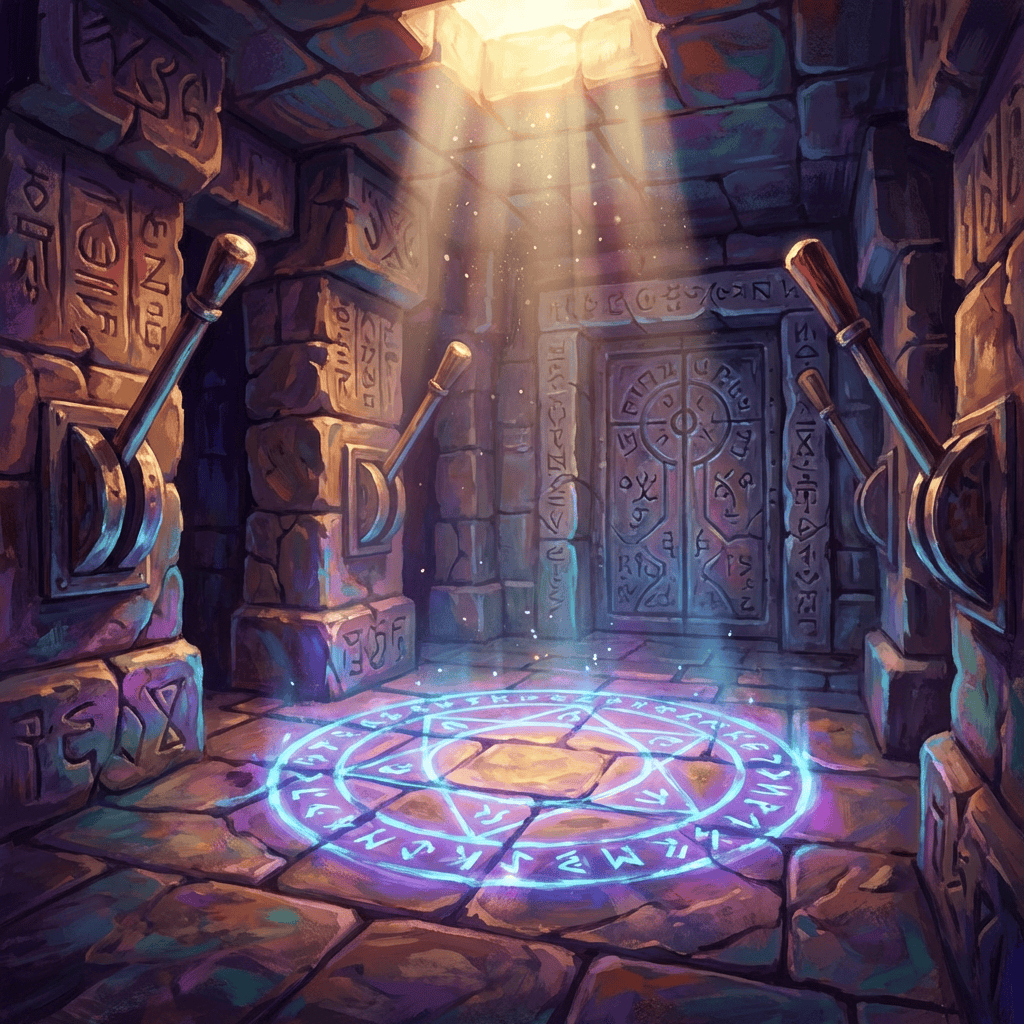

D&D Puzzle Design: 7 Powerful Techniques That Challenge Without Frustrating
D&D puzzle design is one of the most requested and most dreaded skills in a dungeon master’s toolkit. Players love puzzles — the rush of cracking a code, the satisfaction of a mechanism clicking into place, the moment someone shouts the answer and the whole table erupts. But DMs dread them because a puzzle that’s too hard grinds the session to a halt, and a puzzle that’s too easy feels like a waste of everyone’s time.
The problem isn’t that puzzles are inherently difficult to design. The problem is that most DMs design puzzles the way they’d design a riddle for a magazine — one correct answer, no alternative paths, no connection to the adventure’s stakes. That approach works on paper. At the table, it fails almost every time.
This guide teaches you seven techniques for designing D&D puzzles that challenge your players intellectually while keeping the session moving forward, maintaining narrative tension, and giving every player at the table a way to contribute. These aren’t theoretical principles — they’re drawn from adventures where puzzles are central to the experience, including temporal mechanics, environmental riddles, and multi-layered challenges designed for small groups of 2-3 players.
Why Most D&D Puzzles Fail (And How Yours Won’t)
Before diving into techniques, it’s worth understanding why puzzles go wrong. The core issue is a mismatch between how DMs design puzzles and how players experience them.
The DM designs the puzzle knowing the answer. Every clue seems obvious because the DM placed it there intentionally. The solution feels elegant because the DM crafted it with the solution in mind. But the players are working backward from scattered fragments of information, under time pressure, while also tracking initiative order, spell slots, hit points, and six other things the DM isn’t juggling.
The second common failure is isolation. A puzzle that exists in a vacuum — disconnected from the adventure’s story, stakes, and environment — feels like the DM pressed pause on the adventure to administer an IQ test. Good D&D puzzle design integrates the puzzle into the world so deeply that solving it feels like an act of exploration rather than an interruption.
Every technique in this guide addresses one or both of these failures. The goal isn’t just clever puzzles — it’s puzzles that make your adventure design stronger.
Technique 1: Design Puzzles With Multiple Solutions
The single most important principle of D&D puzzle design is this: never create a puzzle with only one solution. If there’s only one way to open the door, and your players can’t figure it out, the adventure stops. No amount of hinting or handwaving fixes a single-solution puzzle that’s stumped the table.
Design every puzzle with at least three viable approaches. The magical lock can be dispelled, picked with thieves’ tools at a higher DC, or bypassed by finding the key hidden in a nearby room. The coded message can be decoded with the cipher, translated by the NPC prisoner, or partially understood through context clues that point players in the right direction even without the full solution.
Multiple solutions also mean multiple player types can contribute. The wizard solves the arcane puzzle through knowledge checks. The rogue spots the physical bypass. The fighter realizes the wall is thin enough to break through. When everyone has a potential path to the solution, nobody sits idle while one player puzzles it out alone.
The Brute Force Escape Valve
Every puzzle should have what designers call an “escape valve” — a way to bypass or partially solve the puzzle through non-puzzle means, always at a cost. The party can force the locked door open, but it triggers an alarm. They can ignore the riddle and climb over the wall, but they miss the treasure hidden behind the correct answer. They can smash the puzzle mechanism, but it damages the artifact inside.
Escape valves prevent the session from stalling while still rewarding players who engage with the puzzle as intended. The players who solve the riddle get the full reward. The players who bypass it keep the adventure moving but pay a price. Both outcomes are valid, and neither breaks the game.
Technique 2: Connect Puzzles to the Story
A puzzle that exists solely to block a doorway is a game mechanic. A puzzle that reveals something about the world while blocking a doorway is storytelling. The difference transforms how players experience the challenge.
The best D&D puzzles teach players something about the dungeon’s builder, the culture that created them, or the history of the location. A dwarven vault doesn’t have a random logic puzzle on its door — it has a mechanism that tests whether the person seeking entry understands dwarven craftsmanship. An elven shrine doesn’t feature a sliding block puzzle — it presents a test of patience and observation that mirrors elven values. The puzzle IS the lore, delivered through interaction rather than exposition.
Story-connected puzzles also provide natural hint systems. If the puzzle reflects the culture that built it, then cultural clues scattered throughout the dungeon serve as hints. The murals on the walls aren’t just decoration — they depict the sequence needed to solve the puzzle three rooms later. The inscription above the entrance isn’t flavor text — it contains the key phrase. Players who pay attention to the world are rewarded with puzzle solutions.
The Sinking Tower of Hours weaves temporal puzzles into its core premise — the tower is sinking through magical sand, and each level’s challenges relate to the wizard’s experiments with time. The puzzles don’t feel bolted on because they emerge from the fiction rather than interrupting it.
The World-Building Test
Ask yourself: “Does this puzzle tell the players something about who built it and why?” If the answer is no, the puzzle is a game mechanic rather than a story element. Redesign it so the solution connects to the dungeon’s history, the culture of its creators, or the motivations of the person who placed it there. A trap designed by a paranoid wizard works differently from one built by a dwarven engineer, and that difference should be visible to the players.
Technique 3: Layer Information, Don’t Hide It
Most puzzle failures come from information problems. The DM has all the information needed to solve the puzzle. The players have fragments. When the gap between those two states is too wide, frustration replaces fun.
The fix is layered information delivery. Don’t give players all the clues at once, but don’t lock essential information behind skill checks they might fail either. Design your puzzle so that basic observation provides the first layer — “the door has four symbols and four buttons.” A successful Investigation check provides the second layer — “one of the symbols is worn from frequent pressing.” An Arcana check provides the third — “the symbols correspond to the four elemental planes, and the room’s decorations emphasize fire.”
Each layer makes the puzzle easier without solving it outright. Players who get all three layers can deduce the answer quickly. Players who only get the first layer can still solve it through experimentation. Nobody is stuck because nobody is locked out of attempting the puzzle entirely.
This layered approach mirrors the Three-Clue Rule from mystery design — the principle that any critical piece of information should be available through at least three different sources. Apply the same thinking to puzzle clues, and your puzzles become self-balancing. Groups that miss one clue still have two others pointing them toward the solution.
The “Always Solvable” Principle
Every puzzle should be solvable with zero successful skill checks. Skill checks should make the puzzle EASIER, not POSSIBLE. If a failed Perception check means the players never find the clue they need, your puzzle has a design flaw. Place essential clues in plain sight. Use skill checks to reveal shortcuts, additional context, or bonus information — not the baseline requirements for a solution.
Technique 4: Make Puzzles Physical and Interactive
The worst puzzles in D&D are the ones where the DM describes a puzzle verbally and the players discuss it verbally. There’s no tactile engagement, no visual reference, and no sense of physical interaction with a game object. It feels like solving a homework problem rather than exploring a dungeon.
Great D&D puzzle design incorporates physical elements at the table. Draw the puzzle. Use props. Place tiles on the map that players can physically rearrange. Hand players a actual coded note they can pass around and study. Give them a physical map with torn edges they need to piece together. The moment players are holding something, turning it over, passing it to each other — that’s when puzzles come alive.
Props don’t need to be elaborate. A handwritten note on aged paper (crumple it and stain it with tea) costs nothing and transforms a “the DM reads a clue aloud” moment into “the players found an actual document.” A set of numbered cards representing tiles the players can physically arrange is more engaging than describing the tile puzzle verbally for twenty minutes.
Digital and Theater-of-the-Mind Puzzles
If you’re running a game without physical props, translate the tactile element to visual presentation. Draw the puzzle on a whiteboard or shared screen. Let players mark up the diagram as they work through possibilities. The key is that players should be DOING something with the puzzle, not just thinking about it. Movement, marking, arranging — any physical or visual action keeps engagement high and prevents the puzzle from becoming a purely mental exercise that excludes less analytically-minded players.
Technique 5: Add Time Pressure to Prevent Stalling
An unrushed puzzle becomes a committee meeting. Players deliberate endlessly, second-guess each other, and lose momentum. The energy drains from the room as the puzzle shifts from exciting challenge to tedious debate.
Time pressure solves this elegantly. When something is happening while the players solve the puzzle — water rising, enemies approaching, a mechanism counting down — deliberation has a cost. Players make faster, more decisive choices because hesitation has consequences.
The timer doesn’t need to be punitive. Rising water might mean the puzzle becomes harder to interact with (submerged buttons, floating clue tiles) rather than instant death. Approaching enemies might mean the party needs to split attention between solving and defending rather than abandoning the puzzle entirely. The pressure creates urgency without creating unfairness.
This technique is central to adventures like The Oasis of Hours, where temporal puzzles exist within a larger ticking-clock framework. Players can’t spend unlimited time on any single challenge because the adventure’s overall deadline keeps pushing them forward. The result is that puzzle-solving feels exciting rather than contemplative — more action movie bomb defusal than Sunday crossword.
The Escalation Model
Design your timed puzzles with escalating consequences rather than binary success/failure. Each round the puzzle isn’t solved, things get slightly worse. Round one: the room starts filling with smoke. Round three: visibility drops to 10 feet. Round five: everyone takes damage from the heat. Round seven: the treasure inside the vault begins to melt. Players can solve the puzzle at any point, and earlier solutions yield better outcomes — but even a late solution isn’t a total failure.
Technique 6: Design Puzzles That Require Different Skills
The classic D&D puzzle rewards one type of thinking — usually logical deduction or pattern recognition. This means one or two players at the table do all the work while the rest watch. For small groups especially, this concentration of engagement is a serious problem.
Design puzzles that require multiple skill types to solve. The physical component requires Athletics or Dexterity. The knowledge component requires Arcana or History. The observation component requires Perception or Investigation. The social component requires talking to an NPC or interpreting emotional cues. When different puzzle elements reward different character strengths, every player has a meaningful contribution.
A multi-skill puzzle might look like this: a sealed door with three locks. The first lock is mechanical (thieves’ tools check). The second requires speaking a command word found in a book in the previous room (Investigation to find the book, language skills to translate). The third requires simultaneously pressing two pressure plates on opposite sides of the room (coordination between players, possibly Athletics for the jumping required). Three players, three contributions, one shared victory.
This collaborative approach to puzzle design is especially important for duet games and small groups where sitting idle during someone else’s puzzle moment means waiting through a significant chunk of the session. When the puzzle needs everyone, everyone stays engaged.
The Role Audit
Before finalizing any puzzle, list the character types in a typical party: the strength-based character, the dexterity-based character, the knowledge-based character, and the charisma-based character. Does your puzzle give at least two of these types something meaningful to do? If only one character type can engage with the puzzle, redesign it to include elements that other types can contribute to.
Technique 7: Build Progressive Puzzle Chains
A single puzzle is a moment. A chain of connected puzzles that build on each other is an experience. Progressive puzzle chains — where solving one puzzle provides tools, knowledge, or access needed for the next — create satisfying narrative arcs within your dungeon and reward players who pay attention to earlier solutions.
The simplest version is the key-and-lock chain: puzzle A gives you the tool to solve puzzle B, which reveals the information needed for puzzle C. But more sophisticated chains layer complexity. The color pattern from room one, the number sequence from room two, and the symbol key from room three all combine into the final vault combination. Players who tracked all three components solve the vault instantly. Players who missed one have to backtrack or find an alternate approach.
Progressive chains also create natural pacing within your dungeon design. Early puzzles are simpler, building player confidence and establishing the puzzle language your dungeon uses. Middle puzzles introduce complications. The final puzzle combines everything players have learned into a culminating challenge that feels earned rather than arbitrary.
The Callback Reward
The most satisfying moment in a puzzle chain is the callback — when players realize that something they dismissed earlier is actually the final piece. The decorative inscription they walked past in room one IS the answer to the final puzzle. The seemingly random pattern on the floor of the first chamber IS the map to the treasure vault. Design at least one callback into every puzzle chain. When a player says “Wait — go back to that first room!” the entire table lights up.
The Sinking Tower of Hours uses this technique across its five descending levels — mechanical themes and temporal clues from upper floors become essential knowledge for the challenges below. Players who rushed through early rooms find themselves returning for details they overlooked, which the sinking tower’s time pressure transforms from simple backtracking into a tense tactical decision.
Common D&D Puzzle Design Mistakes (And How to Fix Them)
Even experienced DMs fall into puzzle traps. Here are the most common mistakes and their solutions.
The first mistake is designing puzzles around DM knowledge rather than player observation. If the solution requires information the players don’t have and can’t discover through play, the puzzle is unfair regardless of how elegant it seems. Fix: every piece of information needed to solve the puzzle must be discoverable within the game through observation, skill checks, or NPC interaction.
The second mistake is making puzzles gatekeepers rather than enrichments. If the main adventure path runs directly through a puzzle with no bypass, a failed puzzle ends the session. Fix: puzzles should guard optional rewards, provide shortcuts, or offer advantages — but the adventure should remain completable even if every puzzle goes unsolved.
The third mistake is overcomplicating the mechanism. If you need more than two sentences to explain how the puzzle works, players will spend more time understanding the rules than solving the challenge. Fix: the puzzle’s mechanism should be immediately apparent. “Press the buttons in the right order” is clear. “Rotate the inner ring while aligning the outer symbols with the corresponding elemental attunement based on the phase of the moon depicted on the ceiling” needs simplification.
The fourth mistake is ignoring the party’s capabilities. A logic puzzle doesn’t care that the barbarian has 20 Strength. A physical puzzle doesn’t care that the wizard has 20 Intelligence. Fix: know your party’s strengths and design puzzles that let those strengths contribute, as covered in Technique 6.
Puzzle Templates You Can Use Tonight
Here are four puzzle frameworks you can adapt to any adventure with minimal prep.
The Sequence Puzzle: players must activate four mechanisms in the correct order. Clues to the order are scattered across the dungeon as murals, inscriptions, or NPC hints. Wrong order triggers a consequence (trap, alarm, reset) but doesn’t block progress permanently. Works for any sealed door, vault, or ritual activation.
The Assembly Puzzle: players find three to four fragments throughout the adventure that combine into a complete object, map, or message. Each fragment is useful on its own (partial map, incomplete key, fragmented instructions) but together they unlock the final reward. Works for treasure hunts, investigation adventures, and multi-room dungeons.
The Environmental Puzzle: the room itself is the puzzle. Water levels that need redirecting, light beams that need reflecting, pressure plates that require specific weight, or temperature zones that affect objects differently. Players interact with the space rather than solving an abstract problem. Works for any location-based challenge.
The Social Puzzle: an NPC has information but will only share it under specific conditions. The conditions aren’t just “pass a Persuasion check” — they require understanding the NPC’s personality, values, or situation. The grieving mother talks if you bring flowers to her son’s grave. The proud craftsman shares secrets if you genuinely appreciate his work. The prisoner cooperates if you ensure her family’s safety. These work especially well in social encounter design where puzzle and roleplay merge seamlessly.
Integrating Puzzles Into Your Adventure Design
D&D puzzle design doesn’t exist in isolation. Puzzles are one tool in a toolkit that includes adventure structure, combat encounter design, NPC creation, and session pacing. The best adventures weave puzzles into the fabric of the experience so seamlessly that players don’t think “now we’re doing a puzzle” — they think “this dungeon is incredible.”
Place puzzles at pacing transitions — between combat encounters, at the entrance to new areas, or as breathers after intense social scenes. Avoid stacking puzzles back-to-back, which exhausts analytical energy. Alternate puzzle types so players don’t feel like they’re taking the same test repeatedly.
If you want to see these puzzle design principles embedded in complete, ready-to-run adventures, the Ready Adventure Series from Anvil & Ink Publishing integrates environmental puzzles, progressive chains, and story-connected challenges throughout. The temporal mechanics of The Sinking Tower of Hours, the ancient temple riddles of The Oasis of Hours, and the investigation frameworks in the Mystery Adventure Toolkit all demonstrate puzzles that enhance rather than interrupt the adventure.
The best D&D puzzle design creates moments where your players lean forward, point at the map, and say “Wait — I think I’ve got it.” Design for that moment, and your puzzles will never fall flat.