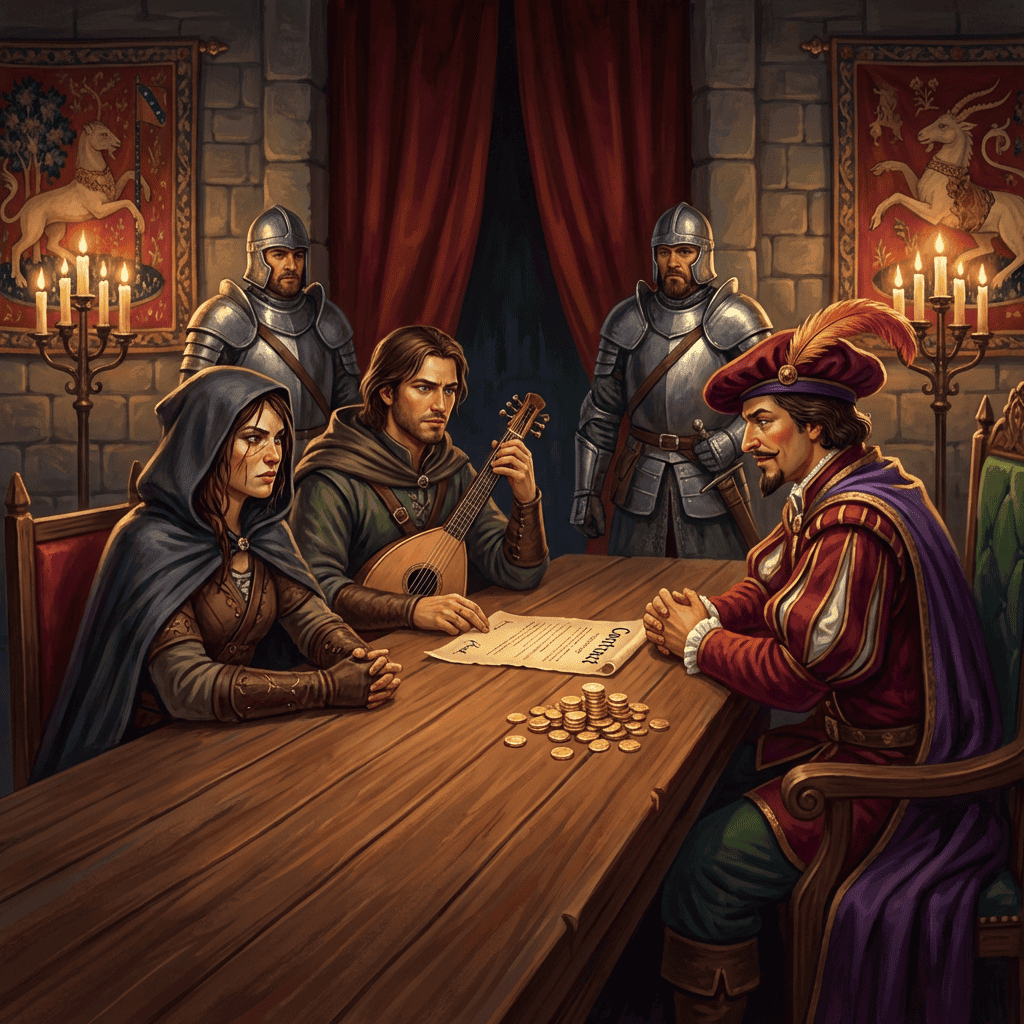

D&D Social Encounter Design: 7 Secrets to Roleplay Scenes That Rival Combat
D&D social encounter design is the most underdeveloped skill in most DMs’ toolkits. We spend hours balancing combat encounters, designing intricate dungeons, and crafting devilish puzzles — then wing every social scene with “roll Persuasion” and move on. The result is sessions where the most interesting conversations happen between players rather than between players and the world.
Social encounters should be as tactically engaging as combat and as creatively rewarding as puzzle-solving. A negotiation with a rival faction should feel as tense as a boss fight. An interrogation of a captured spy should feel as intellectually stimulating as cracking a coded message. A diplomatic dinner should carry stakes as real as any dungeon trap. When social encounters deliver this level of engagement, your sessions become genuinely unpredictable — because no stat block can prepare you for what a player says to a grieving queen.
This guide gives you seven techniques for designing social encounters that players look forward to rather than endure. These principles work for everything from tavern conversations to royal courts, and they’re especially effective in small group games where social encounters naturally occupy a larger portion of the session.
Why Social Encounters Fall Flat (And How to Fix It)
The fundamental problem with most social encounters is that they have no structure. Combat has initiative, action economy, hit points, and clear win conditions. Puzzles have mechanisms, clues, and solutions. Social encounters have… two people talking until the DM decides what happens. Without structure, social scenes drift, stall, or collapse into a single dice roll that replaces actual roleplay.
The second problem is stakes. In combat, failure means character death. In social encounters, failure often means… the NPC says no and the players try again with a different approach. When failure has no meaningful consequence, success has no meaningful weight. The persuasion check that opens a door the players would have opened anyway doesn’t feel like an accomplishment.
Every technique in this guide addresses one or both of these problems. The goal is social encounters with the structural clarity of combat and the meaningful stakes of a dungeon trap — scenes where player choices genuinely matter and the outcome shapes the rest of the adventure. This is the approach behind politically charged adventures like The Crimson Ceremony, where social encounters are as mechanically consequential as any fight.
Secret 1: Every Social Encounter Needs a Win Condition and a Fail Condition
Before any social scene begins, define what success looks like and what failure looks like — for both the players AND the NPCs. This single practice will transform your D&D social encounter design overnight.
The players want information about the cult’s hideout. The NPC guard captain wants to handle the cult investigation through official channels without outside interference. Success for the players: they get the location and possibly an ally. Success for the NPC: she maintains control of the investigation and the players agree to work within her authority. Failure for the players: they get nothing and the captain becomes suspicious of them. Failure for the NPC: she loses control of the situation and looks incompetent to her superiors.
With clear conditions defined, the social encounter has direction. Players work toward their win condition while navigating around the NPC’s goals. The NPC pushes toward their own success while trying to prevent the players from undermining their position. This creates the same tactical back-and-forth that makes combat engaging — but with words instead of weapons.
The Outcome Spectrum
Move beyond binary pass/fail outcomes. Design a spectrum of results from best to worst. Complete success: the guard captain shares everything and volunteers to help. Partial success: she shares the location but refuses to participate. Minimal success: she doesn’t help but doesn’t interfere either. Partial failure: she refuses and assigns a junior officer to watch the players. Complete failure: she actively blocks the players and alerts the cult that someone is investigating. Each outcome should flow naturally from how the conversation went, not from a single dice roll.
Secret 2: Give NPCs Competing Desires
Flat NPCs in social encounters have one desire: give or withhold information based on a skill check. Three-dimensional NPCs have competing desires that the players can leverage, exploit, or navigate. This internal conflict is what makes social encounters feel like genuine interactions rather than vending machines that accept Charisma checks.
The tavern keeper wants to help the players (she hates the bandits too) but she’s terrified of retaliation if the bandits find out she talked. She wants to be brave but she also wants to protect her daughter who works in the kitchen. The players can appeal to her courage, promise protection for her daughter, offer to keep her involvement secret, or find a way to get the information that doesn’t put her at risk. Each approach requires different roleplay and produces different levels of trust.
Competing desires also create natural information gates. The NPC will share general information freely (the bandits are in the forest) because that costs nothing. They’ll share specific information reluctantly (the entrance is behind the waterfall) because the risk is higher. They’ll share dangerous information only if the players address their competing fear (the bandit leader’s name and daily routine, but only if the players guarantee witness protection). This graduated disclosure makes the conversation feel like a negotiation rather than a transaction.
This is where strong NPC creation directly improves social encounters. An NPC built with the motivation-method-limit framework has built-in competing desires that create natural conversation structure. The limit IS the competing desire — the thing they want that conflicts with helping the players.
The Pressure Point Technique
Identify each social NPC’s pressure point — the one thing that, if the players address it, unlocks full cooperation. The merchant’s pressure point is debt. The guard’s pressure point is her sick mother. The spy’s pressure point is a desire to defect but fear of what happens to agents who try. Players who discover and address the pressure point get maximum cooperation. Players who miss it still get partial results through standard approaches. This rewards observant, empathetic roleplay without punishing players who prefer direct conversation.
Secret 3: Structure Social Encounters in Phases
Combat has rounds. Social encounters should have phases. This structure prevents scenes from drifting aimlessly and gives you natural pacing beats where you can adjust the scene’s direction based on player actions.
Phase one is the approach — how do the players present themselves? Their opening impression sets the NPC’s initial disposition. Walking into the merchant’s office in full armor sends a different signal than arriving in civilian clothes with a bottle of wine. This phase establishes the tone of the entire encounter.
Phase two is the exchange — the core conversation where information, requests, and negotiations flow. This is where competing desires create tension and players make their case. Track the NPC’s disposition mentally: are the players winning them over, pushing them away, or maintaining neutral ground? Each exchange shifts the needle.
Phase three is the decision — the NPC commits to a course of action based on how the exchange went. This is where consequences become concrete. The NPC agrees to help, refuses and becomes hostile, offers a compromise, or makes a counter-proposal that creates a new situation the players must respond to.
Phase four is the aftermath — what happens as a result of this conversation? The NPC who agreed to help sends a message. The NPC who was offended warns the villain. The NPC who offered a compromise introduces a new complication. The aftermath connects this social encounter to the rest of the adventure.
The Disposition Tracker
Use a simple three-point tracker during social encounters: hostile, neutral, friendly. Start the NPC at their initial disposition. Each significant player action shifts the tracker one step in either direction. A persuasive argument shifts toward friendly. An insult shifts toward hostile. A bribe might shift either way depending on the NPC’s values. When the conversation reaches a decision point, the NPC’s current disposition determines the outcome. This gives you a mechanical framework without reducing the scene to a single roll.
Secret 4: Create Social Encounters With Time Pressure
Open-ended conversations have no urgency. Players can try approach after approach, retreating from failed attempts and trying new angles indefinitely. This makes social encounters feel consequence-free and drains them of tension.
Time pressure forces commitment. The ambassador will leave the reception in twenty minutes. The spy’s handler is arriving at midnight. The merchant’s auction starts in one hour and the players need his cooperation before it begins. When time is limited, every conversational choice matters because players can’t simply retry failed approaches — they must commit to a strategy and live with the results.
Social time pressure also creates multi-tasking scenarios that engage the whole party. While one player negotiates with the noble, another player needs to intercept the messenger who’s about to deliver compromising information. While the bard distracts the guard captain with conversation, the rogue searches her office for evidence. These split-attention social encounters give everyone a role and prevent the common problem of one charismatic player dominating all social scenes.
The heist adventures in the Ready Adventure Series use this technique extensively. In The Winter Ball Heist, the elegant social setting IS the adventure environment — players must navigate conversations, maintain cover identities, and gather intelligence simultaneously, all while a ticking clock creates escalating urgency. Social encounters in that adventure feel as pulse-pounding as any combat because failure has immediate, visible consequences.
The Social Clock
When designing a timed social encounter, establish three things: the deadline (the event that ends the conversation), the consequence of running out of time (what happens if the players don’t achieve their goal before the deadline), and the escalation (what changes as the deadline approaches). The auction starts and the item is sold. The patrol returns and the NPC clams up. The villain arrives and the window for peaceful negotiation closes. Clear deadlines create urgency that makes social encounters genuinely tense.
Secret 5: Design Social Puzzles, Not Social Checks
The worst D&D social encounter design reduces every conversation to: “I roll Persuasion.” A 23? Great, the NPC tells you everything. This approach treats social encounters as skill challenges rather than roleplay opportunities — and it’s why many tables find social scenes boring.
Design social encounters as puzzles where the “solution” is finding the right approach for this specific NPC. The retired general responds to military discipline and direct communication — flowery flattery insults him. The grieving widow responds to genuine empathy — transactional bargaining offends her. The criminal boss responds to demonstrated competence — begging or threatening makes him lose respect. Each NPC is a puzzle whose solution is understanding who they are and what they value.
Dice rolls should modify the outcome of a well-chosen approach, not replace the approach entirely. A player who identifies the general’s values and speaks to them with respect should succeed regardless of their Charisma modifier. A player who flatters the general and rolls a natural 20 should still face a skeptical response — the roll prevents total failure but doesn’t override the NPC’s personality. This rewards roleplay investment while keeping dice mechanically relevant.
The Mystery Adventure Toolkit structures its entire investigation framework around this principle — NPC interactions are puzzles where understanding the character unlocks information that skill checks alone cannot access. The GUMSHOE-inspired approach ensures players always get baseline information through interaction, with exceptional roleplay and good rolls providing bonus insights.
The NPC Key System
For every social encounter NPC, define their “key” — the approach that unlocks genuine cooperation. Write it as a simple instruction: “Responds to: shared military experience. Shuts down when: offered money.” When players discover the key through observation, conversation, or information from other NPCs, the social encounter clicks open like a well-designed lock. This gives social encounters the same satisfying “I figured it out” moment that makes puzzles enjoyable.
Secret 6: Use the Environment as a Social Tool
Where a conversation happens matters as much as what’s said. A negotiation in the villain’s throne room — surrounded by guards, sitting below the villain on their elevated seat — carries a power dynamic that favors the villain regardless of what the players say. The same negotiation on neutral ground shifts the dynamic entirely. Moving the conversation to the players’ territory flips the advantage.
Environmental D&D social encounter design means choosing locations that create specific power dynamics and then letting players manipulate those dynamics. The merchant is more honest in the temple (where they fear divine judgment) than in their shop (where they control the space). The spy is more forthcoming outdoors (where they can see approaching threats) than in a closed room (where they feel trapped). The noble is more vulnerable in the servants’ kitchen (unfamiliar territory, no social armor) than in the great hall (performing for an audience).
Players who realize they can change the conversation’s location to gain advantage are engaging with social encounters tactically — the same way they’d position themselves for advantage in combat. “Can we invite the merchant to the temple for this conversation?” is the social equivalent of “Can I get to higher ground before the fight starts?” Both show tactical thinking, and both should be rewarded.
In The Merchant’s Vault, the social environment is inseparable from the adventure’s tension. Conversations happen in compromised spaces — a condemned building, a rival thief’s territory, a client’s office where nothing is as it appears. The environment actively shapes what players can say, who might overhear, and what information is safe to share.
The Power Map
For important social encounters, note which character has the “power position” in that location. In their office, the guild master has power. In the street, it’s neutral. In the players’ camp, the players have power. Power position affects NPC confidence, willingness to negotiate, and the likelihood of making concessions. When players shift the power map in their favor — by choosing the meeting location, bringing allies, or revealing information that undermines the NPC’s position — the social encounter’s dynamics shift accordingly.
Secret 7: Make Social Consequences Visible and Lasting
The biggest failure in social encounter design is consequence-free conversation. The NPC the players insulted still helps them next session. The faction they betrayed in negotiation never retaliates. The promise they broke is quietly forgotten. When social choices have no lasting impact, social encounters have no lasting meaning.
Make consequences immediate, visible, and proportional. The merchant the players threatened charges them double for everything going forward. The guard captain they impressed assigns a deputy to assist them — a tangible benefit they can use. The noble they offended at dinner closes a door they needed for the investigation — and they have to find another way. These consequences demonstrate that social encounters matter as much as combat encounters, and they train players to take conversations as seriously as fights.
Consequences should ripple through the adventure. The NPC who feels betrayed warns others about the players. The NPC who feels respected introduces them to useful contacts. The NPC who was threatened becomes an informant for the villain. These social ripples create a dynamic world where the players’ conversational choices shape the adventure as powerfully as their combat decisions.
In adventures designed for duet and small group play, social consequences carry even more weight because there are fewer players to absorb the impact. Burning a social bridge in a two-player adventure might mean losing the only source of information or the only potential ally — a consequence significant enough to make players think carefully before every conversation.
The Reputation Ledger
Track the players’ social reputation with major factions and NPCs using a simple ledger: positive, neutral, or negative. Every significant social encounter shifts their reputation one step. Over the course of an adventure, these accumulated shifts determine which doors open and which close. A positive reputation with the thieves’ guild means easy access to the underground. A negative reputation with the city guard means constant harassment. This visible tracking system shows players that their social choices accumulate into real consequences.
Running Social Encounters at the Table
Theory is valuable but execution is everything. Here are four practical techniques for running social encounters that feel alive rather than scripted.
First, play the NPC’s agenda rather than their dialogue. Don’t pre-write what the NPC says — know what they WANT and let their words flow from that desire in response to whatever the players say. An NPC whose agenda is “protect my daughter” will redirect every conversation topic back to safety and security. An NPC whose agenda is “impress the players” will try to demonstrate knowledge and capability. The agenda generates dialogue naturally and makes the NPC responsive to player input.
Second, let silence be a tool. When a player makes a compelling argument, don’t respond immediately. Let the NPC consider it. A two-second pause followed by “…that’s actually a fair point” feels more real than an instant response. Silence also signals to players that their words are being received rather than processed through a predetermined script.
Third, have the NPC ask questions. Real conversations are bidirectional. The NPC shouldn’t just answer questions — they should ask their own. “Why do you want to know about the cult?” puts players on the defensive and creates a moment where THEY need to make a persuasive case. Questions also reveal the NPC’s concerns and priorities, giving observant players clues about how to approach the conversation.
Fourth, reference earlier social encounters. When the NPC mentions something a previous NPC told them about the players — “The innkeeper said you were asking about the temple” — the world feels interconnected and players realize their social interactions have consequences beyond the immediate conversation. This is the social equivalent of environmental continuity in dungeon design — details that connect separate encounters into a cohesive experience.
Social Encounters as Adventure Architecture
The best D&D social encounter design doesn’t exist in isolation — it’s woven into the adventure’s overall architecture. Social encounters gather information that shapes combat encounters. They introduce villains before the final confrontation. They present moral dilemmas that have no clean resolution. They set the pacing of the session by alternating tension with relief.
If you want to experience social encounters designed with these principles, the Ready Adventure Series from Anvil & Ink Publishing builds meaningful social stakes into every module. The political intrigue of The Crimson Ceremony, the tense negotiations of The Merchant’s Vault, and the undercover infiltration of The Winter Ball Heist all demonstrate social encounters that carry as much weight as any boss fight.
For building the NPCs who populate your social encounters, see our NPC creation guide. For the cultural depth that makes race-specific social encounters authentic, our Roleplay Guide Series provides 50+ phrases and cultural mannerisms for dwarven, elven, and tiefling characters.
Your players came to the table to talk to people who don’t exist — and that’s the most human thing about D&D. Design social encounters worthy of that trust, and your sessions will never feel like they’re missing something.