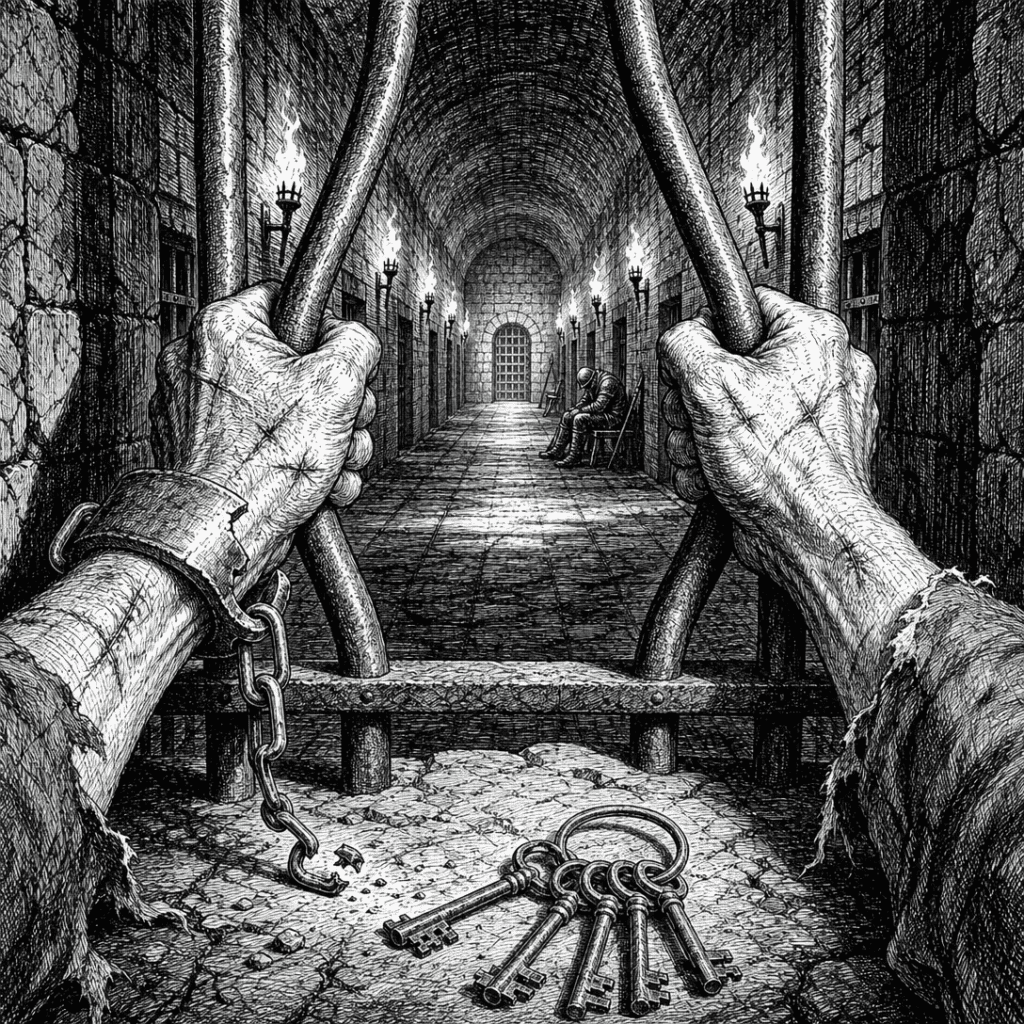

The best D&D prison break one-shots drop your party behind bars — stripped, watched, and on a clock — and make the whole session about getting out. This ranked roundup covers the escape and break-in one-shots from Anvil N Ink, each built for 2–3 players at low levels with zero prep, sorted by the kind of break you want to run.
An escape adventure flips the usual dungeon crawl: instead of fighting deeper in, the party is fighting to get out, usually without their gear and against a facility designed to hold them. That constraint is exactly what makes these sessions tense — and hard to improvise, which is why a scripted one-shot with the guard routes, the collars, and the contingencies already solved is worth its weight. If you want the design method, our guide to running prison-break and escape adventures covers the how; this page covers what to run.
Which D&D prison break one-shot should you run?
Pick by the break. Start with Dead Time for a clean, classic escape; reach for The Gilded Cage if you want the same tension wrapped in gilded horror, or The Slab if you would rather break in than out.
| # | Adventure | The break | Players | Best for |
|---|---|---|---|---|
| 1 | Dead Time | A straight break-out from a grim dungeon lockup | 2–3 | The definitive first prison-break one-shot |
| 2 | The Gilded Cage | An escape from a luxurious sky-prison before a midnight sacrifice | 2–3 | Dread, a countdown, and a moral choice |
| 3 | The Slab | An action-movie prison heist — break in to break someone out | 2–3 | High-octane, set-piece energy |
| 4 | Bandit’s Keep | A stealth rescue — slip in, free the prisoner, slip out | 1–2 | Solo and duo stealth nights |
What makes a good prison break one-shot?
A good prison-break one-shot makes the walls the real antagonist and gives the party three ways through every one of them. The genre’s tension comes from constraint — no weapons, watching guards, a facility built to stop exactly what you are trying to do — so the design has to reward cleverness without punishing a failed roll with a dead end.
The strongest escapes strip the party’s gear to raise the stakes, then hand back power in earned beats; they run on a visible clock (a transfer, a shift change, a rising alarm) so dread builds no matter how quietly the party moves; and they write out what happens when the plan breaks, because an escape with no contingency is one bad roll from a total-party wipe. The Gilded Cage, for instance, runs on an open 0–12 instability track that climbs as the prison comes apart around the table — a clock the players can watch tick.
How do you run an escape for a small group?
Lean on stealth, improvisation, and mercy valves. With two or three players you cannot brute-force a facility, so the best small-group escapes reward disguises, misdirection, and lateral thinking over a straight fight, and they build in a way out even when a plan collapses. A rescue like Bandit’s Keep scales down to a single player; a break-out like Dead Time gives a duo three routes through every obstacle. If your escape shades into a break-in job, it overlaps with the heist lane — see our roundup of the best D&D one-shots for 2 players for the full small-group catalog.
Key takeaways
- The best D&D prison break one-shots make escape the whole session — constraint, a clock, and a facility built to hold you.
- Dead Time is the cleanest starting point; The Gilded Cage adds gilded horror and a countdown.
- Prefer a stealth rescue? Bandit’s Keep scales to 1–2 players. Prefer breaking in? The Slab is a prison heist.
- Small-group escapes work best with three-ways-through design, a visible escalation clock, and a mercy valve when the plan breaks.
- Every pick is a zero-prep, single-session 5e one-shot for a small table.
Frequently asked questions
What is the best D&D prison break one-shot? Dead Time is the best all-around starting point — a clean, zero-prep break-out for 2–3 players. For a table that wants dread and a moral choice, The Gilded Cage is the stronger pick.
Can you run a prison break with two players? Yes. These are built for 2–3 players, and Bandit’s Keep scales down to a solo or duo stealth rescue.
How long does an escape one-shot take? Each is designed for a single 2–3 hour session, with a built-in clock that keeps the pace up.
Do the party start without their gear? Usually, yes — being stripped of weapons and gear is part of the genre’s tension. The adventures hand power back in earned beats, and the best ones (like The Gilded Cage) make the disarmed opening a deliberate, table-safe design choice worth flagging at session zero.
About Anvil N Ink Publishing
Anvil N Ink Publishing makes zero-prep, 5e-compatible one-shots for 2–3 players, solo RPGs, and LitRPG fiction. The escape one-shots above are part of a small-group catalog built for the table most people actually have — see the full list of the best D&D one-shots for 2 players and more ready-to-run one-shot ideas.