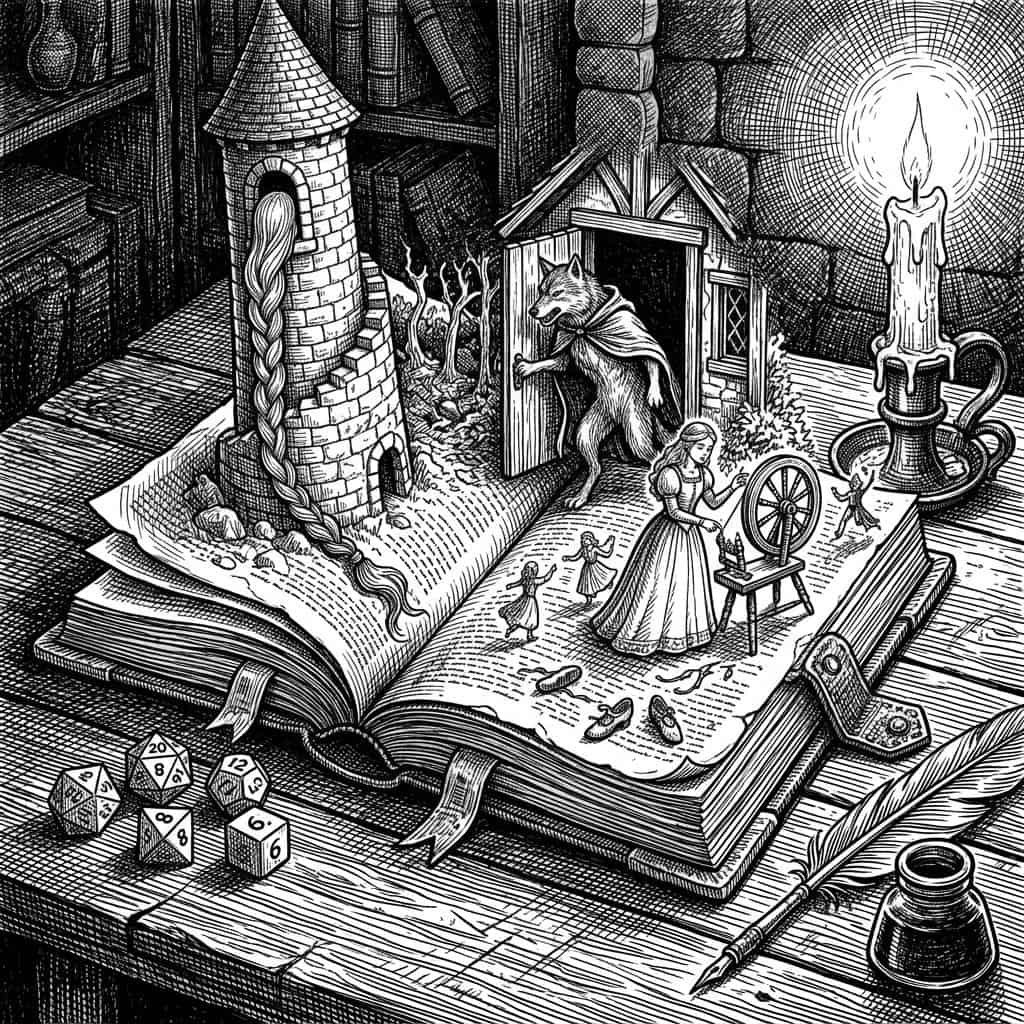

Brothers Grimm D&D adventures are hiding in plain sight. Most DMs have spent years creating original worlds, original villains, and original plots from scratch — when some of the best adventure material ever written has been sitting on bookshelves since 1812. The original Brothers Grimm fairy tales aren’t the sanitized Disney versions you grew up with. They’re dark, morally ambiguous, full of binding contracts and terrible prices, and they translate into D&D one-shots with almost no effort. You just need to know which tales to pick and how to adapt them.
This guide walks through seven specific Grimm fairy tales that work brilliantly as dark fairy tale D&D adventures, with concrete notes on what makes each one tick at the gaming table. These aren’t vague suggestions — they’re practical blueprints for sessions your players will remember.
Why the Original Brothers Grimm Tales Work for D&D
Before diving into specific tales, it’s worth understanding why the original Grimm versions are so much better for D&D than their modern retellings. The stories collected by Jacob and Wilhelm Grimm in the early 1800s were folk tales passed down through oral tradition. They weren’t written for children. They were cautionary tales about the cost of broken promises, the danger of trusting appearances, and the terrible arithmetic of desperate bargains.
That’s D&D adventure design in its purest form.
Every Grimm tale contains the same core ingredients that make great one-shots: a clear inciting incident that pulls characters into action, an escalating mystery where things aren’t what they seem, NPCs with competing motivations, and a climax that demands a choice rather than just a fight. The tales are also short — most can be read in five minutes — which means they give you a complete narrative arc without burying you in lore. Perfect for a two to three hour session.
Grimm vs. Disney: Why the Darkness Matters
In the Disney version of Cinderella, the stepsisters are vain and petty. In the Grimm version, they cut off parts of their own feet to fit the glass slipper. In Disney’s Sleeping Beauty, the curse is broken by a kiss. In the Grimm version, the hedge of thorns around the castle is littered with the corpses of princes who tried and failed — impaled on thorns that seized them like claws. This is the tone that makes Brothers Grimm D&D adventures work. Not gratuitous violence, but consequences that feel real. Actions that cost something. A world where magic has a price and desperate people do desperate things.
Tale 1: Rumpelstiltskin — The Unbreakable Bargain
Rumpelstiltskin is arguably the single best Grimm tale for D&D adaptation, and it’s easy to see why. The entire plot revolves around a magical contract — a binding bargain with escalating stakes. A father lies about his daughter’s abilities. A king threatens her life if she can’t deliver. A mysterious creature offers help at a price. And the price keeps rising.
The D&D Adaptation
Your players arrive in a town where a young woman is imprisoned and sentenced to death unless she can perform an impossible task — spinning straw into gold, or whatever equivalent fits your world. The local authorities are unmovable. The woman’s father caused the problem with his boasting, and he’s either fled or is too cowardly to help. A mysterious NPC has already struck a bargain with the woman: they’ll solve her problem, but the price is her firstborn child.
Here’s the twist that makes this a Brothers Grimm D&D adventure rather than a simple rescue mission: the mysterious creature isn’t evil. They’re a fey being who was once robbed of their own child by mortals, and the bargain is their attempt to rebuild what was taken from them. The woman agreed willingly, understanding the terms. The players must decide: honor a freely made contract between two parties (even though the outcome is terrible), break the contract and face the magical consequences, or find a third path that somehow satisfies the fey’s grief without sacrificing a child. The Name of Rumpelstiltskin runs this exact scenario as a complete, ready-to-play one-shot.
Tale 2: The Twelve Dancing Princesses — The Beautiful Trap
This is one of the most underused Grimm tales in D&D, and it’s a tragedy because it’s tailor-made for investigation adventures. Twelve princesses sneak out every night through a secret passage to dance in an underground kingdom until their shoes are worn through. Every suitor who tries to discover their secret is drugged and fails — and in the original Grimm tale, those who fail are executed.
The D&D Adaptation
Your players are hired to solve the mystery of the worn shoes. The investigation takes them through the castle, following clues and resisting magical deception. But here’s where the Grimm version diverges from the Disney imagination: the princesses aren’t victims sneaking away from a controlling father. They’re willing participants in a dark arrangement. The underground kingdom is ruled by a fey lord who has enchanted them — or has he? Maybe the princesses chose this. Maybe the dancing is a binding ritual that protects the kingdom from something worse. Maybe the father-king knows exactly what’s happening and is using his daughters as a sacrifice he disguises as mystery.
The investigation structure makes this perfect for mystery-focused D&D sessions. Players gather clues, interview NPCs who contradict each other, and gradually realize the situation is far more complex than a simple rescue. The Twelve Dancing Princesses adventure in The Twisted Tale Series uses this exact framework, designed specifically for two to three players.
Tale 3: The Pied Piper of Hamelin — Broken Promises and Stolen Children
The Pied Piper is one of the darkest Grimm-adjacent tales and it translates into D&D with devastating effectiveness. A town plagued by rats hires a stranger to solve their problem. He does. They refuse to pay. He takes their children. Simple. Brutal. Morally horrifying when you think about it from every angle.
The D&D Adaptation
Your players arrive after the children have already been taken. The town is in chaos. The townsfolk present themselves as victims — a monster came and stole their children. They want heroes to bring the children back. But as the players investigate, the truth emerges: the town made a deal and broke it. The Piper was promised payment and was cheated. By the laws of fairy tale magic, the Piper had every right to claim a forfeit.
This creates an incredible moral dilemma. The children are innocent, but the town is guilty. The Piper is a kidnapper, but he’s also the wronged party in a broken contract. Do the players side with the law of bargains? Do they rescue the children and leave the town’s broken promise unpunished? Do they force the town to finally pay what they owe — and if so, what price is fair for the suffering caused by their dishonesty? Pay the Piper explores exactly this scenario, giving DMs a complete adventure that runs in a single session.
Tale 4: Hansel and Gretel — Who Is the Real Monster?
Everyone knows Hansel and Gretel. Children abandoned in the forest, a candy house, a witch who wants to eat them. But go back to the Grimm original and ask yourself: who is the actual villain of this story? The witch lives alone in the forest, minding her own business, until two children show up and start eating her house. Meanwhile, the children’s own parents deliberately abandoned them to die because they couldn’t afford to feed them.
The D&D Adaptation
Reframe the witch as an elderly hedge mage who lives in the deep forest, avoided by townsfolk who fear her. She’s eccentric, possibly dangerous, but not malicious. Two children from the village have gone missing, and the village blames the witch. Players are sent to investigate and rescue the children. When they find the cottage, the children are there — being fed, sheltered, and protected. The witch took them in after finding them abandoned. She’s angry at the village for discarding children and refuses to return them to parents who threw them away.
Now the players face the question: is the witch a kidnapper or a rescuer? Should children be returned to parents who abandoned them? Does the village’s fear of the witch justify their accusations? This adaptation strips away the simple hero narrative and forces players to examine their own assumptions about who deserves protection and who deserves punishment. This kind of morally grey adventure works especially well with small groups of two players where every voice in the discussion carries weight.
Tale 5: The Frog Prince — Consent, Bargains, and Broken Promises
The Frog Prince isn’t about a magical kiss. In the original Grimm version, the princess promises the frog anything if he’ll retrieve her golden ball from the well. He asks to eat from her plate, drink from her cup, and sleep in her bed. She agrees — then tries to break her promise once she has what she wants. The frog isn’t freed by love. He’s freed when the princess hurls him against a wall in disgust.
The D&D Adaptation
A cursed NPC approaches the players in animal or monstrous form, begging for help. They explain the terms of their curse: a specific set of conditions must be met, and those conditions require the willing cooperation of someone who finds the cursed being repulsive. The players must convince a reluctant NPC to honor a bargain they’d rather break — or find an alternative way to satisfy the curse’s requirements.
The moral complexity deepens when players discover the curse wasn’t random. The cursed NPC did something to deserve their transformation — but does any crime deserve this punishment? And does the NPC who made the original bargain have the right to break their word just because fulfilling it is uncomfortable? This tale is perfect for social-heavy sessions where social encounter design matters more than combat mechanics.
Tale 6: The Robber Bridegroom — Horror at the Wedding Feast
This is one of the Grimm tales that most people haven’t heard, and it’s absolutely terrifying. A young woman is betrothed to a wealthy stranger. She visits his house before the wedding and discovers, hidden in the basement, that her future husband is a murderer and cannibal who has been killing his previous brides. She escapes with evidence and exposes him at the wedding feast.
The D&D Adaptation
Your players are invited to or attending a grand celebration — a wedding, a coronation, a festival — hosted by a respected community figure. Everything seems wonderful until small details start going wrong. A servant who seems terrified. A locked room that shouldn’t be locked. A guest who mentions a previous event that the host claims never happened. As players investigate, they discover the host’s dark secret: they’ve been eliminating rivals, absorbing their wealth, and maintaining their position through murder disguised as accidents or disappearances.
This tale works brilliantly as a heist-in-reverse — players aren’t breaking in but trying to get evidence out while trapped in a social situation where accusation without proof means their own destruction. The ticking clock is the wedding ceremony itself. Once the vows are spoken, the host gains legal control of their victim’s assets and the evidence becomes meaningless. Perfect for players who love tension and investigation over combat.
Tale 7: The Juniper Tree — Grief, Transformation, and Justice
The Juniper Tree is one of the most emotionally devastating Grimm tales. A boy is murdered by his stepmother. His stepsister, who loved him, gathers his bones and buries them beneath the juniper tree. From the tree rises a beautiful bird who sings about the murder, eventually dropping a millstone on the stepmother’s head. It’s a story about grief, about justice, and about the dead refusing to be forgotten.
The D&D Adaptation
Players encounter an undead creature — not a mindless zombie, but a sentient revenant or ghost — that is systematically targeting specific people in a community. The community wants the creature destroyed. The creature claims it is seeking justice for its own murder. As players investigate, they discover the ghost is telling the truth: it was murdered by someone the community protects, and the authorities covered it up because the killer is too powerful or too important to accuse.
Do the players destroy the undead and protect the status quo? Do they help the ghost achieve justice, knowing the consequences will tear the community apart? Do they try to broker peace between the living and the dead — and is that even possible when the crime was murder? This kind of adventure rewards the NPC development work that makes every character feel like a real person with real stakes.
Running Your First Brothers Grimm D&D Adventure
Pick one tale from this list and read the original Grimm version — not a summary, not a retelling, the actual text. It’ll take five minutes. Then ask yourself three questions: who made a bargain? Who broke a promise? What if the villain had a reason? Those three questions will generate your adventure’s twist, your moral dilemma, and your three possible endings.
Structure the session in four acts: establish the familiar story, crack it open with contradictions, reveal the full truth, and let the players choose their ending. Keep the group small — two to three players is ideal for the intimate moral weight these stories carry. And remember the golden rule of Brothers Grimm D&D: every fairy tale ending has a price.
Common Pitfalls to Avoid
The biggest mistake DMs make with Brothers Grimm D&D adventures is revealing the twist too early. If players discover the villain is sympathetic in the first twenty minutes, the remaining session becomes a straightforward moral puzzle with no tension. Structure your clues so the first act feels exactly like the fairy tale players expect. The second act should plant seeds of doubt. The third act delivers the full revelation. This pacing ensures that when the truth hits, it hits with force.
The second pitfall is making the twist too clever for its own good. If your players need a flowchart to understand who wronged whom and why, you’ve overcomplicated the moral landscape. The best Brothers Grimm adaptations have simple, gut-punch dilemmas: this person was wronged, but their response went too far. Both sides have a legitimate claim. There’s no solution that doesn’t hurt someone. Keep it human, keep it clear, and trust your players to find the complexity in simplicity.
Finally, don’t force an ending. Present the situation, present the options, and let the players argue it out. Some of the best moments in fairy tale D&D happen when two players disagree about what the right thing to do is. That disagreement is the adventure working exactly as intended.
If you want to skip straight to the table with a complete, ready-to-run Grimm adaptation, The Twisted Tale Series from Anvil & Ink Publishing takes these exact principles and delivers them as finished one-shot adventures for small groups. The Name of Rumpelstiltskin, The Twelve Dancing Princesses, and Pay the Piper each run in two to three hours, require zero prep, and are designed specifically for the small groups that fairy tales serve best.
Brothers Grimm D&D adventures take the darkest, most morally complex fairy tales ever written and transform them into one-shot sessions where every bargain has a price, every villain has a reason, and your players face choices the original stories never offered.