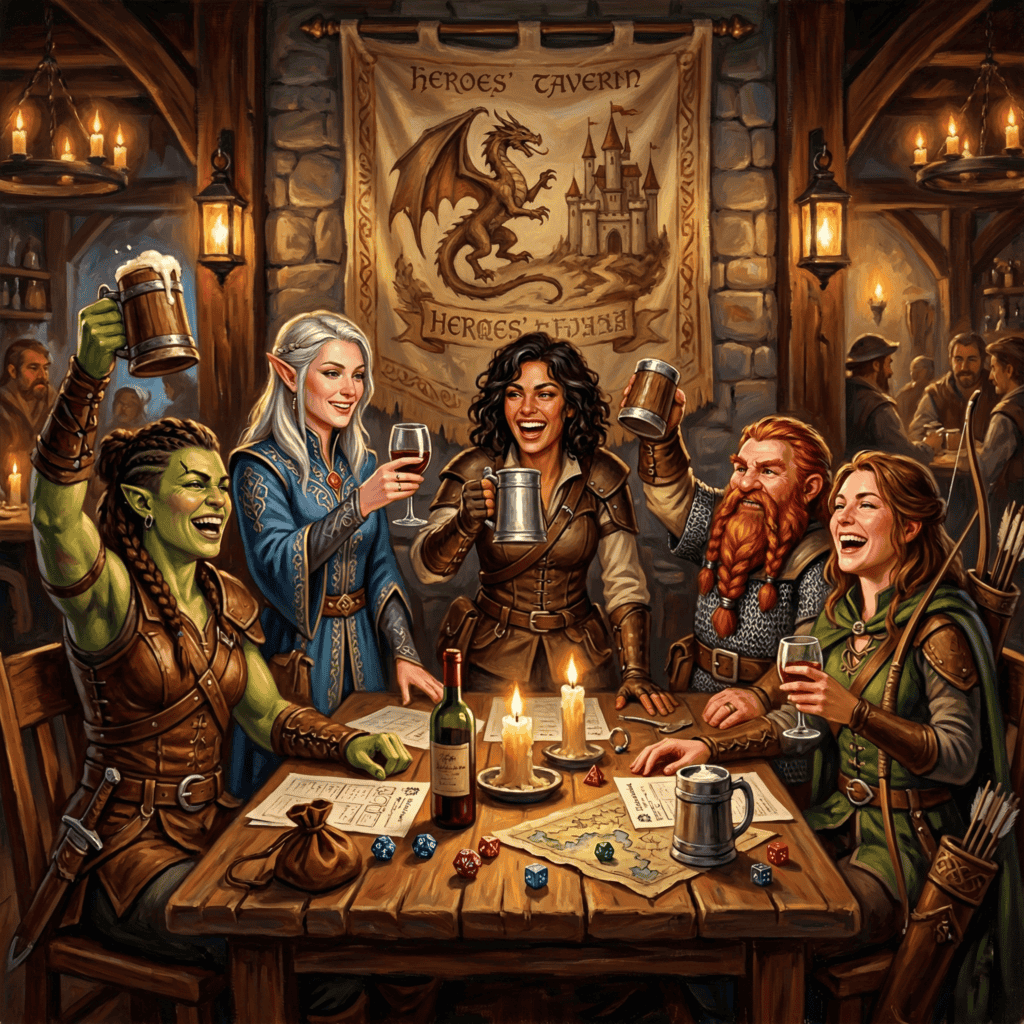

A D&D bachelorette party is one of those ideas that sounds like a joke until someone actually does it — and then it becomes the event everyone talks about for years. Standard bachelorette nights are pleasant and forgettable. A well-run D&D one-shot is neither of those things. It is specific, it is collaborative, and it produces a story that belongs entirely to the people in the room on that particular night.
This guide covers how to pull it off: what format works, how to handle guests who have never touched a rulebook, how to make the adventure genuinely about the bride or person being celebrated, and what pitfalls to avoid when mixing D&D with a party context.
Why D&D Works as a Bachelorette Party Format
Most bachelorette activities are passive or require a specific kind of social energy that not everyone in the group will have. A bar works if everyone drinks and is comfortable in loud spaces. A spa works if everyone is comfortable with that setting. A cooking class works if everyone wants to cook.
D&D requires none of those specific conditions. It works in a living room, it works at a rented venue, it works with wine and snacks or without. The activity itself is the socialising — you are not doing something while socialising, you are playing together, and the play produces the conversation.
More importantly, D&D is a gift the guest of honour actually participates in. Most bachelorette activities happen to the person being celebrated. A D&D one-shot is something they do — with their friends, as the central character, shaping the outcome. That is a meaningfully different experience.
Choosing Your Format
Two formats work well for a bachelorette D&D session:
Option 1: One DM, Everyone Plays
The most common format. One person — ideally someone who already knows how to run D&D — takes the DM role. Everyone else plays a character. The guest of honour plays the central character around whom the adventure is built. This format works for groups of three to six players including the DM.
If no one in the group has DM experience, a zero-prep published adventure with pre-generated characters solves the problem. The DM reads the adventure once before the event, hands out character sheets on the night, and follows the structure. No world-building required, no prep beyond one read-through.
Option 2: Guided Adventure (No DM Required)
For groups with no one willing to DM, a guided adventure format — similar to an escape room, but with roleplaying and dice — removes the DM role entirely. A printed adventure with read-aloud text and clear decision points can be played collaboratively, with players taking turns reading sections and making group decisions. Slower and less flexible than a traditional DM-run session, but viable for groups with no game experience at all.
Designing the Adventure Around the Guest of Honour
This is what separates a D&D bachelorette party from a regular game night. The adventure should be specifically, visibly about the person being celebrated. A few ways to do this:
Name the Hero After Her
The guest of honour’s pre-generated character shares her name, or a fantasy version of it. NPCs in the adventure know her name and have opinions about her specifically. This sounds small and lands large — being addressed by name in the adventure makes the fiction feel personal in a way that generic “the adventurer” framing does not.
Build the Stakes Around Something She Cares About
The thing being saved, recovered, or protected in the adventure connects to something the guest of honour values. If she loves her dog, the adventure involves a beloved animal companion. If she cares deeply about her friends, the adventure is about protecting a community she belongs to. If she is competitive, the adventure ends in a contest she can win decisively. This does not require rewriting an adventure — it requires adjusting three or four sentences of description.
Give Her the Final Moment
Design or frame the climax so the guest of honour’s character has the decisive action. The final blow. The pivotal choice. The moment that ends the adventure. Not by rigging the dice — by positioning the situation so that what her character does in the last scene is what matters. She should be the one who closes the story.
Include the Partner (Tastefully)
A popular choice is to include the partner as an NPC — either as someone who needs rescuing (played completely straight), as a mysterious figure who appears in the final scene, or as a message or token discovered during the adventure. This requires knowing the couple well enough to read the room, but done right it is the moment the event becomes genuinely emotional rather than just fun.
Handling Guests Who Have Never Played D&D
In a bachelorette party context, you will almost certainly have guests who have never played D&D and may be slightly skeptical. This is not a problem — it is an opportunity. People who come in with low expectations and have a genuinely good time are the most enthusiastic converts.
Three things make this work for non-players:
Pre-generated characters with personality notes. Do not ask anyone to build a character. Hand them a sheet that says: “You are Seraphine, a quick-talking merchant’s daughter who got tangled up in this adventure looking for a stolen family heirloom. You are clever, impatient, and terrible at keeping secrets.” That is enough. They can play from the first minute without knowing the rules.
One person who can quietly explain mechanics. Not the DM — someone sitting next to each new player who can whisper “roll that die and add three” when a check comes up, without making it a lesson. New players who feel supported rather than tested engage much more readily.
Permission to do impractical things. The single most effective thing you can tell a new player is: “Whatever your character would actually do is the right answer. There is no wrong choice.” Players who are worried about doing it wrong go quiet. Players who know there is no wrong choice try things, and trying things is where the fun is.
Tone and Adventure Selection
A bachelorette D&D session should lean toward fun, adventure, and some emotional payoff at the end. Horror is a hard no unless you specifically know the group wants it. Comedy works brilliantly — absurdist premises played straight produce laughter without requiring the DM to be funny. Romance subplots work well in this context. Heists work because they are inherently collaborative and produce a shared victory.
From the Anvil N Ink catalog, a few titles that suit this format particularly well:
- The Golden Rest — comedy one-shot in a retirement home for adventurers. Works for any group size and produces consistent laughter without requiring prior D&D knowledge.
- Love’s Labyrinth — the Valentine’s Day one-shot, which has built-in romantic theming and works beautifully for a bachelorette context with some light customisation.
- The Merchant’s Vault — heist format. The planning phase keeps everyone engaged from the start. Good for competitive groups who want to feel clever.
For the full range of options, the complete guide to the best D&D one-shots covers every genre and runtime. For inspiration on how to adapt an adventure for a specific occasion, the D&D birthday party guide covers the same personalisation techniques in more detail.
Practical Setup for the Evening
The physical setup communicates what kind of evening this is. A few things worth doing:
- Themed character sheets — print the pre-gen sheets with a decorative border, or put each one in a small envelope the player opens at the start of the session.
- Dice for each player — even a simple set of basic dice feels like a prop and signals that this is their adventure, not a spectator event.
- A small token for the guest of honour’s character — a miniature, a meaningful object, anything that sits on the table and represents her character specifically.
- Fantasy ambient music — thirty minutes of playlist prep before the event produces an atmosphere that no amount of verbal scene-setting can match.
- Keep the table snacked. People play better when they are comfortable. This is a party, not a game night where snacks are an afterthought.
Frequently Asked Questions: D&D Bachelorette Party
How long should a bachelorette D&D session run?
Two hours is the sweet spot for a party context. Long enough to develop a genuine story arc, short enough that attention and energy stay high throughout. Build in thirty minutes of setup and character introduction before the formal adventure starts, and plan for thirty minutes of post-game conversation — the total evening is three hours, but the actual play is two.
What if the guest of honour has never played D&D?
This is ideal, not a problem. Someone experiencing D&D for the first time in a context specifically designed around celebrating them, with friends who are equally new to the game, is going to have a better first experience than almost any other introduction to the hobby. Keep the mechanics simple, keep the adventure focused, and make sure the central character is clearly hers from the first scene.
Do we need a dedicated DM or can we hire one?
Both work. If someone in the group already plays D&D and is comfortable running a session, that is the simplest option. Hired DMs — available through platforms like StartPlaying Games — bring professional experience and can customise the adventure specifically for the occasion. The cost is typically $30-60 per hour for a private session. For a bachelorette party, splitting that cost across the group is usually very reasonable.
Is D&D appropriate for a bachelorette party with very mixed interests?
Yes, with the right framing. Do not pitch it as “we are playing D&D” — pitch it as “we are going on an adventure together.” The distinction matters to people who have preconceptions about what D&D is. Once play starts, the preconceptions dissolve almost universally. The activity sells itself within the first fifteen minutes; the framing just gets people to the table.
Can we incorporate drinking into a D&D bachelorette session?
Carefully. Light drinking throughout the session is fine and fits the social atmosphere. Heavy drinking before or during play significantly degrades the experience — not because D&D requires sobriety, but because the things that make D&D fun (decision-making, creativity, paying attention to what the DM describes) all work better when everyone is present. Front-load drinks before the session if the group wants a proper pre-game, then keep it moderate during play.
Planning a D&D bachelorette party? The Ready Adventure Series from Anvil N Ink includes zero-prep one-shots with pre-generated characters and 2-hour runtimes — exactly what this format needs. Browse titles on Amazon or get the full library with the Complete Collection on Payhip.
A D&D bachelorette party gives the guest of honour something a standard night out cannot: a story she was the hero of, told with the people she chose to celebrate with.