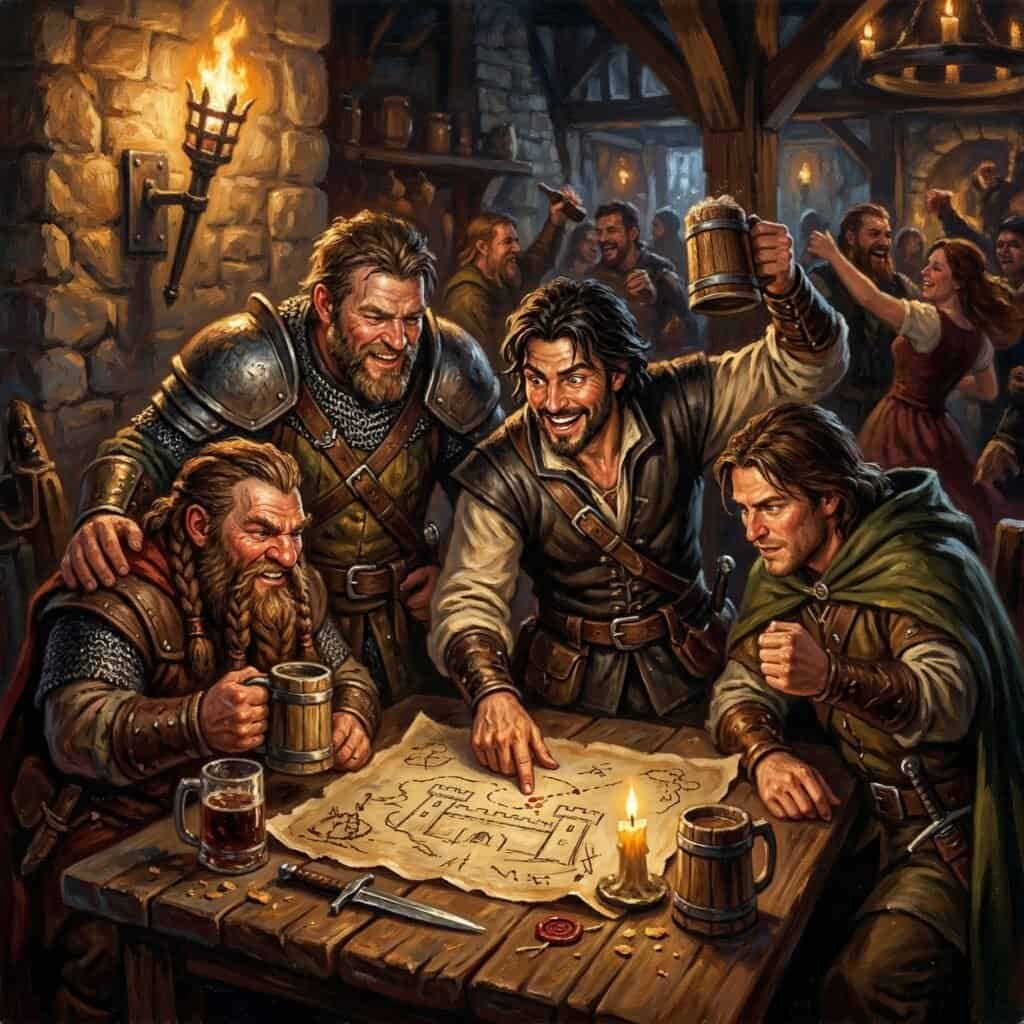

A D&D bachelor party is the kind of idea that sounds unusual right up until someone actually does it — and then it becomes the thing everyone who was there still talks about three years later. Bar crawls are forgettable. Escape rooms are fun but generic. A D&D one-shot built around the groom and his friends produces a story that belongs to that specific group of people on that specific night and nowhere else.
This guide covers how to actually run one: which format works for a stag context, how to handle guests who have never played, how to personalise the adventure for the groom, and what to avoid when mixing D&D with a celebration.
Why D&D Works for a Stag Night
Most bachelor party activities have the same basic structure: go somewhere, drink, and let the social energy do the work. That structure has a ceiling. The conversation stays surface level because there is nothing to actually engage with together.
D&D changes that equation. The game gives everyone a shared task, shared stakes, and shared decisions. The conversation that comes out of a D&D session is specific — you are talking about what your character did, why you made that choice, what happened when the plan fell apart. That specificity is what creates the stories people remember.
There is also a competitive angle that suits a stag context well. Heist adventures in particular — where the group has a clear objective, a plan that gets improvised on the fly, and a payoff at the end — give competitive groups something to win together. The shared success (or spectacular failure) becomes the event.
Format Options
The Traditional Session
One DM, everyone else plays. Ideal group size is four to six players including the DM. The groom plays the central character — the mission leader, the party face, the one whose reputation is on the line. The adventure is built around him specifically. The DM runs the session and the players drive it.
For this format to work without prior D&D experience in the group, use a published zero-prep adventure with pre-generated characters. The DM reads it once beforehand. On the night, they hand out character sheets and run the adventure as written, with light personalisation layered on top. No world-building required, no prep beyond one read-through.
The Competitive Format
Split into two teams of two or three. Each team plays through the same adventure simultaneously, racing to complete the objective first — or with a scoring system based on what they accomplish. Teams reconvene at the end to compare results. This format adds a competitive edge that works well for groups where everyone wants to win something, and it naturally doubles the engagement because players are making tactical decisions with consequences.
The Drinking Integration
If the group wants drinking integrated rather than separate: assign a specific in-game trigger to drinks. Failed saving throw, rolled a 1, character takes damage. Keep it light enough that the game stays functional — the goal is a fun evening, not a session that collapses in the second act because everyone is too drunk to remember their character name. Front-loading drinks before the session and keeping it moderate during play produces a better evening than trying to integrate heavy drinking into active play.
Personalising the Adventure for the Groom
The personalisation is what separates a D&D bachelor party from a regular game night. The adventure should be visibly, specifically about the groom.
His Character, His Mission
The groom’s pre-generated character is the team leader. The mission brief refers to him specifically. NPCs know his name and have opinions about his reputation. In the opening scene, the reason the group is here is because of something he did, something he is known for, or something only he can accomplish. The adventure starts with him already at the centre of it.
Reference the Wedding
Done right, this is the most memorable moment of the evening. The mission objective connects to the wedding in some way — the thing being recovered is something that matters to the couple, the antagonist’s plan would affect the wedding itself, or the final reward in the adventure is a reference to the partner. This requires knowing the couple well and reading the room, but when it lands it shifts the session from entertainment to something genuinely personal.
Bring In the Lads
Give each player’s pre-generated character a personality note that reflects something true about the person playing them — not their real name, but their role in the group. The responsible one gets the character with the plan. The chaos agent gets the character who improvises everything. The quiet one gets the character with the crucial skill nobody expected. These connections do not need to be announced. The players will notice.
Adventure Selection
Tone is the primary selection criterion for a bachelor party context. A few directions that work consistently:
Heist
The strongest match for a bachelor party group. Clear objective, collaborative planning, execution that requires everyone to contribute, and a satisfying payoff at the end. The Merchant’s Vault delivers this structure cleanly for 2-3 players — scale it up with additional complications for larger groups. Heist adventures reward the kind of lateral thinking and improvisation that makes for good stories.
Action One-Shot
High stakes, fast pace, clear enemies. The group has been sent to do something dangerous and comes out the other side having done it. Works well for groups that are less interested in roleplay and more interested in the shared experience of facing something together and winning. Keep combat encounters punchy rather than tactical — the goal is momentum, not chess.
Comedy
For groups that want to laugh rather than strategise. The Golden Rest — a one-shot set in a retirement home for adventurers — works for any group size and produces consistent laughter without requiring prior D&D knowledge. The absurdist premise plays itself; the DM just has to keep up with where the players take it.
Avoid horror for a bachelor party context unless you specifically know the group wants it. Horror requires buy-in and sustained atmospheric commitment that is hard to maintain in a celebratory social setting.
For the full range of options, the complete guide to the best D&D one-shots covers every genre and runtime. The bachelorette party guide covers the same format for the other side of the wedding party — worth reading for the personalisation techniques even if the context is different.
Handling Non-Players
A bachelor party D&D group almost certainly includes people who have never played. Two things make this work without anyone feeling lost:
Pre-generated characters with two-sentence personality notes. Do not ask anyone to build a character or read rules before the event. Hand them a sheet that tells them who they are and what they are good at. That is all they need to start playing. Mechanics reveal themselves through play; the personality note is what gets them into the character immediately.
Low-stakes first decisions. The opening scene should give new players an easy first choice — something where there is no wrong answer and both options lead somewhere interesting. This gets them making decisions before they are worried about whether they are doing it right. Once someone has made one decision and seen the game respond to it, the hesitation dissolves.
Practical Logistics
A few things worth sorting before the night:
- Location: A private space works better than a public venue. Background noise kills table atmosphere and makes it hard to hear the DM. A living room, a rented private room, or a party venue with a dedicated quiet space all work. A bar does not.
- Duration: Plan for two hours of actual play, with thirty minutes of setup before and time afterward for the normal bachelor party activities. A D&D session as the anchor event of the evening, not the entire evening, is the right framing.
- Dice: One set per player feels more engaging than sharing. Cheap sets are fine — the point is that each person has their own dice, which signals this is their adventure.
- Food and drinks: Present before play starts, accessible during without requiring anyone to get up. Interrupting a tense scene because someone needs another drink breaks the momentum.
Frequently Asked Questions: D&D Bachelor Party
Does the groom need to have played D&D before?
No. A first-time player experiencing D&D in a context built around celebrating them, with friends who are equally new, will have a better first experience than almost any other introduction to the hobby. The unfamiliarity is part of the adventure. Keep the mechanics accessible and the adventure focused, and it will work regardless of prior experience.
How do we handle it if the group gets drunk and stops engaging?
Have an exit. Know which scene in the adventure is the natural stopping point if you need to wrap early — most well-designed one-shots have a midpoint that functions as a mini-climax and can serve as an ending if the session needs to cut short. Better to end at a satisfying midpoint than push through to a conclusion the group is no longer present for.
Can we hire a DM for this?
Yes, and it is worth it if no one in the group has experience running games. Professional DMs available through platforms like StartPlaying Games can customise an adventure for the occasion, handle the game mechanics completely, and free everyone else including the group organiser to just play. For a bachelor party where the organiser wants to participate rather than run the game, this is often the cleanest solution.
How many people is the right size for a bachelor party D&D session?
Four to six players including the DM is ideal. Under four and the group dynamic feels thin. Over six and the DM is managing too many threads to give each player meaningful attention. If the bachelor party group is larger, either run two simultaneous sessions with a competitive scoring element, or have some guests spectate the first half and swap in for the second.
What if the groom thinks D&D is not for him?
Do not pitch it as D&D. Pitch it as “we are going on a mission together.” Once play starts, the preconception dissolves. Almost universally. The activity sells itself within the first fifteen minutes — the framing just gets people to the table.
Ready to run the session? The Ready Adventure Series from Anvil N Ink includes zero-prep one-shots with pre-generated characters and 2-3 hour runtimes. Browse individual titles on Amazon or get the full library with the Complete Collection on Payhip.
A D&D bachelor party gives the groom something a bar crawl cannot: a story he was the hero of, with the people he chose to spend the night with.