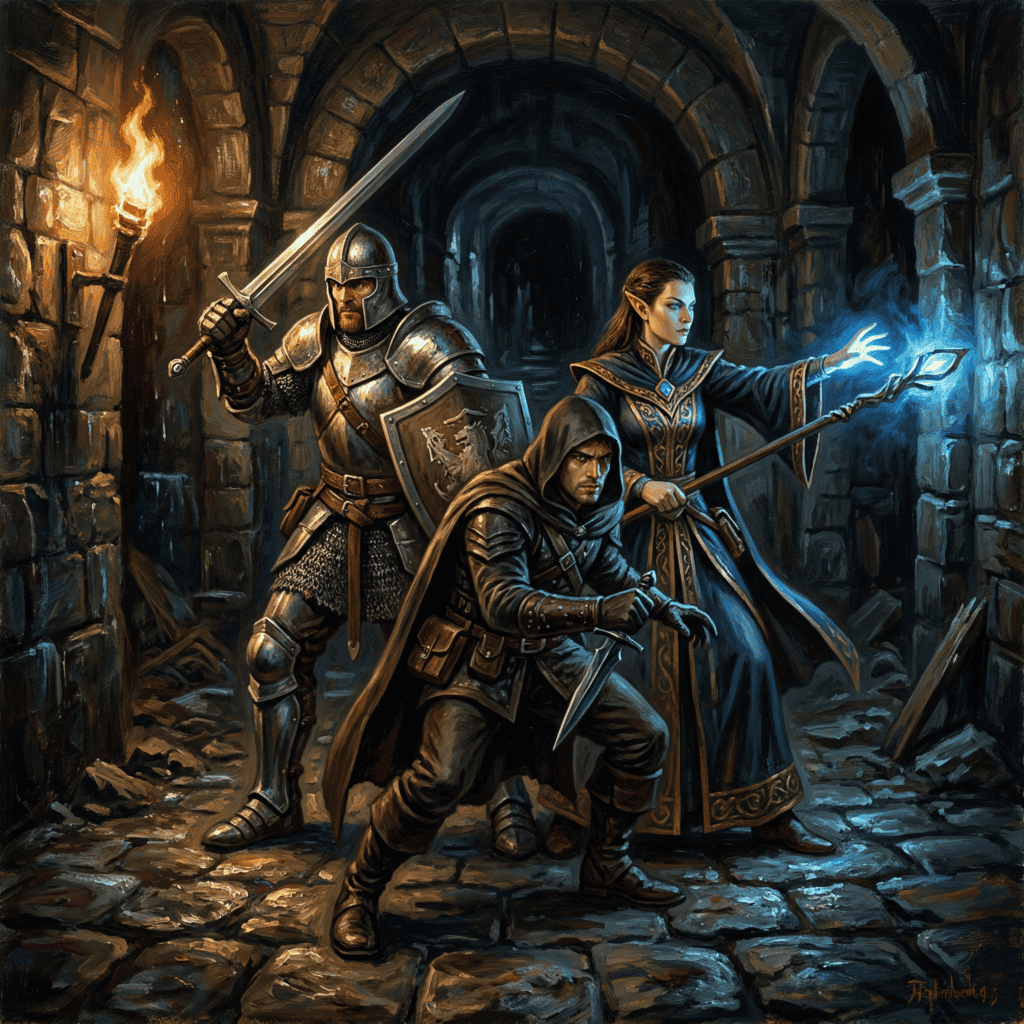

D&D for 3 players occupies a strange gap in tabletop content. Most published adventures assume a party of four or five. Duet D&D — one player, one DM — has a dedicated community and a growing body of specific advice. Three players sits between those two worlds: too many for duet content, too few for most published adventures, and almost entirely ignored by guides that address small-group play.
That gap is worth closing. Three players is probably the most common small-group D&D format in practice. Three friends who all want to play. A family of three where two kids and a parent want to run a session. A group that was four players until someone moved. Three is the number that comes up constantly, and it deserves specific attention rather than recycled advice from guides written for different group sizes.
This guide covers what actually changes at three players — class composition, encounter math, spotlight management, and which adventures are built to work at this specific player count.
Why 3 Players Is Different From 2 and From 4
Three players is not simply “two players with an extra person” or “four players missing one.” The group dynamics are genuinely distinct.
At two players, the game is intimate and focused. Every scene involves both players. Pacing is tight because there is no table management overhead. The DM can give each player sustained attention in a way that is impossible at larger tables.
At four players, the game has enough class coverage to handle most encounters without major adjustments. The social dynamics include enough voices to create genuine party debate. Published adventure math works cleanly.
At three players, you get some of the intimacy of duet play — each player gets meaningful screen time — combined with enough party members to have genuine inter-character dynamics. Three is enough for relationships to be interesting: two people can disagree and the third has to choose a side, or align with, or mediate. That dynamic does not exist at two players and gets diluted at four or more.
The challenge at three is coverage. D&D is designed around a party that can handle combat, exploration, and social encounters — typically spread across a healer, a frontline fighter, and someone with utility or ranged options. At three players, one role does not get filled. That gap requires specific choices to manage.
Class Composition for 3 Players
The honest answer to class composition for D&D for 3 players is: pick classes the players actually want to play, then adjust the adventure rather than the party. Forcing players into classes they do not want to play because the party needs a healer produces bad sessions faster than any encounter math problem.
That said, understanding where three-player parties typically struggle helps you anticipate problems before they hit the table.
The Healing Gap
Three players with no healing class will burn through hit points faster than they can recover them, especially without short rest access. The solutions are not necessarily to play a Cleric — Potions of Healing should be more available and cheaper, short rests should be more frequent, and the Healer feat (which lets any character use a healer’s kit to restore hit points) is worth making available to any party member who wants it.
Recommended Three-Player Combinations
Fighter / Wizard / Rogue: The classic. Frontline, arcane damage, skill coverage. Works in almost any adventure. The gap is healing — address it with potions and short rest access rather than forcing a class swap.
Paladin / Ranger / Bard: Excellent social and exploration coverage, reasonable combat durability, built-in healing from Paladin. Works especially well for adventures with significant roleplay and investigation content.
Cleric / Fighter / Warlock: Healing covered, frontline covered, Warlock provides sustained damage and short rest recovery. Slightly less skill coverage than other combinations but very durable across a full adventuring day.
Any three classes with the Healer feat distributed: If players want to play classes they love rather than what the party needs, give everyone access to the Healer feat. Medical kits plus that feat plus available potions closes the healing gap for most three-player groups without anyone being locked into a support role.
Encounter Balancing for 3 Players
The official encounter difficulty math in D&D 5e assumes four players. Running it with three produces encounters that are harder than intended by a significant margin — not because the math is wrong, but because it was not designed for your party size.
A practical adjustment: treat your three-player party as if it were a two-and-a-half player party when calculating encounter difficulty. Use the XP thresholds for three players but reduce enemy numbers by 20-25%, or reduce enemy hit points by the same amount, rather than the official multiplier for three enemies or more.
Specific adjustments that help:
- Reduce enemy count, not enemy quality. Three strong enemies in a boss fight are more interesting than five weak ones. Three players can focus fire on three targets; five targets means someone always goes ignored.
- Increase escape options. Three players who get into a bad combat are more likely to need an out than four players. Give enemies reasons to retreat, offer environmental ways to end fights, and let morale breaks occur earlier.
- Shorten adventuring days. Three players burn through resources faster than four. Plan for two or three encounters per adventuring day rather than four to six. The small group encounter balancing guide covers this math in detail.
Spotlight Management at 3 Players
Three players is the sweet spot for spotlight management. At four or more players, active DM effort is required to ensure every player has meaningful scenes. At two players, the question almost never arises. At three, scenes naturally rotate — two players in a scene while the third observes, then a shift — in a way that feels organic rather than managed.
Where three-player spotlight management can go wrong: one player dominates social encounters because they have the highest Charisma, and the other two become observers. The solution is not mechanical — it is a design question. Build social encounters with multiple NPC threads. One NPC is interested in the charismatic character; another specifically wants to talk to the quiet one; a third is watching the third character suspiciously. Three threads for three players, each pulled by the player most suited for it.
Adventures That Work Best for 3 Players
Not all adventures scale equally well to three players. The ones that work best tend to share specific structural features: encounter design that does not depend on having a full party of four, spotlight distribution that gives each player distinct contributions, and pacing that accounts for a smaller table making decisions faster than a larger one.
The Ready Adventure Series from Anvil N Ink is designed specifically for groups of 2-3 players. Every adventure in the series has been built and tested at that player count — the encounter math, the NPC interactions, and the pacing all assume three players or fewer rather than scaling down from a four-player design.
For the broader picture of adventures worth running at any group size, the complete guide to the best D&D one-shots covers genre and format. For the full framework of small-group D&D — everything from session zero to campaign management — the complete guide to D&D for 2-3 players is the place to start. The specific guide on D&D for 2 players covers the duet end of the small-group spectrum if your group sometimes drops to two.
The Unique Advantages of 3-Player D&D
It is worth naming what three players does well, not just what it requires adjusting for.
Character relationships are richer. Three characters generate three two-way relationships. Each pair has its dynamic; the third character has a perspective on that dynamic. This produces the kind of inter-party roleplay that gets lost in larger groups where relationship threads multiply beyond the session’s ability to develop them.
Sessions start faster. Three players at a table do not spend twenty minutes deciding on a plan. Decisions happen quickly because there are not enough voices to deadlock. This means more of the session is actual play and less is negotiation.
The DM can give each player genuine attention. With three players, every character gets multiple scenes per session where they are the focus. That is not guaranteed at four or five players without active effort. Three players means everyone leaves the session having had a moment.
Logistics are simple. Three people can coordinate a game night. Five people cannot. The scheduling overhead of a larger group is one of the primary reasons regular campaigns collapse. Three is a group small enough to actually keep playing.
Frequently Asked Questions: D&D for 3 Players
Can three players handle a standard D&D dungeon?
Yes, with adjustments. Reduce enemy count by 20-25%, make healing resources more available, and plan for shorter adventuring days. The structural challenge is coverage — make sure the party has some answer for each of the three encounter pillars (combat, exploration, social) even if it is not optimal. Three players with creative problem-solving and appropriate resource management can handle anything a four-player party can.
Do you need a healer in a 3-player D&D group?
No. You need healing resources — which is a different thing. Potions of Healing, the Healer feat, more frequent short rests, and DM adjustment of encounter damage output can replace a dedicated healing class. The Healer feat in particular is underused and dramatically changes the durability of a three-player party without anyone being locked into a support role.
How do you handle a player going down in a 3-player fight?
More carefully than in a four-player fight. With three players, one character going unconscious reduces the party’s action economy by 33%. Design encounters with escape valves — enemies who flee when bloodied, environmental features that can end a fight, NPCs who might intervene. And make the Healer feat or stabilisation options clearly available so one player going down does not cascade into a total party kill.
What is the best adventure format for exactly 3 players?
One-shots designed for 2-3 players. Adventures in this category account for the specific party dynamics, encounter math, and pacing of small groups. Running a five-player adventure with three players produces a game that feels wrong without anyone being able to say exactly why — because the design assumptions are off. Purpose-built small-group adventures solve this before the session starts.
Is 3 players enough for a long-term campaign?
Yes, and often better than larger groups for sustained play. Three players means three times fewer scheduling conflicts, three times fewer instances of someone missing a session, and a group small enough to genuinely develop the inter-character relationships that make campaigns memorable over time. Many of the most celebrated long-running home campaigns run at three or four players precisely because the logistics stay manageable.
Running D&D for 3 players tonight? The Ready Adventure Series is built specifically for groups of 2-3 — complete one-shots with pre-generated characters, adjusted encounter math, and 2-3 hour runtimes. Browse titles on Amazon or get the full library with the Complete Collection on Payhip.
Three players is not a compromise on the ideal group size — it is a format with specific advantages that larger tables simply cannot replicate.