
A D&D 4th of July one-shot is the easiest way to turn a long Independence Day weekend into a memorable session — even with only two or three players around the table. This guide covers what makes a 4th of July adventure work, five plug-and-play hooks for your small group, pacing that fits between cookouts, and the published one-shot that captures the holiday spirit without any prep at all.
Why a 4th of July D&D One-Shot Works for Small Groups
The 4th of July is a strange holiday for tabletop gaming. People are around — friends visit, family gathers — but everyone is also half-checked-out, drifting between the grill and the pool and the parade. Long campaign sessions don’t fit. A six-hour deep dive into your ongoing Strahd game isn’t going to happen. Whoever brought the kids has to leave by 4 PM. Someone is going to wander off to the fireworks at sundown.
That is exactly why a one-shot fits. A 4th of July D&D one-shot gives you a complete experience in two hours, between the morning parade and the evening fireworks. Two or three players is actually the sweet spot — large groups slow down, but a tight 2-3 player table can run a full adventure inside a single afternoon window without waiting on six different schedules to align.
The Independence Day theme also translates surprisingly well to fantasy. Throwing off tyrants. Smuggling revolutionary documents. Defending a coastal town from an oppressive fleet. Fireworks that are actually elven pyromancy. The 4th of July is built from tropes that D&D has been running for fifty years. The hard part is not finding ideas — it is picking one and running it cleanly in the time you have.
5 Independence Day Adventure Hooks for Small Groups
Each of the hooks below is designed for 2-3 players, level 2-3 characters, and roughly two hours of play. Pick one, swap the names to fit your setting, and you have a session ready to run. None of them require preparation beyond reading the hook.
1. The Tyrant’s Document
A small frontier town has secretly drafted a declaration of independence from the corrupt baron who taxes them into starvation. The original document is hidden in the town hall, but the baron’s tax collector arrives at dawn to seize the records. The party has one night to retrieve the document, smuggle it out of the town hall past the baron’s sleeping garrison, and get it to the regional capital before the baron can claim ignorance and call for a brutal example. The complication: the town’s mayor is a coward who is leaning toward turning the document over and naming the players as the conspirators.
2. The Stolen Fireworks
The festival’s centerpiece — a cache of celestial-grade fireworks crafted by a now-dead pyromancer — has been stolen by goblins. The fireworks are too volatile to use offensively but powerful enough to light the entire harbor when set off correctly. The party has six hours to track the goblins to their warren, recover the fireworks, and get them back to the festival ground without the cache exploding in transit. The goblins, it turns out, did not steal the fireworks for themselves. They were paid by someone in town who wanted the festival to fail. That someone is going to try to stop the party on the way back.
3. The Border Run
A revolutionary leader from the neighboring kingdom has fled across the magical border into the party’s territory. The tyrant’s hunters are tracking her. The party is hired to escort her safely to the harbor town before midnight, when the border wards reset and the hunters cross unopposed. Forest paths, wild animals, and one bounty hunter who knows the players by name. The complication: the revolutionary leader is willing to die rather than be captured, and she will start trying to engineer her own death the moment she suspects the party is going to lose. The session becomes about keeping her alive against her will.
4. The Compact
Two warring city-states have agreed to a peace summit on a contested island. The party is hired as neutral guards for a magical contract — a binding compact that, when signed, will hold both sides to their treaty for a hundred years. Someone wants the summit to fail. The party must keep the contract intact, the negotiators alive, and the assassin out of the room until the ink is dry. The twist: there are at least two assassins, working independently, with different employers and different methods. The party only finds out about the second one halfway through.
5. Battle of the Bay
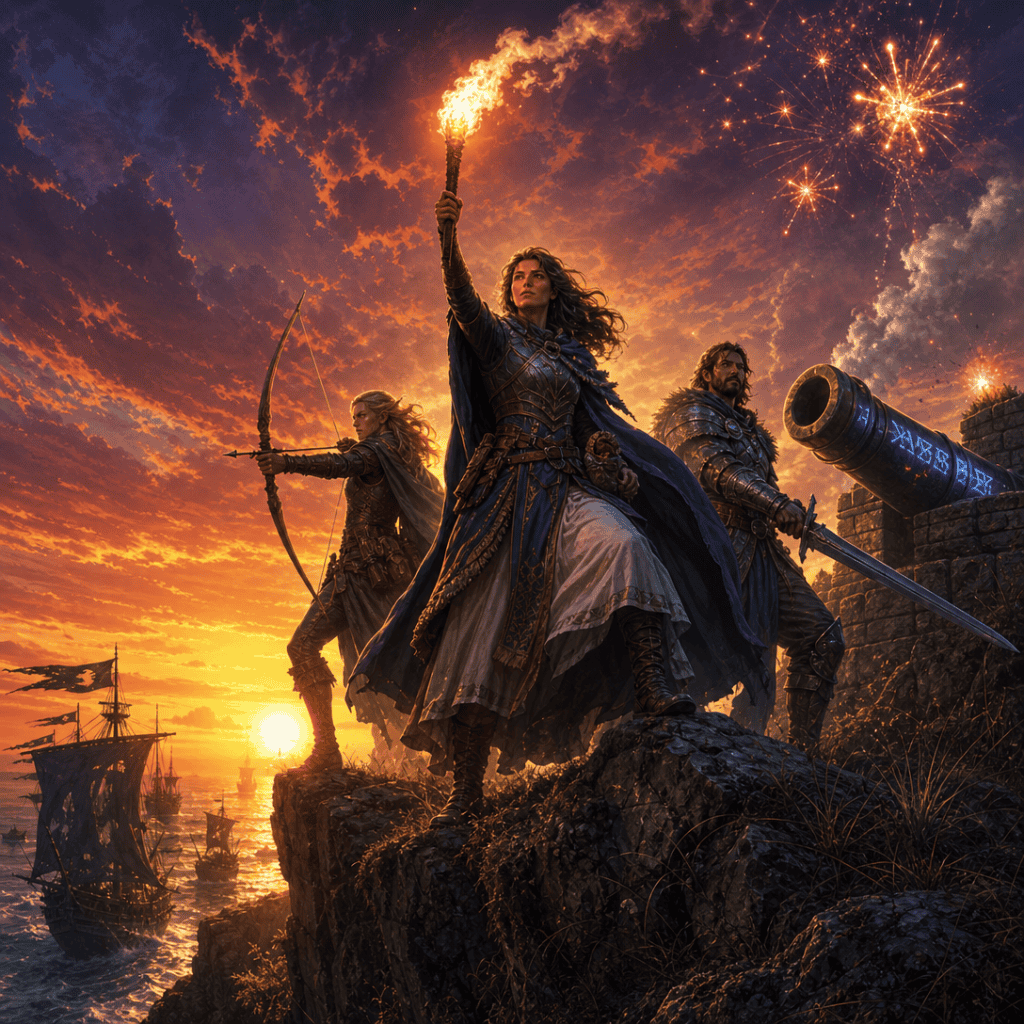
The tyrant’s fleet has been sighted off the coast. The town’s only defense is a single battery of magical cannons mounted on a clifftop. The party — for whatever reason, the only competent fighters left in town — must man the cannons, fend off boarders, and hold the cliff until reinforcements arrive at dawn. Pure tactical combat with rotating roles: gunner, defender, runner. Each round, the players choose which role they take, and each role has a different set of options. The session is essentially a three-round siege with escalating stakes, and a clear win condition tied to the rising sun.
How to Run a 4th of July D&D One-Shot in Two Hours
The biggest mistake DMs make on holiday sessions is pacing for a normal evening. You don’t have a normal evening. You have ninety minutes between the cookout and the fireworks. Plan accordingly.
Skip the prologue. The party already knows each other. They already have a job. The first sentence of the session is the call to adventure, not “you’re in a tavern.” If the players need backstory, deliver it in the second scene, not the first.
Three acts. Combat in every act. Setup, complication, climax. Each act gets a fight, a roleplay beat, and a skill challenge. If you can’t fit a fight into an act, you’ve designed the act wrong. Holiday players are easily distracted — keep something physical happening.
Hard time pressure. The festival starts at sunset. The fleet arrives at dawn. The contract must be signed before the bell rings. Holidays come with built-in deadlines — use them. The session ends when the holiday event happens, in-game and real. If the players know the session ends when the fireworks start, they will not stall.
Resolve before sunset. Whatever you have set up, finish it before the players have to leave for fireworks. If the climax is dragging, cut a scene, not the climax. A one-shot that ends without a climax is worse than a one-shot that ends without its second-to-last scene. Players remember the ending.
Themes That Fit the 4th of July D&D Vibe
Independence Day is built around a small set of themes that map directly to D&D adventure design. Lean into one or two — don’t try to use all of them in a single two-hour session.
Liberty and tyranny. The most obvious one. A small population stands up to a larger oppressor. The party’s job is usually to tip the balance: protect a leader, secure a document, sabotage the oppressor’s symbol of power. The smaller the heroes and the larger the oppressor, the better the story. This theme rewards moral clarity — players want to feel like they are on the right side of history for one session, even if their regular campaign is morally complex.
Founding moments. The session takes place at the moment a town, kingdom, or order is born. The party isn’t fighting an existing system — they are creating one. This works especially well for politically-minded players who like the weight of consequences. The session is not about defeating the antagonist; it is about choosing what comes next.
Pyrotechnics and spectacle. Fireworks. Cannons. Magical explosions. Independence Day is a holiday of sound and light, and a 4th of July D&D one-shot should feel like that. Big set-piece moments. Loud climaxes. A finale that the players can hear. If your climax is a quiet conversation, you have written the wrong climax for this holiday.
Sacrifice for the collective. Someone has to carry the bomb. Someone has to hold the line. Someone has to stay behind. The 4th of July’s revolutionary roots include real cost, and the best holiday one-shots don’t shy away from that — they earn the celebration. This theme works best when the sacrifice is voluntary and recognized; players should feel that the choice mattered.
Coastal and frontier settings. Harbor towns, frontier outposts, forested borders. The geography of early American history maps cleanly to D&D’s wilderness adventures. A coastal town under siege, a frontier village resisting taxation, a forest path that crosses a magical border. Choose a setting that gives you natural urgency: the ship is coming, the deadline is dawn, the road only stays open until the storm hits.
Adapting Independence Day Hooks for 2 vs 3 Players
Two players runs differently from three. The hooks above all work for both, but a few adjustments make a real difference.
For 2 players, drop one combat encounter from each act. A 2-player party has fewer action economy options and tires faster in extended combat. Replace one fight with a skill challenge or a roleplay scene. Also: give one of the two players a clear “spotlight role” in the climax — the gunner, the speaker, the safe-cracker. Two-player sessions feel best when each player has a distinct identity that drives the final scene.
For 3 players, lean into split-pressure scenarios. The Battle of the Bay hook works especially well with three: gunner, defender, runner. Each player picks a role each round, and the choices interact. Three players also handle the Compact hook better than two — there is enough action economy to keep both assassins alive without the session becoming a slog.
One-Shots That Already Capture the 4th of July Spirit
If you would rather not design your own from scratch, several published one-shots already work as 4th of July adventures with little or no modification.
By Dawn’s Early Light is the obvious one. It is a published 4th of July D&D one-shot for 2-3 players, designed for level 2-3 characters and a two-hour session. It draws on the coastal-defense theme — a town has to hold against a hostile fleet long enough for help to arrive — with combat in every act and a clear ticking clock that ends at sunrise. Zero-prep: read it, run it. Battle maps and NPC stat blocks ship with both the paperback and the PDF.
For DMs who want to mix the seasonal one-shot library, several other holiday adventures from the catalog work well alongside July 4th sessions:
- The Winter Ball Heist brings a winter holiday angle to the heist genre.
- The Pink Plague handles the spring holiday slot.
- Hold the Fifth covers Cinco de Mayo with similar pacing.
- Love’s Labyrinth is the Valentine’s option.
- The Pot at the End is the St. Patrick’s Day option.
For broader small-group resources, the D&D for 2-3 Players Complete Guide and the Best D&D One-Shots guide both round out the toolkit. If you are running a year of seasonal one-shots, the holiday one-shot ideas hub covers every long weekend in the calendar.
Frequently Asked Questions
What level should a 4th of July D&D one-shot be?
Level 2 to 3 is the sweet spot for most published 4th of July one-shots. Low enough that combat is decisive in two hours, high enough that the party has meaningful options. Level 1 forces too many “I miss” rolls; level 5+ adds spell complexity that slows a holiday session down past its window.
Can you run a 4th of July D&D one-shot with only 2 players?
Yes — and 2 players is actually ideal for a holiday session. Smaller groups move faster, dodge scheduling issues, and let each character drive a meaningful piece of the narrative. The trade-off is that combat needs to be tuned down (drop one enemy from each encounter) and skill checks should reward creativity over redundancy.
How long should a 4th of July D&D session run?
Two hours, including setup and snacks. Independence Day is a divided-attention holiday — fireworks, food, family — so the session has to fit the gap, not fill the day. A two-hour session with a clean three-act structure is plenty.
What themes work for July 4th D&D adventures?
Liberty and tyranny, founding moments, pyrotechnics, sacrifice for the collective, and coastal or frontier settings. Pick one or two and run them hard. Trying to hit every theme in one session usually means none of them lands.
Is “By Dawn’s Early Light” a 4th of July D&D one-shot?
Yes. By Dawn’s Early Light is Anvil N Ink’s published 4th of July D&D one-shot. It is built for 2-3 players, level 2-3, and a two-hour session, with combat in every act and a coastal-defense scenario that runs from dusk to dawn. The PDF and paperback both ship with battle maps and ready-to-run NPCs.
Run a 4th of July D&D Session This Year
The biggest barrier to a holiday session isn’t player availability — it is prep time. Independence Day weekend is the worst possible time to spend three hours building a custom adventure. Use a published one-shot, lean into the themes that the holiday already gives you, and keep the session short enough that nobody misses the fireworks.
Read the full review of By Dawn’s Early Light — Anvil N Ink’s published 4th of July D&D one-shot for 2-3 players. Two hours, levels 2-3, zero prep.
Independence Day comes once a year. The session shouldn’t take three weeks of prep to run.