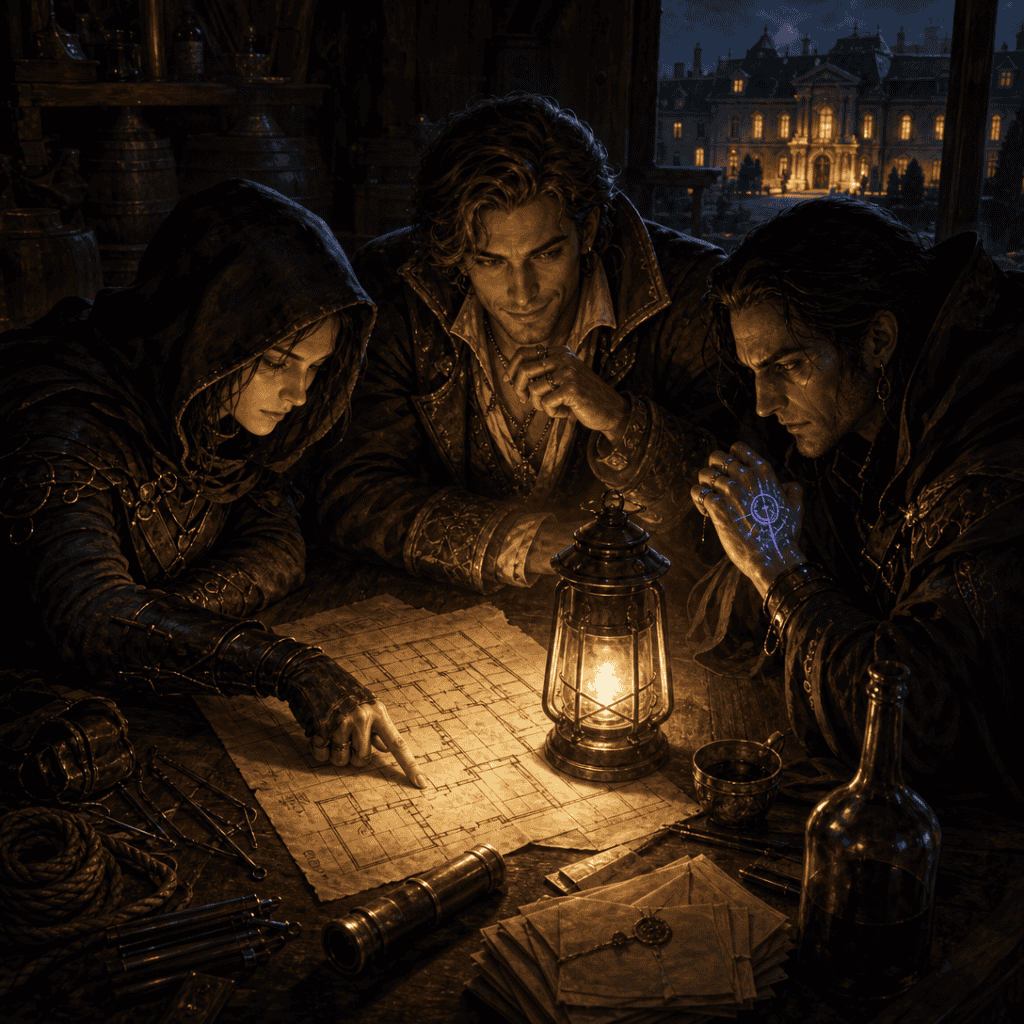

D&D heist crew roles aren’t built for 2-3 player tables. Most heist guides assume a crew of six — mastermind, hacker, muscle, charmer, infiltrator, distraction — and tell you to assign one role per player. That’s fine for tables of six. For tables of two or three, those role assignments break the moment the muscle has to also be the hacker. This guide covers how to compress traditional heist crew structure into something a small table can actually run, with three crew-build templates, class recommendations, and the published one-shots that use this design.
Why Traditional Heist Crews Don’t Fit Small Tables
The heist genre is built around specialist roles. The Italian Job, Ocean’s Eleven, Leverage — every major heist story has the same crew template: a planner, a face, a thief, a hitter, and one or two specialists. The drama comes from each role doing what they alone can do, and the tension comes from any one of them failing.
D&D inherits this template through every heist supplement on the market. Keys From the Golden Vault. The Heist Toolkit. Most DMs Guild heist one-shots. They all assume the table has enough players to fill each specialist seat.
Two- and three-player tables can’t. Two players can cover, at best, two specializations each. The party either stretches every role thin or skips half of them entirely. Both fail. Stretched roles mean every check is uncertain; skipped roles mean the encounter is solved by the wrong specialist or not at all.
The fix isn’t to scale down the encounter. It’s to redesign the crew structure so two or three characters can plausibly cover the work of six.
The Seven Traditional Heist Crew Roles
Before compressing, it helps to know what’s being compressed. The heist crew template traditionally includes:
The Mastermind. Plans the job. Knows the layout. Holds the contingencies. Usually doesn’t enter the building.
The Face. Talks past guards, charms targets, forges credentials. Charisma-based.
The Infiltrator. Stealth, lockpicking, sleight of hand, slipping past detection. The classic rogue.
The Muscle. Fights when fighting is required. Carries heavy things.
The Specialist. Domain-specific: arcanist for magical wards, alchemist for poisons, locksmith for vaults. Often two or three of these.
The Distraction. Pulls attention away from the actual operation. Often someone the crew can afford to lose.
The Inside Man. An NPC ally already inside the target. Not a player character, but plays a role.
Most heist sessions need at least three of these to function: someone who plans, someone who infiltrates, someone who handles the unexpected. With two or three players, every character has to be at least two of those roles.
How to Compress Heist Crew Roles for 2-3 Players
The compression principle: each player character is a “hybrid specialist” — primary role plus a clear secondary that fills a gap. The party covers the same functional area as a six-person crew through deliberate role overlap rather than role count.
The four hybrid specialist archetypes that work best:
Planner-Face. The character who designs the job and talks the party past obstacles. High Intelligence and Charisma. This player has the heaviest pre-job workload — they should know the layout better than anyone else, including the DM. Class fits: Bard, Knowledge Cleric, Wizard with high Charisma.
Infiltrator-Specialist. The character who gets into the place and handles the technical work — locks, traps, magical wards. High Dexterity, decent Intelligence. The classic small-table rogue with arcanist multi-class. Class fits: Arcane Trickster Rogue, Magical Trickster Bard, Soulknife Rogue.
Muscle-Distraction. The character who handles the inevitable combat AND draws attention when needed. Loud, capable, good at being seen. High Strength and Charisma, OR low Wisdom and a flair for the dramatic. Class fits: Battle Master Fighter, Hexblade Warlock, Eldritch Knight.
Inside Man-Specialist. Less common, but valuable: the character who has been inside the target before, or whose backstory connects them to the location. They handle a domain-specific specialty (ritual, magic, languages) AND provide narrative access the rest of the party doesn’t have. Class fits: anything, with a backstory hook.
Three D&D Heist Crew Build Templates
2-Player Build: Planner-Face + Infiltrator-Specialist
The cleanest small-table heist crew. One player handles the social and strategic side; the other handles the inside work. Combat is rare and brief — the build assumes the heist succeeds via stealth or persuasion, with one or two emergency fights. Best for: groups who like investigation, planning, and moments of high tension over sustained combat.
3-Player Build A: Planner-Face + Infiltrator-Specialist + Muscle-Distraction
The most flexible 3-player heist crew. Each role is distinct enough that the party can split up effectively (one player faces the mark, one slips past the guards, one creates the diversion) but each character can also support the others if a role fails. Best for: tables that want to use all three pillars of D&D — combat, exploration, social — in equal measure.
3-Player Build B: Planner-Face + Infiltrator-Specialist + Inside Man-Specialist
The investigation-heavy 3-player crew. Combat is minimal. The party’s strength is information — what they know, who they know, what has been waiting for them. Best for: groups who like mystery, social complexity, and heists where the climax is “what we already learned, applied at the right moment.”
Class Recommendations for Small-Crew Heists
Some 5e classes flex into heist roles better than others. For 2-3 player heist crews:
Best fits: Rogue (any subclass), Bard (Lore or College of Whispers), Warlock (Hexblade or Archfey), Sorcerer (Divine Soul or Wild Magic for chaos), Ranger (Gloom Stalker for urban infiltration).
Solid fits with adjustment: Cleric (Trickery or Knowledge domains), Wizard (Enchantment or Illusion), Fighter (Battle Master with infiltration tools), Monk (Way of Shadow).
Harder fits: Paladin, Druid (animal forms can work but the party loses a face character), Barbarian (the Muscle-Distraction archetype works but caps the party’s social options).
The principle: classes with high skill versatility and at least one social or technical specialty fit best. Pure combat classes work only if another character covers the social side.
Common Pitfalls in Small-Crew Heists
Forgetting the planner exists. Without a Planner-Face, the heist becomes ad hoc improvisation. One player has to do this work. Not necessarily on the spot — the planning can happen between sessions, but it has to happen.
Splitting the party in heist scenarios. Tempting in a heist setting. Disastrous at small tables. Two players in the same scene have at least one person to bounce off of. Two players in separate scenes (one each) have only the DM. The pace dies.
Designing for six players, scaling enemies down. The encounter math works, but the role math doesn’t. If the heist is designed to require a face check AND a stealth check AND a combat encounter, two players doing all three back-to-back is exhausting.
Published D&D Heists for Small Crews
The Score is Anvil N Ink’s flagship small-group heist one-shot, designed specifically for 2-3 players. The structure assumes hybrid roles and includes guidance for compressing the team further if only two players are at the table. Two hours, level 2-3.
The Merchant’s Vault covers urban heist work, and The Winter Ball Heist brings the heist genre into a holiday setting — both built for 2-3 players.
For the broader heist pillar, see D&D Heist Adventure and the Heist Adventures planning guide. For broader small-group resources, see the D&D for 2-3 Players Complete Guide.
Frequently Asked Questions
What is the minimum crew size for a D&D heist one-shot?
Two players is workable, but the build has to be deliberate. Both characters need hybrid roles, and the heist itself has to be designed for two characters covering a six-character workload. Three players is more comfortable.
What is the best class for a D&D heist?
Rogue is the obvious answer, but Bard is often better at small tables — they cover the social and infiltration sides simultaneously. Warlocks (especially Hexblade) handle muscle and arcanist work in one chassis.
Can a paladin or barbarian work in a heist crew?
They can, but only if another character covers the face and infiltrator roles. A two-player crew of Paladin + Barbarian will brute-force every encounter, which kills the heist genre. A three-player crew of Paladin + Bard + Rogue can work because the bard and rogue cover finesse.
How long should a small-crew heist session run?
Two to three hours. Three acts: planning and approach, infiltration, climactic complication. Each act gets a clear focal challenge, with the right specialist taking the spotlight.
What if my players want to do a heist but won’t commit to specialist roles?
Don’t run a heist. The genre depends on specialist roles. If players want generalist combat with a heist coat of paint, run a dungeon crawl with stolen treasure as the McGuffin instead.
Run a Small-Crew Heist This Month
Heists at 2-3 player tables work — they just require redesigned crew structure. Hybrid specialist archetypes, deliberate role compression, and a published one-shot built for the smaller team make the difference.
Read the full review of The Score — Anvil N Ink’s heist one-shot for 2-3 players. Two hours, level 2-3, zero prep, hybrid-role-aware design.
For the broader heist pillar, see D&D Heist Adventure. For other small-group heist titles, try The Merchant’s Vault and The Winter Ball Heist.
The crew of six fits in three when each character is two things at once.