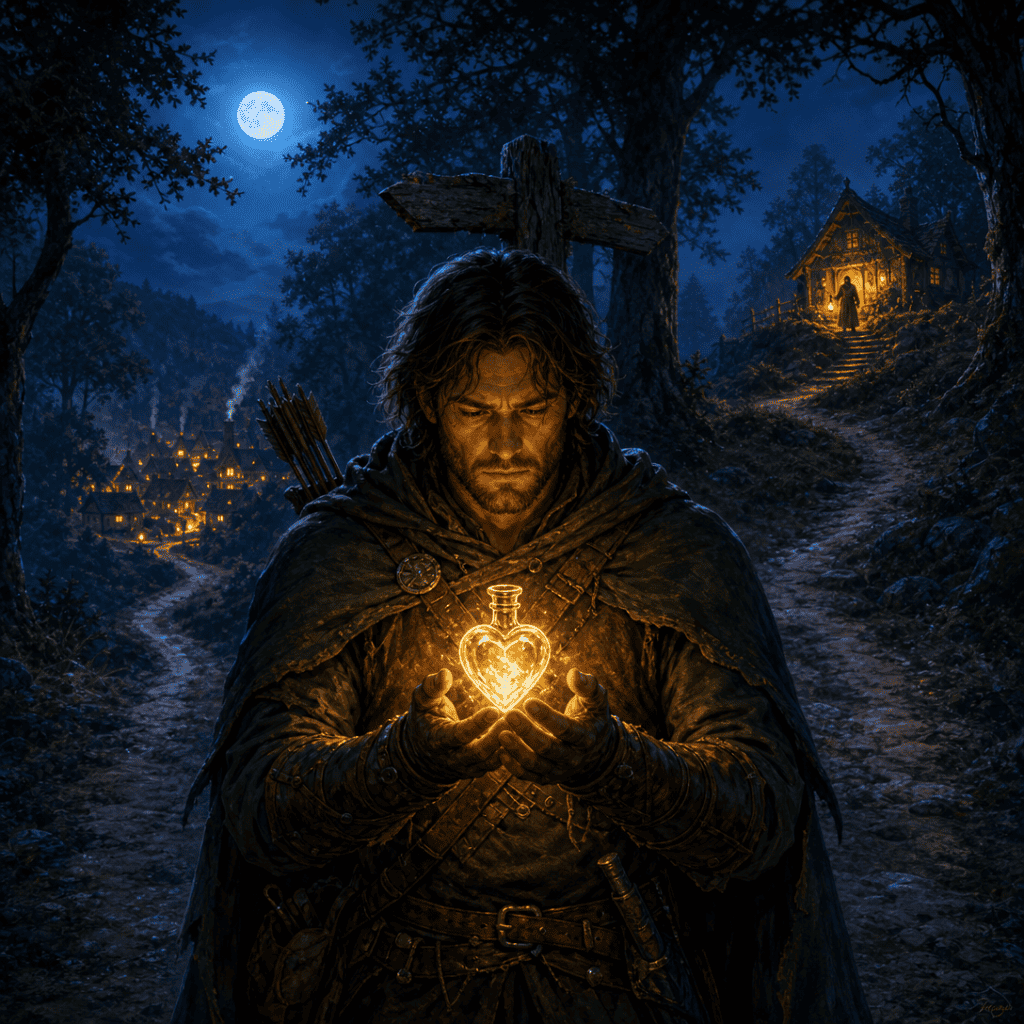

D&D moral dilemma one-shots are the format where the party doesn’t just defeat a villain — they have to choose what to lose. Done well, the session lands harder than any combat-focused adventure could. Done poorly, it becomes an emotionally manipulative trolley problem the players resent. This guide covers the four kinds of sacrifice that drive a moral dilemma session, how to structure the choice so it hits, and the published one-shots that show the format working at the table.
Why Moral Dilemma One-Shots Hit Harder
Most D&D sessions end with combat. The party fights the BBEG, wins, takes the treasure, levels up. The structure is satisfying because it’s familiar — the players resolved the problem with the tools they brought.
Moral dilemma sessions end differently. The party can’t fight their way out. The villain is sympathetic, the choice is real, and the cost falls on them. They walk away from the table having lost something that matters. They remember it.
This works because it inverts the implicit promise of D&D. Players come in expecting agency — the right tools, the right rolls, the right plan, and they win. Moral dilemma one-shots tell the player: yes, you have agency, but every option costs something. The agency is the choice itself, not the escape from cost.
For 2-3 player tables, this format is especially powerful. With a smaller party, the moral weight lands more clearly on each individual character. There are fewer voices competing for the choice; each player has to genuinely decide.
The Four Kinds of Sacrifice in D&D Moral Dilemma One-Shots
Every moral dilemma one-shot involves giving up something. The kind of thing being given up determines the texture of the session.
1. Object Sacrifice
The party has to destroy or surrender a magical item, a treasure, an artifact. The object is valuable — narratively, mechanically, or both. Giving it up has consequences but doesn’t break the campaign.
Example session: The party retrieves the cure to a magical plague but discovers it can only be used once. The cure heals the city or the party’s mentor. They can’t have both.
2. Time Sacrifice
The party has to give up time itself. Years of life, lost memories, a missed opportunity. The cost is paid by the future self of one or more characters.
Example session: A magical seal can only be closed by someone who burns ten years of their own life force. The party has to decide who pays the price — or whether the seal stays open.
3. Character Sacrifice
One of the party’s characters is the cost. They die, are transformed, are bound to the location, or are otherwise removed from play. This is the heaviest version of the format and requires explicit player buy-in.
Example session: A demon-summoning ritual can only be unmade by binding a soul into the wards. The bound soul becomes part of the prison forever. The party chooses who does it — or refuses, and the demon escapes.
4. World Sacrifice
The party doesn’t sacrifice anything they own. They sacrifice something larger — a city, a kingdom, a population. They choose between two outcomes, both of which kill people who don’t get a vote.
Example session: A magical bomb has to detonate within an hour. The party can either set it off in the slums (mass casualties, but the city’s leadership survives) or in the noble district (fewer dead, but the kingdom collapses politically).
How to Structure the Choice So It Lands
The choice has to feel real. A few principles:
Both options have to be defensible. If one option is obviously correct, it’s not a moral dilemma — it’s a decision. The DM should be able to defend either choice in good faith. If the players choose A, the DM should be able to articulate why A was the right call. Same for B.
The information has to be honest. Don’t hide costs. Don’t reveal a “secret third option” after the choice is made. Players who feel manipulated by the dilemma will reject the format entirely.
Time pressure should be moderate, not absolute. The choice needs space. Five minutes of player discussion is fine. Twenty minutes is fine. Two hours is too long. Set up the deadline as part of the session structure but don’t rush the moment of choice.
The DM doesn’t choose for them. Even if the party is hesitating, the DM doesn’t pick. The session waits. If the players genuinely refuse to decide, that becomes the choice — usually the worst possible outcome, but theirs.
The consequences play out at the table. Whatever they chose, the next ten minutes shows the result. Don’t fade to black. Don’t summarize. The session ends with the players living through the consequences, not narrating around them.
Building NPCs That Make Sacrifice Meaningful
The choice only matters if the people involved feel real. Three rules:
Name them. The villager who needs the cure has a name and a face. The mentor who will die without it has a name and a face. The mass casualties in option B aren’t a number — they’re a specific street, a specific tavern, a specific child.
Make them sympathetic in different ways. Both sides of the dilemma should have NPCs the party has reason to care about. If only one side has a person, the choice is rigged.
Don’t let the NPCs make the choice for the players. The NPCs can offer context, plead, refuse to help — but they don’t decide. The party decides. Even if the obvious thing is for the dying mentor to say “save the city,” resist that. Let the player choose.
Common Pitfalls in Moral Dilemma D&D Sessions
The fake dilemma. One option is clearly worse, and the DM expects the players to pick the “right” one. This isn’t a moral dilemma — it’s railroading dressed in moral language.
The trolley problem trap. Two abstract groups, no individual NPCs, just numbers. Players can’t engage emotionally with abstract populations. Specificity is what makes the dilemma real.
The session that ends without consequence. The choice happens, the party makes it, and the session immediately fades out. Show the consequences. Make the choice mean something.
Surprise sacrifice. Pulling a “hard choice” on players who showed up for a normal session. Moral dilemma one-shots should be advertised as such — players who want to opt out should be able to.
Published D&D Moral Dilemma One-Shots
Burden of the Unmaker is Anvil N Ink’s flagship moral dilemma one-shot, structured around character sacrifice. Someone in the party has to carry the bomb to its destination — and the bomb won’t stop ticking until it goes off. Two hours, 2-3 players, level 2-3. The session is built around the moment of decision and the run that follows.
The Extraction Job is the morally complex retrieval mission — the party discovers that what they were sent to recover has its own moral claim on staying where it is. The Crimson Ceremony is the political-stakes version, where the choice is between two factions, both with legitimate grievances.
The Colossus Autopsy uses the moral dilemma format with body horror — the party is exploring the corpse of a sentient giant and must decide whether to honor the giant’s last wish or use its body for the greater good.
For broader moral dilemma technique, see D&D Moral Dilemmas: 7 Techniques That Haunt Your Players and Sympathetic Villains in D&D.
Frequently Asked Questions
What’s a moral dilemma in D&D?
A moral dilemma is a choice the party has to make where every option has serious cost and neither is clearly correct. The session is structured around the choice itself — investigation, complication, decision, consequence — rather than around defeating an antagonist.
Should every D&D session include a moral dilemma?
No. Moral dilemma one-shots are emotionally heavy and work best as occasional sessions, not as the default format. Most groups can handle one moral dilemma per quarter without the format losing its weight.
How long should a D&D moral dilemma one-shot run?
Two to three hours. The choice itself needs time to breathe — players should be able to discuss, weigh, and disagree before deciding. Sessions that try to compress the dilemma into thirty minutes feel rushed and reduce the impact.
What if the players choose neither option?
Refusing to choose is a choice. Usually the worst-case outcome unfolds — the bomb goes off, the city dies, the artifact is taken by someone else. The DM should respect the refusal and play it through honestly. Players who refuse to choose remember the consequences.
Should I warn players that a session will have a moral dilemma?
Yes. Surprise sacrifice damages player trust. Moral dilemma one-shots should be advertised in advance (“this session involves a hard choice; you may want to consider that going in”) so players can opt in or out.
Run a Moral Dilemma Session This Month
Moral dilemma one-shots are the format where D&D stops being a power fantasy and starts being a story. The choice has to be real, the costs have to be honest, and the consequences have to play out at the table — but when all three line up, the session lands harder than any combat finale.
Read the full review of Burden of the Unmaker — Anvil N Ink’s published moral dilemma D&D one-shot for 2-3 players. Two hours, level 2-3, built around the moment of choice.
For more on running moral dilemmas, see 7 Techniques That Haunt Your Players. For the most morally complex titles in the catalog, try The Extraction Job and The Colossus Autopsy.
You can survive a fight. You don’t always get to survive a choice.