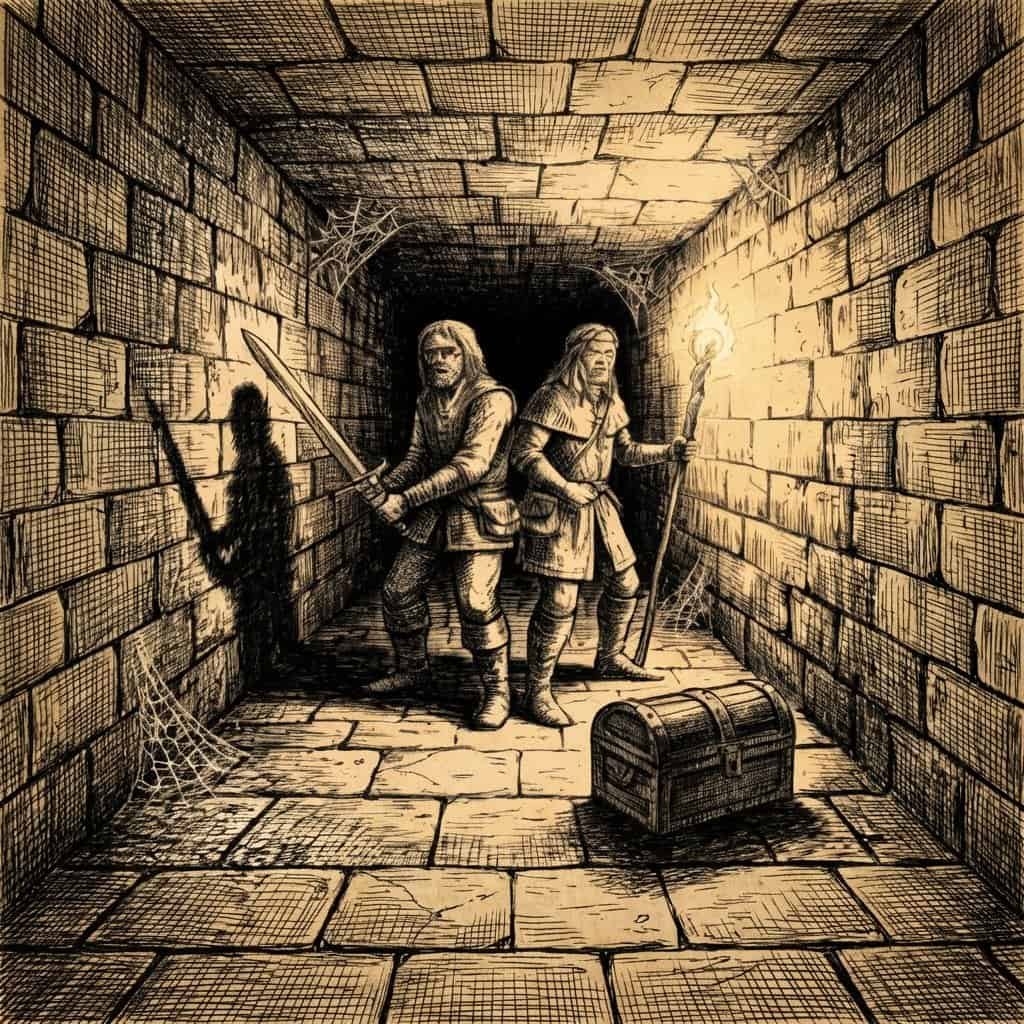

The Complete Guide to Running D&D
for Small Groups (2-3 Players)
Can you run a great D&D campaign with just two or three players? Absolutely — and in many ways, it’s better than a full table. Small group D&D delivers faster combat, deeper roleplay, and sessions that actually finish on time. The problem isn’t the player count. The problem is that most adventures assume four to six players, leaving small-group DMs to improvise, rebalance, and hope for the best.
This guide changes that. Whether you’re running D&D for 2 players for the first time or you’ve been adapting published adventures for years, you’ll find practical, tested advice for making small group D&D sessions consistently excellent — from encounter design and pacing to adventure selection and roleplay depth.
At Anvil & Ink Publishing, every adventure we create is designed specifically for 2-3 players. Not scaled down. Not adapted. Built from the ground up for small tables. This guide distills everything we’ve learned into one resource.
Why Small Group D&D Works Better Than You Think
The assumption that D&D requires four or more players is baked into the hobby’s DNA. Published modules, encounter balance tools, and even the Dungeon Master’s Guide all default to parties of four to six. But the reality at most tables looks very different. Scheduling conflicts, busy lives, and the simple difficulty of coordinating multiple adults mean that two or three players is often what actually shows up.
Rather than treating this as a limitation, experienced DMs recognize small groups as a genuine advantage. Combat resolves in half the time when you’re not waiting for six people to take their turns. Every player gets meaningful spotlight time in every scene. Roleplay conversations happen naturally instead of being drowned out by cross-talk. And sessions that would take four hours with a full party wrap up cleanly in two to three hours — perfect for weeknight games or parents who need to be done by 10 PM.
The key shift is mental. Stop thinking of your small group as an incomplete party. Start thinking of it as a focused team where every character matters and every decision carries weight. That’s not a compromise. That’s compelling drama.
Building Adventures for Small Groups
The biggest mistake DMs make with small groups is taking a standard adventure and simply reducing the number of enemies. That approach misses the point entirely. Adventures designed for larger parties assume a specific action economy — multiple characters covering different roles, absorbing damage across a broader health pool, and providing redundancy when someone goes down. Removing two players from that equation doesn’t just make fights harder; it changes the fundamental dynamics of exploration, social encounters, and resource management.
Effective small-group adventure design starts with scope. Two to three hour sessions suit small groups perfectly. The narrative should be tight enough to resolve in a single sitting, with clear objectives and built-in urgency. A ticking clock — whether literal or implied — keeps momentum high and prevents the analysis paralysis that can stall smaller parties who feel every decision more acutely.
Structure your adventures around multiple solution paths rather than single chokepoints. A full party can brute-force a locked door, a social barrier, or a combat encounter through sheer versatility. A small group needs options. If the only way forward requires a rogue’s lockpicking, and nobody brought a rogue, your adventure stalls. Design every obstacle with at least two viable approaches — force, finesse, magic, or negotiation.
Our Ready Adventure Series follows this exact philosophy. Every adventure includes multiple solution paths, scaling guidelines, and pre-generated characters specifically balanced for small parties. No rebalancing required. No guesswork about what works.
Encounter Design That Actually Works for 2-3 Players
Encounter balancing for small groups isn’t about doing less — it’s about designing differently. The standard Challenge Rating system assumes a party of four, and simply halving monster hit points or reducing enemy count produces flat, unsatisfying encounters. Instead, rethink what makes a fight interesting when fewer characters are on the field.
Fewer Enemies, More Environment
Replace extra enemies with environmental hazards and terrain features. A fight against two goblins on a crumbling bridge over a chasm is more engaging than a fight against six goblins in a flat room. The environment becomes your third or fourth “enemy,” creating tactical complexity without overwhelming a small party’s action economy. Collapsing floors, spreading fire, rising water, or unstable terrain force movement and decision-making that keep combat dynamic.
Single Powerful Enemies With Phases
Boss fights work brilliantly for small groups when you design them with phases or shifting mechanics. A single ogre that fights differently once bloodied — becoming reckless, retreating to a defensible position, or calling for reinforcements — creates a memorable encounter without requiring the party to manage a dozen initiative slots. Our adventure The Sinking Tower of Hours uses this approach across five descending levels, with each floor presenting a distinct challenge that rewards tactical thinking over raw numbers.
Time Pressure Over Body Count
Small groups thrive under time pressure. When the ceiling is collapsing, the ritual is completing, or the hostage is being moved, players don’t have time to optimize. They act, they improvise, and they create memorable moments. Time pressure also naturally prevents the cautious, room-by-room clearing that bogs down small parties who (rightly) feel vulnerable.
Running D&D for Just Two Players
Two-player D&D — sometimes called duet play — is one of the fastest-growing segments of the hobby, and for good reason. Couples, parents with one child, or friends who can’t coordinate a larger group discover that duet games deliver an intensity of roleplay and narrative focus that larger tables rarely match.
The practical challenges are real, though. Two characters cover fewer roles, have less total hit points, and can be overwhelmed by action economy disadvantages. Here are the approaches that work.
Sidekick Characters
Tasha’s Cauldron of Everything introduced official sidekick rules for a reason. A DM-controlled or player-managed sidekick fills gaps in the party without adding the complexity of a full character. Keep sidekicks simple — a warrior who tanks, an expert who handles skills, or a spellcaster who provides healing. The sidekick shouldn’t steal spotlight; they exist to enable the players’ heroics.
Adventures Built for Two
The most reliable approach is using content specifically designed for two players. The Stolen Festival Bell was built from scratch as a beginner-friendly adventure for exactly two players, with encounters, puzzles, and social situations all calibrated to that number. Similarly, The Bandit’s Keep is a stealth rescue mission designed for one to two players, emphasizing infiltration and clever problem-solving over straight combat.
Lean Into Roleplay
Two-player games naturally gravitate toward deeper character interaction. Embrace this. Spend more time on dialogue, character development, and the relationship between the two PCs. Some of the most memorable D&D moments happen in quiet conversations between characters — and a two-player game gives you room to breathe into those moments without five other people waiting for their turn.
No-Prep Adventures: The Small Group DM’s Secret Weapon
Small group DMs are often forever DMs — the one person in their friend group willing to run the game. And forever DMs are busy. Between work, family, and the basic logistics of adult life, spending four hours prepping a two-hour session isn’t sustainable.
No-prep and low-prep adventures solve this problem directly. The best ones give you everything you need to run a complete session right out of the book — maps, stat blocks, NPC motivations, read-aloud text, and “what if” sections covering common player choices. You open the book, read for fifteen minutes, and you’re ready.
This is the core design philosophy behind every adventure in our catalog. 101 Adventures for Busy DMs takes this further with a complete collection of ready-to-run adventure frameworks you can grab and go. For DMs who want a structured investigation without the headache of writing mystery plots, the Mystery Adventure Toolkit provides frameworks, templates, and three complete mysteries.
Making Roleplay Shine at a Small Table
Roleplay at a small table is fundamentally different from roleplay at a large one. With fewer voices competing for attention, every word matters more. Characters develop faster, relationships deepen naturally, and players feel comfortable taking creative risks they might avoid in front of a larger audience.
As a DM, your job is to create space for this. Ask questions about character motivations. Let conversations between PCs run longer than you normally would. Put characters in situations where their values are tested — not just their hit points. Moral complexity hits harder when two players have to agree on a course of action rather than defaulting to majority vote.
For players looking to deepen their characters, our Roleplay Guide Series provides practical tools — 50+ in-character phrases, six detailed archetypes, and cultural context that transforms stereotypes into authentic personalities. Guides are currently available for Dwarves, Elves, and Tieflings.
Genre Adventures That Work for Small Groups
Small groups excel at specific adventure genres that larger parties often struggle with. Understanding which genres play to your strengths helps you pick — or design — the right adventures.
Horror
Horror is almost impossible with six players cracking jokes. With two or three, it’s electric. Vulnerability is built into the small party, and isolation — the foundation of horror — feels genuine when there’s no cavalry to call. Adventures like The Colossus Autopsy, The Spider’s Seminary, and Little Lambs all leverage this intimacy for genuine tension.
Heist and Infiltration
Stealth missions fall apart when six players need to coordinate. Two or three operatives can move as a unit, make quick decisions, and maintain tension through a heist without the coordination overhead. The Winter Ball Heist and The Merchant’s Vault were built specifically for this dynamic.
Mystery and Investigation
Investigation adventures reward careful attention and deductive reasoning — both of which improve dramatically with fewer players. When two people are following clues, they remember details, connect dots, and engage with the mystery. With six players, someone’s always checking their phone during the crucial revelation. The Crimson Ceremony combines investigation with political thriller elements, where the quality of your investigation directly impacts the final confrontation.
Survival
Resource management and survival mechanics carry real weight when the party is small. Every ration matters, every spell slot counts, and every choice about where to rest or when to push forward becomes a genuine tactical decision. Frostfall drops a small party into frozen wilderness after an airship crash, where trust and resource management are as dangerous as the environment.
D&D for Families and New Players
Families represent one of the largest natural small groups in D&D. A parent DMing for one or two kids is the definition of small-group play, and it comes with its own considerations.
Keep early sessions short — 60 to 90 minutes for younger kids, building toward two hours as their attention develops. Use simple, clear objectives with visible progress. Gateway adventures that teach the game while telling a story work far better than dropping new players into complex scenarios and explaining rules as you go.
No Rest for the Buried was designed specifically as a gateway adventure for new players and families — complete with a bonus adventure and village gazetteer to extend the experience. For families with children on the autism spectrum, The Neurodivergent Adventurer’s Guide provides specific adaptations, session structures, and adventures designed for ages 8-14.
Solo Play: When the Group Is Just You
Sometimes the smallest group is a party of one. Solo D&D has exploded in popularity, and for good reason — it lets you scratch the dungeon-crawling itch anytime, anywhere, with no scheduling required.
Solo play ranges from journaling games and oracle-based systems to purpose-built solo dungeon crawlers. Deep Delving offers a streamlined solo experience with d20 combat, 8,000+ boss combinations, and permadeath stakes in sessions that run 30 minutes to two hours. It’s designed for the moments between group sessions — or for when you simply want to play and nobody else is available.
Practical Tips for Every Small Group Session
After publishing over 30 adventures for small groups, certain principles show up again and again. These are the habits that separate good small-group sessions from great ones.
Start sessions with momentum. Small groups don’t need 20 minutes of “what happened last time” — recap in two sentences and drop them into action or a decision point immediately. The energy at the table sets the tone for everything that follows.
Use pre-generated characters or streamlined character creation for one-shots. Character creation for a party of two takes less time than for six, but it still eats into your limited session window. Pre-gens get you playing faster and ensure the party is balanced for the adventure.
Embrace the “yes, and” philosophy more aggressively than you would with a larger group. With fewer players, creative solutions deserve encouragement. If the barbarian wants to throw the halfling across the chasm, find a way to make it work. Small parties need their victories to feel earned and creative.
End sessions with a clear hook for next time, or — if running a one-shot — with a satisfying resolution. Small groups form tighter narrative bonds, and an unresolved ending that a larger group might shrug off can genuinely bother players who are deeply invested in two or three characters.
Choosing the Right Adventure for Your Small Group
Not every adventure works for every group. Here’s a quick framework for matching adventures to your specific table.
For brand-new players or families, start with something beginner-friendly that teaches the game through play. The Stolen Festival Bell and No Rest for the Buried both serve this purpose well. For groups that want tactical challenge and clever problem-solving, heist adventures like The Merchant’s Vault or stealth missions like The Bandit’s Keep deliver exactly that. For experienced players who want narrative weight and moral complexity, The Crimson Ceremony and The Extraction Job provide choices with real consequences.
And for the group that wants to laugh, The Golden Rest proves that comedy and genuine heroics aren’t mutually exclusive — four retired adventurers stumbling into an actual crisis is exactly the kind of unexpected story that small groups tell for years.
The Bottom Line about D&D small group play
Small group D&D isn’t a lesser version of the game. It’s a different game — one with its own strengths, its own rhythms, and its own kind of magic. Faster combat, deeper roleplay, easier scheduling, and tighter narratives aren’t consolation prizes. They’re genuine advantages that make the experience better for the right groups.
The only thing you actually need is content designed to support you. Adventures built for your table, not scaled down from someone else’s. That’s what we do at Anvil & Ink Publishing — every adventure, every guide, every resource designed specifically for small groups of 2-3 players.
Your table is the right size. Now go play.
Anvil & Ink Publishing — forging adventures for tables of every size. Browse the complete Ready Adventure Series on Amazon or visit anvilnink.com for free resources, DM tips, and more.