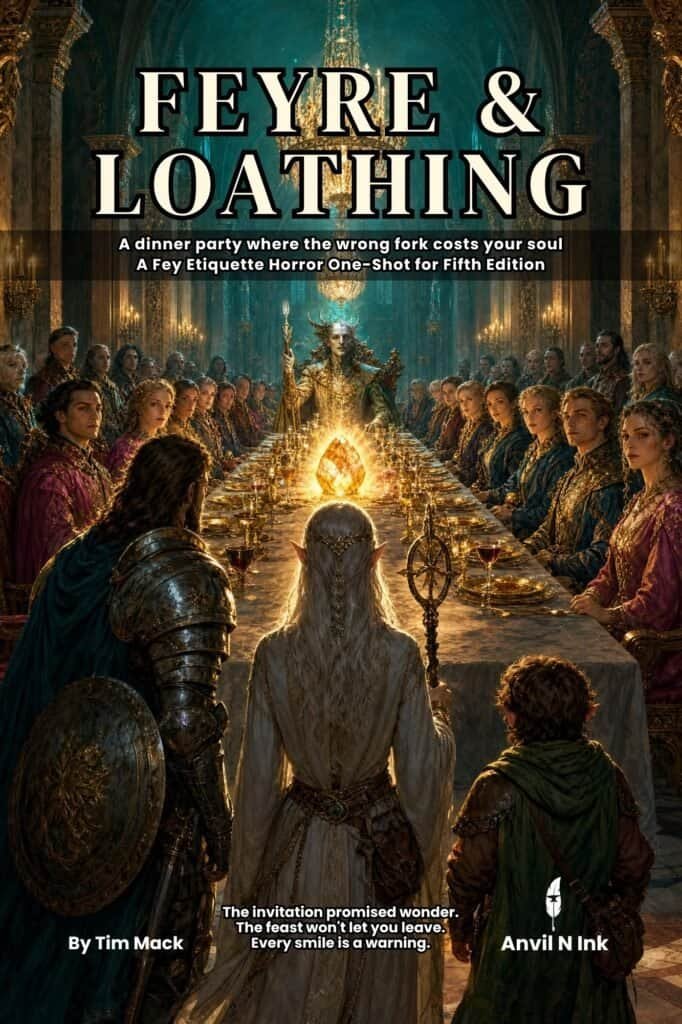

If you have ever wanted to run a fey horror one-shot that unsettles a table without a single dungeon in sight, Feyre & Loathing is built for exactly that evening. It is a complete, ready-to-run fifth edition adventure for two or three players at levels 2–3, playable cold in a single two-to-three hour session with zero preparation. Your party arrives at a glittering fey banquet holding silvered invitations, the wine tastes of starlight, the company is radiant — and every course, every toast, every glance obeys an ancient etiquette that punishes a wrong move with transformation. Open the book, read the first block aloud, and watch your players realize they are the only guests who do not know the rules.
This is a horror of manners. The combat is real, but the deeper danger is social, and the scares come from a slow, creeping understanding of where you actually are and who is really sitting beside you.
A Fey Horror One-Shot Where Manners Are the Monster
Most horror adventures reach for a monster in the dark. This one reaches for the wrong fork. The hall runs on a small code of fey etiquette — the Laws of the Revel — and the whole table is being judged against rules nobody handed them.
The genius of the design is that the etiquette is a mechanic your players can learn, dread, and eventually try to game. They will find themselves bowing to furniture on purpose, wrapping iron in silk, and complimenting a roast that is very obviously a transformed person. Play it straight and the comedy and the horror share a single chair.
Break a rule and the hall rewrites you
When a character commits a breach, they do not just lose a roll — they take a Mark of Rudeness. Silver thread laces their lips shut. One hand stiffens to painted porcelain. Roots pin their shoes to the floor. Each Mark is a small, reversible transformation with a real mechanical bite, removed by a sincere apology or a proper gift. It is the promised body horror, landed on the players themselves instead of on the scenery, and it is the thing your table will talk about afterward.
The Twist: The Guests Used to Be People
The beautiful nobles filling the hall are not fae. They are the bound souls of mortals who accepted an invitation long ago, glamoured into roles they can no longer leave. The lord at the head of the table has been dead for seventy years, kept walking by a crystallized fruit of pure glamour. And the revel cannot end until someone new agrees to take his place — which is precisely why your table was invited.
The adventure hides three key truths and protects each one with at least three separate clues, found through observation, conversation, or plain accident. A party that searches nothing and talks to no one will still trip over enough of the truth to understand the stakes. They will simply get there slower, and with more screaming.
The Unraveling: A Dread Meter Your Players Can Watch
The engine underneath the night is the Unraveling, a visible gauge from 0 to 12 that tracks the glamour rotting away. At the low end the hall gleams and the wine is perfect. As it climbs, the cracks show — shadows fall wrong, the wine tastes of copper, the guests flicker between beautiful and haggard. Near the top, the rot is undeniable and the host at the far end of the table is visibly a corpse.
Breaking etiquette pushes it up. Perfect manners and spoken truths hold it down. Crucially, it has a rising floor, so the dread builds no matter how cleanly your table plays — good play buys you a gentler night, never a safe one. The number sitting in front of your players when the final course arrives decides how dangerous the host becomes.
Two Roads Through One Poisoned Evening
Act Two forks, and both halves are written in full. Take the Servant’s Way down into the Cauldron Warrens, where a cook the size of a wardrobe stirs a cauldron with a femur and the larder answers a great many questions you did not want answered. Or take the Guest’s Way into the ballroom, where the dances are binding rituals and a card game quietly wagers your memories.
Both paths surface the truth and converge at the same table, so nothing downstream is locked behind the choice. Your players pick a texture — stealth and observation, or risk and participation — and the adventure respects it. Neither route is the correct one, and a table that goes below stairs never feels it missed the better half.
A Boss Built So It Never One-Shots a Hero
The finale is a three-phase confrontation with the dead host, and it has been stress-tested the hard way — simulated thousands of times against the worst-case table of two level-2 characters with no healer between them.
A weak point, and a reluctant villain
The host does not fight to kill. He wants a replacement, not a corpse, so he never lands a finishing blow on a badly hurt hero — a mercy that is genuinely unnerving to run, and the reason a small party survives him. His one weakness is the paradox at the center of the whole book: cold iron offered with a sincere courtesy, a blade presented like a gift rather than concealed. Present it well and even an all-martial pair can bring him down.
Then the adventure hands your table the fruit and one minute to decide its fate. Shatter it and free the bound souls into a world seventy years gone. Swallow it and become the new eternal host. Or plant it, and let the wild fey reclaim everything. All three endings are written in full, with consequences and an epilogue. Groups argue about this one on the drive home, which is the only review that matters.
What’s Included
Sixteen named scenes across four acts, with the branching second act described above, and nineteen read-aloud blocks written to be delivered cold without rehearsal. The Laws of the Revel and the Marks of Rudeness give you a complete manners-as-combat system, and the Unraveling gives you a dread clock the whole table can see.
You also get six creatures and four bound-soul characters with full SRD 5.1-compatible stat blocks, four ready-made heroes built so that any two of them form a viable party, six battle maps, six opening hooks, six off-script contingencies, and three fully written endings. The maps come with an explicit note that they are a suggestion, not a requirement — run it on a grid, a whiteboard, or entirely in the theatre of the mind.
The book is written to be run, not just read. A one-page Cast at a Glance keeps the five faces you need at your elbow, a Six Signs the Glamour Is Failing box hands you the sensory cues to drop as the dread rises, and every single scene carries a written fallback for the moment your players ignore the plot and do something nobody planned. Each clue has three separate ways in, so no revelation is ever locked behind one character’s skill list. This is the part most one-shots skip, and it is the part that quietly saves your night at the table.
Perfect For
Game Masters who want a complete horror session without surrendering a week to prep. Small tables of two or three players, with no need to recruit strangers to fill empty chairs. Anyone who loves a slow-burn horror where politeness is the trap and the scariest thing in the room is a place setting.
It also works beautifully as a one-night break from a long campaign, or as an unforgettable first adventure for new players — the premise explains itself, and the etiquette gives people who have never rolled a d20 something concrete to play with immediately.
Series Information
Feyre & Loathing is part of the Ready Adventure Series — one-shots built for two or three players, levels 2–3, one session, zero prep. Every book in the line is designed for the table you actually have rather than the six-player group published adventures keep imagining. If a horror of manners is your table’s speed, the series runs the full tonal range from comedy to cosmic dread, each entry finished by midnight. See where it ranks among the best D&D horror one-shots.
Run This Fey Horror One-Shot Tonight
You need the core fifth edition rules and two or three friends. Everything else — the heroes, the creatures, the maps, the whole poisoned evening — is in the book. There is no session zero, no prep block, no homework. Just print the invitations and knock.
Feyre & Loathing is the fey horror one-shot where the wrong fork costs your soul — and your table decides, in the end, exactly what kind of monster to become.
Get Your Copy
Choose your preferred format