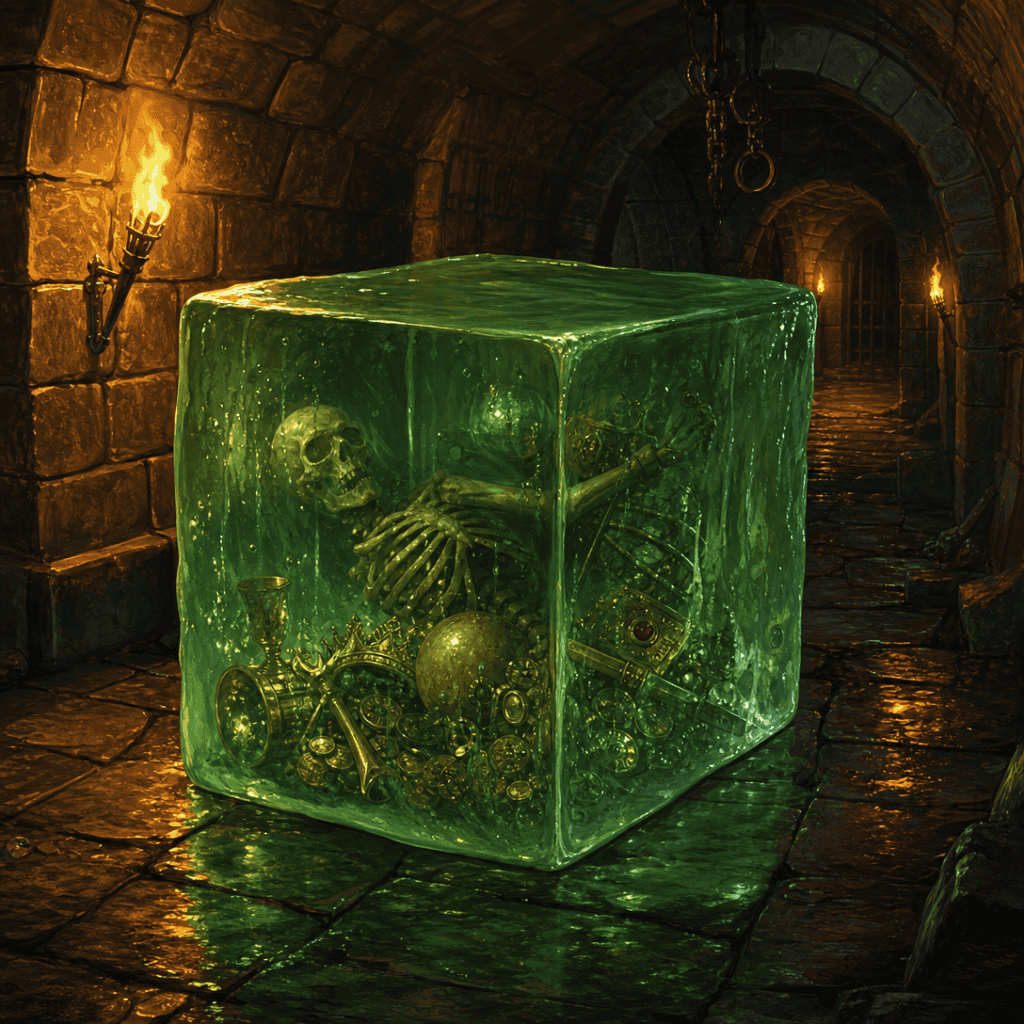

The gelatinous cube in 5e is a ten-foot block of transparent, acidic jelly that drifts through dungeon corridors, dissolving anything it touches and carrying the slowly digesting remains of its victims suspended inside it. It is nearly invisible, completely silent, and almost everyone who meets one walks straight into it. For a monster with no face, no plan, and barely any intelligence, it is one of the most beloved creatures in the game — and, argued correctly, the best monster D&D has.
Here’s what the gelatinous cube actually is, why it works so well at the table, and how to run one that earns the scream it deserves.
What is a gelatinous cube?
Mechanically, the gelatinous cube is an ooze that fills a space ten feet on every side — the exact width of a classic dungeon hallway. That’s not an accident. It evolved, in fiction and in game design, to be the thing that occupies the corridor you’re about to walk down.
It’s transparent enough to be easy to miss, so characters often blunder into it before they notice it’s there. It senses the world without needing eyes, moves slowly and relentlessly, and engulfs whatever it overtakes, dealing acid damage and trapping the victim inside its body. Anything it has already eaten — coins, weapons, bones — hangs motionless within it, which is both a warning sign and a treasure chest.
The lore: a dungeon’s silent cleanup crew
The gelatinous cube exists to explain something every dungeon quietly needs answered: why isn’t the place knee-deep in rubble, corpses, and refuse? The cube is the answer. It slides up and down the halls scouring them clean, eating the dead, the dropped, and the unwary, and leaving polished stone behind.
That gives it a strange dignity. It isn’t malicious. It’s maintenance. A cube doesn’t hunt you out of hunger or hatred; you simply happened to be in the corridor it was cleaning. Understanding the gelatinous cube as part of a working ecosystem makes it far more interesting than a wandering hazard — and it opens up a whole approach to how a dungeon’s ecology actually works.
Why the gelatinous cube is the best monster in 5e
Most monsters threaten you. The cube embarrasses you first, then threatens you. The fun is in the reveal — the moment a player realizes the “empty” hallway they just stepped into is solid, and closing.
It’s also rare among monsters in that it’s frightening and funny at the same time. A dragon is only ever majestic. A cube is a horror (you are being slowly digested while fully conscious) and a punchline (you walked into a wall of jelly) in the same breath. That tonal range is why it sticks in players’ memories for years.
And it rewards clever play. You can’t simply trade blows with a corridor. Players have to think — back up, use reach, burn it, lure it, or sprint past. The cube turns a fight into a puzzle, which is almost always more memorable than another round of swinging swords.
How to run a gelatinous cube in 5e
Place it in a corridor, not a room. The cube’s whole identity is the hallway it fills. In an open room it loses the trap; in a ten-foot corridor it becomes a moving wall the party has to solve.
Telegraph it — but quietly. Don’t say “you see a gelatinous cube.” Describe a stretch of floor that’s suspiciously clean, a faint slosh, a coin hanging in midair, a torchlight that bends oddly. Give players the clues and let the dawning realization do the work.
Make the engulf matter. The terror of the cube is being trapped inside it, taking acid each round while your friends try to cut you out. Play that beat for tension. A captured ally raises the stakes far more than a simple hit.
Reward the players who notice. The party that spots the suspended treasure and stops in time should feel smart. The one that charges ahead should feel the consequences. Either way, they’ll remember the cube.
An adventure built around the cube
If you want to do more with the gelatinous cube than drop one in a hall, Squeaky Clean turns the creature’s janitorial role into an entire mystery. In it, a dungeon’s gentle cubes — the quiet crew that has kept the place spotless for generations — are turning up dead, poisoned, and the party has to find out who’s killing the cleanup crew and why.
It takes everything interesting about the cube — the ecology, the misunderstanding, the dark comedy — and builds a complete one-shot on top of it. It’s a good example of how much story a single “simple” monster can carry when you take it seriously.
For the creature’s deeper roots in the game, the gelatinous cube has been part of Dungeons & Dragons since its earliest days as one of its signature oozes.
Frequently asked questions
How big is a gelatinous cube in 5e?
It fills a ten-foot cube — the width of a standard dungeon corridor. That size is the point: it’s built to occupy the hallway the party walks into.
Can you see a gelatinous cube coming?
Often not until it’s close. It’s transparent, so the usual giveaways are indirect: oddly clean floors, objects suspended in midair, or a faint wet sound. Telegraph those instead of naming the monster.
What happens when a gelatinous cube engulfs you?
You’re trapped inside its body, taking acid damage each round until you escape or your allies destroy it. The engulf is the cube’s signature threat and the source of most of its tension.
Is the gelatinous cube a good monster for low-level parties?
Yes — it’s a classic early-game encounter. It’s dangerous enough to demand clever play but beatable by a small group that thinks rather than charges.
Why do gelatinous cubes live in dungeons?
They function as scavengers, eating refuse and the dead and keeping corridors clean. Treating the cube as part of the dungeon’s ecology makes it far more than a random hazard.
Put a cube in front of your players
Run one well and your table will be talking about the clean hallway for years.
Get Squeaky Clean:
- PDF on Payhip — instant download
- Paperback on Amazon
- Ebook on Amazon
One corridor. One cube. One unforgettable mistake.