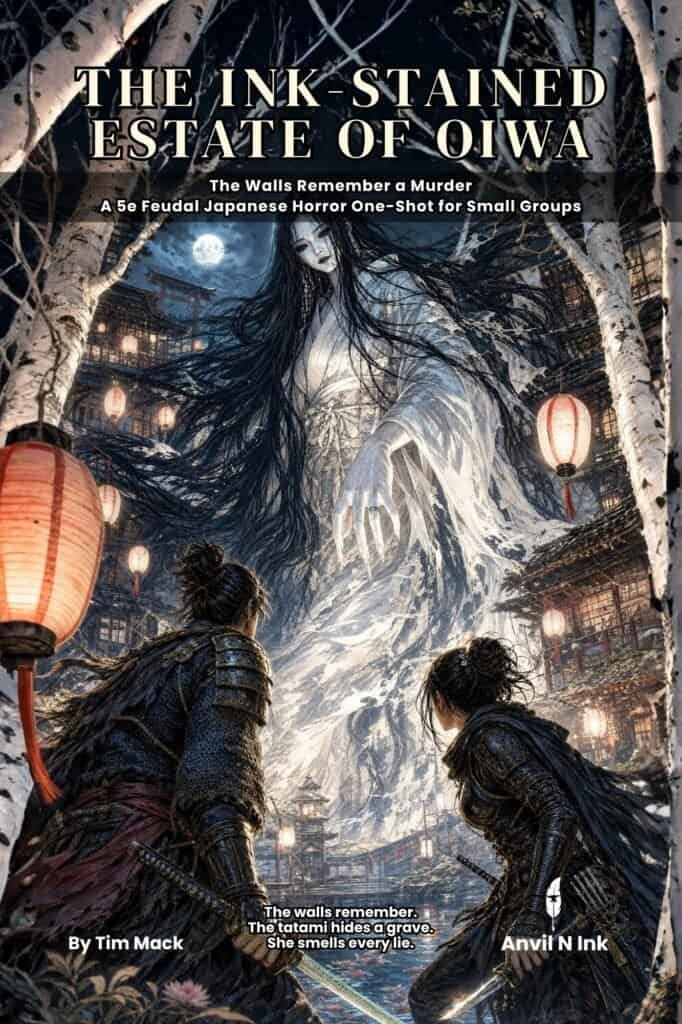

Every Game Master who has wanted to run a Japanese horror one-shot hits the same wall: the ghost is easy to picture and impossible to find on a shelf, and the few adventures that fit the mood assume a full table and a month of prep. The Ink-Stained Estate of Oiwa answers that in a single evening — a complete, ready-to-run ghost story for fifth edition, built for two or three players at levels 2–3 and playable cold in one two-to-three-hour session with zero preparation. Your table is hired to recover an heirloom blade from a beautiful manor. The blade is the weapon that murdered the woman now haunting it.
This is a ghost story with a crime at the center of it. Three months ago the lord of the Estate of Black Birch strangled his wife, Oiwa, and hid her body beneath the floor. He told everyone she ran away. The estate believed him. The walls did not — and now her vengeful spirit has rewritten the house into a living nightmare of ink and hair that can smell a lie the moment your players tell one.
Running a whole spooky season?
This is one of many ready-to-run Halloween one-shots. See the full lineup sorted by theme, gothic, folk, undead, coastal, cosmic, and comedy-horror, all 5e and zero prep.
See all Halloween one-shots →A Japanese horror one-shot built on grief, not gore
The horror here is atmospheric, not graphic. Oiwa is an onryo — a vengeful ghost from the kaidan tradition of the Japanese ghost story — and the estate is less haunted than grieving. Ink seeps through the paper screens, corridors rearrange themselves when no one is watching, and her hair fills the koi pond like black silk. Your table has been hired by the estate’s desperate steward to descend into the house and recover its ancestral blade before the manor sinks into the underworld. But that blade is the weapon that killed her, and Oiwa knows exactly why the party has come. The job is a lie, and she can smell it from the first bow at the gate.The Grudge Track your players can watch
The engine of the adventure is the Grudge Track — a visible 0-to-10 gauge that sits on the table where everyone can see it. It starts at 2, and here is the twist: it has a rising floor, so it climbs by act no matter how carefully your players behave. It rises when they lie to a spirit, force a door, smash a mirror, or take what is not theirs. It falls when they leave an offering, calm a restless ghost, return what they stole, or simply tell a hard truth. Low on the track the house is merely wrong; higher, the walls drip ink and mirrors show Oiwa standing behind the viewer; at the ceiling the estate collapses into the underworld on a ten-round clock.A house that reacts to how you behave
The dread is not buried in the Game Master’s notes. It is a number ticking in front of your players, and it feeds the finale directly: the angrier Oiwa is when they reach her shrine, the faster and deadlier her final form. Good play holds the floor. It never erases the clock.Two ways into the dark
Act Two forks, and both halves are written in full. Creep east through the lord’s study — illusory rooms, a season-locked puzzle, and documents that confirm the murder — for a quiet, investigative route. Or fight west through the burning servants’ quarters, a face-stealing spirit, and a hungry fire for the loud one. Both paths surface the same clues and both converge on the Cellar of Faces, so nothing downstream is locked behind the choice. Your table picks a texture, patient or violent, and the house obliges. Threaded through all of it are five paper ofuda talismans, a tight resource where every ward you burn to seal a door or banish a spirit is a real decision.The ghost is the victim
Here is what lifts this above a haunted-house crawl. Oiwa is not evil. She is a murdered woman, and the estate is her grief given architecture. Deep in the cellar the party finds her body, her broken comb, and the full truth of what her husband did — and the fight stops being a monster hunt and becomes a question of what she is owed. By the time your players understand who they are fighting, the book has already handed them the one object that reaches her: the ivory comb her husband snapped the night he killed her.Three endings, one choice, no clean answer
The finale is a three-phase confrontation that ends in a decision your table makes together. Shatter the comb on the shrine and lay Oiwa to rest for good. Bind her spirit into the blade and carry her power out with you at a cruel cost. Or kneel, set the blade down, and offer the apology she was never given in life. All three endings are written in full, with consequences, an epilogue, and a hook into whatever you run next. None of them is clean, and groups argue about this one on the drive home.Why this Japanese horror one-shot fits a small table
Most published adventures quietly assume four to six players and a Game Master with a free weekend. Run one with two friends on a weeknight and it buckles — encounters built for a full party flatten a duo, and the clue you needed sits behind a skill nobody took. The Ink-Stained Estate is tuned the other way from the ground up. Every fight is balanced against the worst case — two players at level 2, no healer, rolling badly — and stress-tested against it. No single attack can drop a full-health hero in one hit, the boss’s one repeatable weak point is capped so it can never trivialize or lock the fight, and even an all-martial pair is handed a guaranteed way to wound a ghost that shrugs off ordinary steel. Every revelation has three separate ways in, so no clue depends on one character’s skills, and every scene carries a written fallback for the moment your players go off-script. That is the part most one-shots skip, and it is the part that saves the night.What’s Included
Four acts and twenty named scenes, including the branching second act above. Twenty-three read-aloud blocks written to be delivered cold, without rehearsal. Six SRD 5.1 stat blocks — from paper shikigami to the onryo herself — plus fully written NPCs. Four ready-made characters built so that any two of them form a viable party, with no filler seats and no “we need a healer” problem. The reference behind it is dense: five battle maps, six opening hooks, six contingencies for when players leave the rails, and five campaign seeds for tables that want the estate to be the start of something. The maps come with an explicit note that they are a suggestion, not a requirement — run it on a grid, a whiteboard, or entirely in the theatre of the mind.Perfect For
Game Masters who want a complete horror session without surrendering a week to prep. Small tables — two or three players, with no need to recruit strangers to fill chairs. Groups who love a tragic villain and a final choice with no correct answer, the kind that starts a real argument once the dice are down. It also makes a strong first scare for newer players. The premise explains itself, the opening skirmish teaches the action economy without punishing anyone, and the Grudge Track gives people who have never rolled a d20 a reason to weigh every move.Series Information
The Ink-Stained Estate of Oiwa is part of the Ready Adventure Series — one-shots built for two or three players, levels 2–3, one session, zero prep. It sits on the shelf beside our other D&D horror one-shots, each designed for the table you actually have rather than the one published adventures keep imagining. If the feudal-Japan setting is your table’s thing, The Oni’s Road sends the party up a haunted mountain to face a demon who was once a man. For a different flavor of dread, Dial M for Mindflayer trades the manor for a rain-drowned noir mystery. Different worlds, same promise: open the book and play.Run This Japanese Horror One-Shot Tonight
You need the core fifth edition rules and two or three friends. Everything else — characters, creatures, maps, the whole haunted night — is in the book. There is no session zero, no prep block, no homework. Open to the first page, read the opening block out loud, and let the house begin. The walls remember, and the ink never dries. The Ink-Stained Estate of Oiwa is the Japanese horror one-shot that hands your table a murdered ghost, a broken comb, and a choice they will not agree on.Get Your Copy
Choose your preferred format