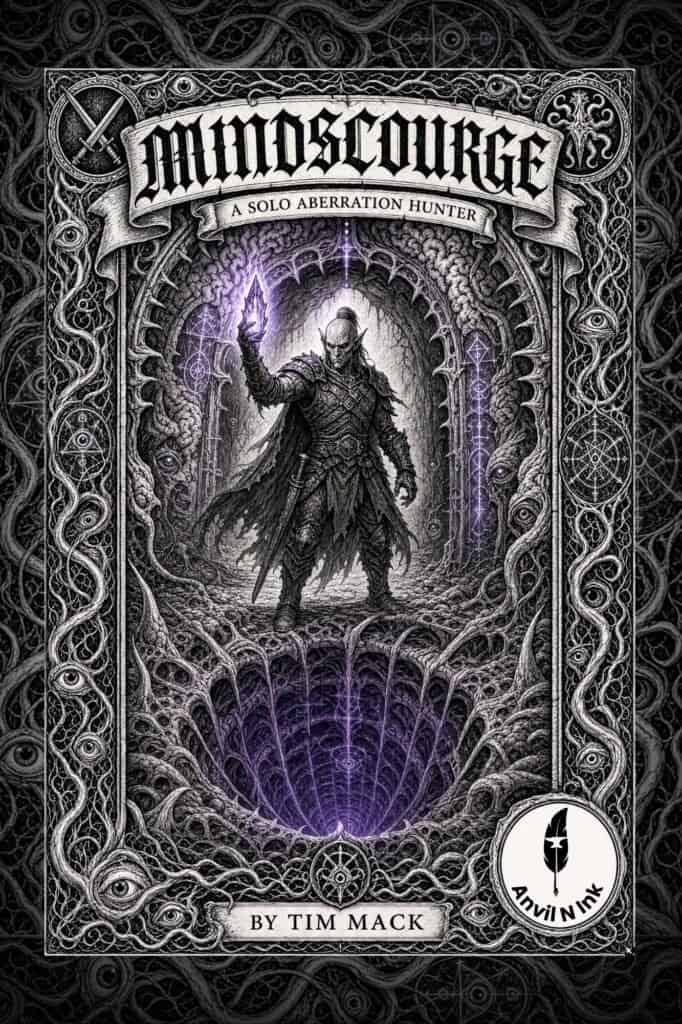

MINDSCOURGE: A Mind Flayer Solo RPG Where Losing Your Mind Is Worse Than Dying
You are githyanki. Your warband is dead. The illithids took their minds before they took their lives — and now they wait in the dark, wearing their own faces. You go down alone.
MINDSCOURGE is a mind flayer solo RPG for one player. One book, one twenty-sided die, no game master, no group, no prep. You play the last survivor of a failed githyanki raid on an illithid colony, and you descend alone through four levels of living dark to kill the elder brain dreaming at the bottom — before it finishes waking up.
If you have ever wanted to run the githyanki-versus-mind-flayer war as a game you can play by yourself on a Tuesday night, this is that game.
🧠 The Whisper Track: A Sanity System With Teeth
Every chamber you enter costs you a piece of your mind. Hit points you can heal. Sanity you cannot — not easily, not down there.
As your Sanity drains, you slide down the Whisper Track through six states: Lucid, Uneasy, Shaken, Fractured, Unraveling, and finally Broken. Each state makes the colony notice you more. Shaken adds +1 to every encounter roll. Fractured adds +2 and starts lying to you — a “safe room” might not be safe at all. Unraveling adds +3 and drops your attack rolls.
Read that again, because it is the whole game: the more your mind frays, the more monsters you meet, which drains your mind faster. It is a downward spiral with a mathematical engine underneath it, and once it starts spinning, you rarely climb out of it inside the colony.
And at zero Sanity you do not die. You kneel, you turn, and you join them — ceremorphosis by any other name. The next delver who comes down will find you waiting in the dark, wearing your own face.
That is the design thesis of this illithid dungeon crawler. Death is clean. Domination is a wound your whole bloodline carries.
👁️ Four Levels of the Colony
The colony deepens by degrees of wrongness:
- The Flesh-Gardens — warm, breathing, peristaltic. The colony’s livestock and watchdogs. Carrion crawlers, chuuls, grells, and your first spectator.
- The Memory-Warrens — crystal and stolen memory. Intellect devourers, oblex spawn, cranium rat swarms, and a mind flayer adept who reaches for your thoughts with practiced ease.
- The Void-Temples — wrong geometry, corridors that loop upward. Nothics, cloakers, umber hulks, aboleth spawn, and an arcanist whose mind blast steals your turn.
- The Cortex — folded grey matter veined with light. Ulitharids, neothelids, brain golems, beholders, and the thing at the bottom that dreams in every direction at once.
Forty aberrations across four bestiaries, every one with a full stat block.
⚔️ Build-a-Boss: 32,000 Guardians
Each level is sealed by a Guardian, and no two are ever the same. You build one with three rolls of a d20: a base aberration, a physical mutation, and a psionic power.
That is 8,000 possible bosses per level — over 32,000 across the game. One delve might hand you a massive, regenerating horror that drains a point of Sanity every single round. The next might give you an ulitharid heir that dominates your mind and makes you swing Vlaakith’s silver blade at yourself.
The genius of the system is that the Guardian’s body is rarely the problem. Its psionic power is. Learning to read that roll — and knowing which of your consumables answers it — is the skill ceiling of the entire game.
🩸 A Bloodline, Not a Hero
No single warrior conquers this place. A bloodline does.
When your delver dies, the gold and potions they carried die with them. But four things survive: cleared levels, the shard vault, your permanent armory upgrades, and the Resistance Network bonuses that make every future delver tougher.
So death is not a reset. Death is tuition. Your first delver is a lamb. Your fortieth walks into the dark carrying everything the thirty-nine before her learned — and that is the only way anyone ever reaches the bottom.
The dark mirror of this is the Curse system. When a delver’s mind breaks on level two or deeper, the colony brands the bloodline, and the next two warriors descend weakened. Progress can go backwards. That is what makes the retreat decision matter.
🏃 The Hardest Decision Is When to Climb Out
Push one more room and you might find the shard that opens the portal — or the whisper that finally learns your name. A delver who turns back banks everything she carried. A delver who dies loses all of it.
Retreat is not the failure state. Retreat is how you win the long game. New players almost always die the same way: they took one room too many. The colony is patient, and it is counting on you not to be.
🗡️ Three Githyanki Delvers, Three Ways to Fail
- The Blade of Vlaakith — the highest damage in the game, and the lowest mental defenses. He kills fast because he has to. Battle Trance lets him ignore a Guardian’s psionics for an entire fight. Glorious and brittle.
- The Astral Stalker — almost always strikes first, and once per fight simply refuses to take the worst blow, halving its damage automatically. A tactician who out-positions what he cannot out-trade.
- The Pyrrhoc Caster — slowest to kill, hardest to break. The most hit points, the most Sanity, a bonus to resist every psionic effect, and a Psionic Push that stuns a boss mid-windup. The right first character, and the one who handles the Cortex best.
🎲 Difficulty You Can Actually Tune
MINDSCOURGE ships with five difficulty modes — from a forgiving Story mode to Ironman, where your shard vault does not persist and you may not retreat once you have opened a portal.
On top of that sit nine optional challenge rules. The best is the Finite Bloodline: roll dice at the start of the campaign to determine how many warriors the Resistance has left. When they are gone, they are gone, and the colony wins. It turns a war of attrition you would eventually grind out into a genuine race you can lose.
There is also an optional two-player co-op variant, twelve named weapons, printable character and campaign sheets, and two fully worked example playthroughs rolled out die by die.
🎯 Who This Solo DnD Horror Game Is For
- Anyone who fell in love with githyanki and illithid lore and wants to play that war, not just read about it
- D&D players who love d20 math but cannot get the group together this week
- Roguelike fans who want permadeath, meta-progression, and a spiral that actually bites
- Solo players who want a real dungeon crawler — tactical, mechanical, winnable — not a journaling prompt
A single delve runs 20 to 40 minutes. A full campaign — lambs to victor — runs across many sessions.
📚 Availability
MINDSCOURGE is in final production. Paperback, Kindle, and a direct PDF edition are coming soon.
Links will be added here at launch.
MINDSCOURGE is a mind flayer solo RPG of the slow descent and the slower madness. One githyanki, one die, and four levels of dark that get louder the deeper you go. The deeper you delve, the louder they whisper — and the louder they whisper, the less of you returns.
Get Your Copy
Choose your preferred format