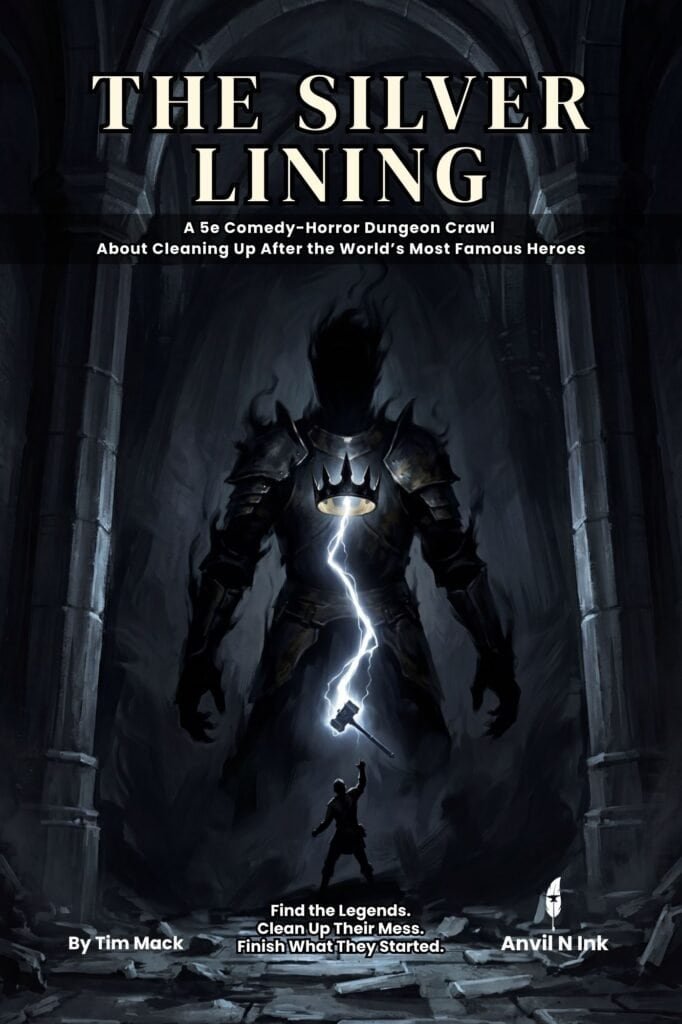

Disclosure: I wrote this adventure. What follows is a straight, honest breakdown of what works, what doesn’t, and who it’s for.
The Silver Lining is a comedy-horror one-shot for D&D 5e, built for 2–3 players at levels 2–3 and playable in a single 2–3 hour session. You play the backup party sent to rescue four famous adventurers who failed. It works best for small groups who want laughs and genuine stakes in one sitting.
I have run this adventure at the table more than a dozen times while tuning it, including a deliberately brutal worst-case run with two level-2 characters and no healer, and it held together every time. That playtesting is where the comedy-horror one-shot earned its structure: the jokes land because the danger underneath them is real.
The setup is simple and does a lot of work. The most famous party in the realm — the Silver Swords — walked into the Obsidian Spire two weeks ago and vanished, and your nobodies are hired to find them and finish the job. What you uncover, room by room, is that the legends did not lose to the dungeon. They lost to their own arrogance, and they made the place far more dangerous on the way down. You are not exploring a fresh dungeon so much as walking through a crime scene.
You can read the full A-Maze-ing Fools review and The Score review if you want to compare them in depth. All three are zero-prep and built for the same small-group sweet spot.
Running a whole spooky season?
This is one of many ready-to-run Halloween one-shots. See the full lineup sorted by theme, gothic, folk, undead, coastal, cosmic, and comedy-horror, all 5e and zero prep.
See all Halloween one-shots →What’s included in The Silver Lining?
The Silver Lining is a complete four-act adventure with everything a Game Master needs to run it cold. There is no separate prep step — the boxed read-aloud text, encounter math, and scaling notes are all in the book.- A four-act one-shot for 2–3 players, levels 2–3, in one 2–3 hour session
- Four battle maps: a full-dungeon overview plus three tactical encounter maps
- Four pre-generated level 3 characters with full two-page sheets
- Complete stat blocks for every creature, plus a one-of-a-kind boss
- A forensic investigation built on the three-clue method, so players are never stuck
- Opening hooks, a “What If?” contingency section, and sequel hooks
- Pen-and-ink interior art throughout
Who is this comedy-horror one-shot for?
This comedy-horror one-shot is for small groups who like to feel clever. The premise rewards players who read the room: the famous heroes failed because they were impatient and arrogant, and your party wins by being the opposite. It suits two-to-three-player tables especially well, since the encounters are tuned for that size rather than scaled down from a party of five. It is friendly to newer Game Masters, too. The pre-generated characters cover every role the finale asks for, and the read-aloud text and scaling notes mean you can run it without writing a word in advance. If your group only enjoys pure dungeon-bashing with no investigation or comedy, this is not the one-shot for you — the humor and the clue-reading are the point.How long does The Silver Lining take to run?
Across my playtests, The Silver Lining ran about 2 to 3 hours, with three required combat encounters spread across the four acts and a climactic ritual sequence at the end. Tables that lingered on the investigation and read every abandoned note trended toward the three-hour mark; tables that pushed straight through finished closer to two. The book includes scaling guidance for 2, 3, or 4 players, so the runtime stays stable regardless of party size. The final encounter is the one that varies most: a smart, coordinated party can resolve it quickly, while a party that improvises under pressure will stretch it into a memorable, down-to-the-wire finish.Strengths and weaknesses
The biggest strength is the tone. The comedy-horror one-shot starts as a workplace comedy about cleaning up after insufferable coworkers and turns, in its third act, into something with real weight — and the turn lands because it is earned, not announced. The finale puts the killing blow in the players’ hands, which is the moment groups remember. Honestly, it has limits. It is a guided experience, not a sandbox, so groups who want open-world freedom will feel the rails. The climax is mechanically involved — a ritual with skill checks running alongside a boss fight — which asks a little more of a brand-new Game Master than a straight combat would. And the humor depends on the GM leaning into it; play it totally straight and you lose half the charm. None of these is a flaw so much as a fit question.How The Silver Lining compares
If you are weighing it against our other one-shots, here is the honest shape of it next to two siblings in the Ready Adventure Series.| Adventure | Tone | Players | Runtime | Best for |
|---|---|---|---|---|
| The Silver Lining | Comedy-horror | 2–3 | 2–3 hrs | Clever play, big emotional finish |
| A-Maze-ing Fools | Comedy-mystery | 2–3 | 2–3 hrs | Lighthearted puzzle nights |
| The Score | Heist thriller | 2–3 | 2–3 hrs | Tense, time-pressured play |
Sample encounter
Early on, your party finds the body of the dungeon’s guardian — a colossal construct the famous heroes destroyed on the way in. It is not just slain; it is drained, with a scorched crater where someone stood too close and loosed a spell instead of reading the warning carved on the wall behind it. Two of the guardian’s lesser attendants still patrol the hall, running on their last order with no one left to command them. Here is where the design shows its hand. Each attendant has a glowing control rune on its chest. A party that slows down and investigates can shut the constructs off with a single check or a well-aimed strike, ending the fight in two clean strokes. A party that charges in swinging earns the long version. The same scene rewards looking before leaping or punishes the opposite — which is the entire thesis of the adventure, delivered as a tutorial. It is a small encounter, but it teaches the table how to read the rest of the dungeon, and it sets up the running joke that the legends triggered every hazard the hard way.Where to buy The Silver Lining
The Silver Lining is available in paperback and ebook on Amazon, and as a PDF on Payhip. Use the buttons on this page for current pricing and links. See how it ranks among the best D&D horror one-shots.Key takeaways
- A comedy-horror one-shot for D&D 5e, 2–3 players, levels 2–3, 2–3 hours.
- Zero prep: read-aloud text, four battle maps, four pre-gen characters, full stat blocks.
- Built on the three-clue method, so the investigation never dead-ends.
- Tuned for small groups, including a worst-case two-player table.
- The finale hands the killing blow to the players, not the famous NPCs.
- Best for groups who want laughs and real stakes; not for pure sandbox play.
Frequently asked questions
Can I run The Silver Lining with two players? Yes. It is balanced for three and includes scaling notes that drop encounter hit points and difficulty for a two-player table, including a tested worst-case two-player level-2 run. Do I need to prep it? No. It is a zero-prep one-shot — boxed read-aloud text, encounter math, maps, and pre-generated characters are all included. Is there a digital map pack? The book includes four battle maps as printed pages. They are designed for in-person and screen-share play. Does it require D&D Beyond or any extra purchase? No. It is 5e-compatible and self-contained; you only need the core fifth-edition rules from the System Reference Document. Is it good for new Game Masters? Yes, with one caveat: the climax is more involved than a plain combat, but the step-by-step guidance and pre-gens make it very runnable for a first-timer. Does the comedy hold up if my table plays it straight? Some of it. The forensic mystery and the finale work even played deadpan, but the adventure is funnier and lands harder if the Game Master leans into the workplace-comedy tone in the first two acts. Find the legends. Clean up their mess. Finish what they started.Get Your Copy
Choose your preferred format