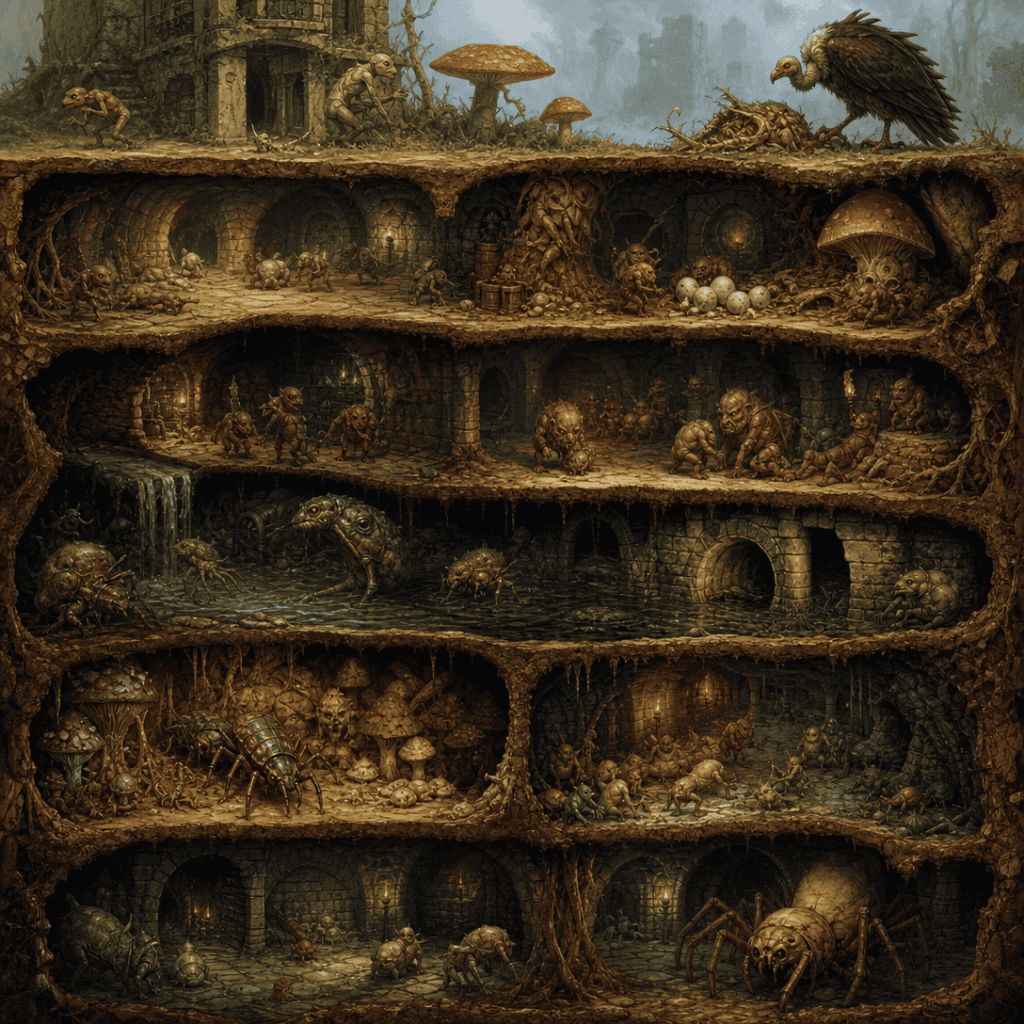

Dungeon ecology is the difference between a dungeon that feels like a video-game level and one that feels like a place. A good dungeon isn’t a random string of rooms with a monster in each — it’s a living system, where creatures eat, hunt, hide, and avoid each other, and where every door answers a quiet question: who lives here, and why? Build that logic in and players stop seeing a map. They start seeing a world.
Here’s how to use dungeon ecology to turn a flat crawl into somewhere that breathes.
What is dungeon ecology?
Dungeon ecology is the practice of treating a dungeon as a working ecosystem instead of a container for encounters. It asks the questions a real environment would have to answer: what does everything in here eat? Where does the water come from? Who’s the apex predator, and what’s smart enough to stay out of its way?
You don’t need a biology degree. You need cause and effect. Once the inhabitants relate to each other — predator and prey, rival and ally, tenant and landlord — the dungeon gains an internal logic players can feel even when they can’t name it.
Why a living dungeon plays better
A dungeon with ecology rewards thinking. Players who notice that the goblins avoid the east corridor can guess something worse lives there. Players who find gnawed bones can brace before they meet what did the gnawing. The dungeon becomes readable, and a readable dungeon is one players engage with instead of just clearing.
It also makes your job easier. When you know who eats whom, you don’t have to script every encounter — you can ask what these creatures would actually do when the party shows up, and the answers write themselves. Monsters flee, regroup, strike bargains, or turn on each other, all without a page of prep.
Start with the food chain
The fastest way into dungeon ecology is to build the food chain first. Decide what’s at the bottom — fungus, vermin, scavengers — and what sits at the top. Everything in between is defined by what it eats and what eats it.
This single decision generates content for free. A bottom feeder explains why the dungeon isn’t drowning in refuse. A mid-tier predator explains the missing bottom feeders. An apex threat explains why the mid-tier predators are nervous. Three creatures, and you already have a story about who’s afraid of whom.
The humble dungeon scavenger is the keystone here. Something has to clean up — which is exactly the role the gelatinous cube was invented to fill. Give your dungeon a janitor and the whole place suddenly makes sense.
Give every room a reason
Once the food chain exists, audit your map and ask of each space: why is this here, and why is this creature in it? A room with no answer is a room that feels fake. The answer doesn’t have to be grand — a lair, a hunting ground, a nest, a place too dangerous for anything to live — but it has to exist.
Water is the cheat code. Add a source of water and the whole map reorganizes around it: predators hunt near it, prey drinks nervously at its edges, and the driest corner becomes the safest. One pool can do more for believability than a dozen lore notes.
Let the ecology react to the party
The final step is the one that sells it: when the players disrupt the system, the system responds. Kill the apex predator and watch the prey species grow bold. Burn out the scavengers and the next room fills with the mess they used to clear. The dungeon shouldn’t sit frozen waiting to be looted — it should notice the intruders and change.
This is where a dungeon crawl stops feeling static. The party isn’t clearing rooms; they’re pulling threads in a web, and the web pulls back.
A one-shot built on dungeon ecology
If you want to see ecology drive an entire adventure rather than decorate one, Squeaky Clean is built on exactly this idea. Its dungeon depends on gentle gelatinous cubes to keep it clean — until someone starts murdering the cleanup crew, and the whole fragile system begins to rot from the absence.
The mystery only works because the ecology is real: remove one species and the consequences cascade. It’s a ready-to-run, no-prep one-shot for two to three players, and a working demonstration of how much story a dungeon’s food chain can carry.
Frequently asked questions
What does dungeon ecology mean?
It’s designing a dungeon as a functioning ecosystem — deciding what its inhabitants eat, how they relate, and why each one is where it is — rather than placing monsters at random.
Do I need to plan a whole food chain for every dungeon?
No. Even three linked creatures — a scavenger, a predator, and an apex threat — give a dungeon enough internal logic to feel alive. Scale the detail to the dungeon’s importance.
How does ecology make a dungeon more fun to play?
It makes the environment readable and reactive. Players can infer danger from clues, and their actions ripple through the system, so exploration feels like investigating a place rather than clearing a checklist.
What’s the easiest way to start?
Decide what eats what, then add a water source. The food chain explains your monsters, and the water reorganizes the map into hunting grounds, safe corners, and contested ground.
Can a dungeon’s ecology carry a whole adventure?
Yes. When the plot hinges on disrupting the system — removing a species, poisoning a source, breaking the food chain — the ecology becomes the story rather than the backdrop.
Build a dungeon that breathes
Decide what eats what, give every room a reason, add water, and let the system react. Your players will feel the difference even if they never see the work.
See it in action with Squeaky Clean:
- PDF on Payhip — instant download
- Paperback on Amazon
- Ebook on Amazon