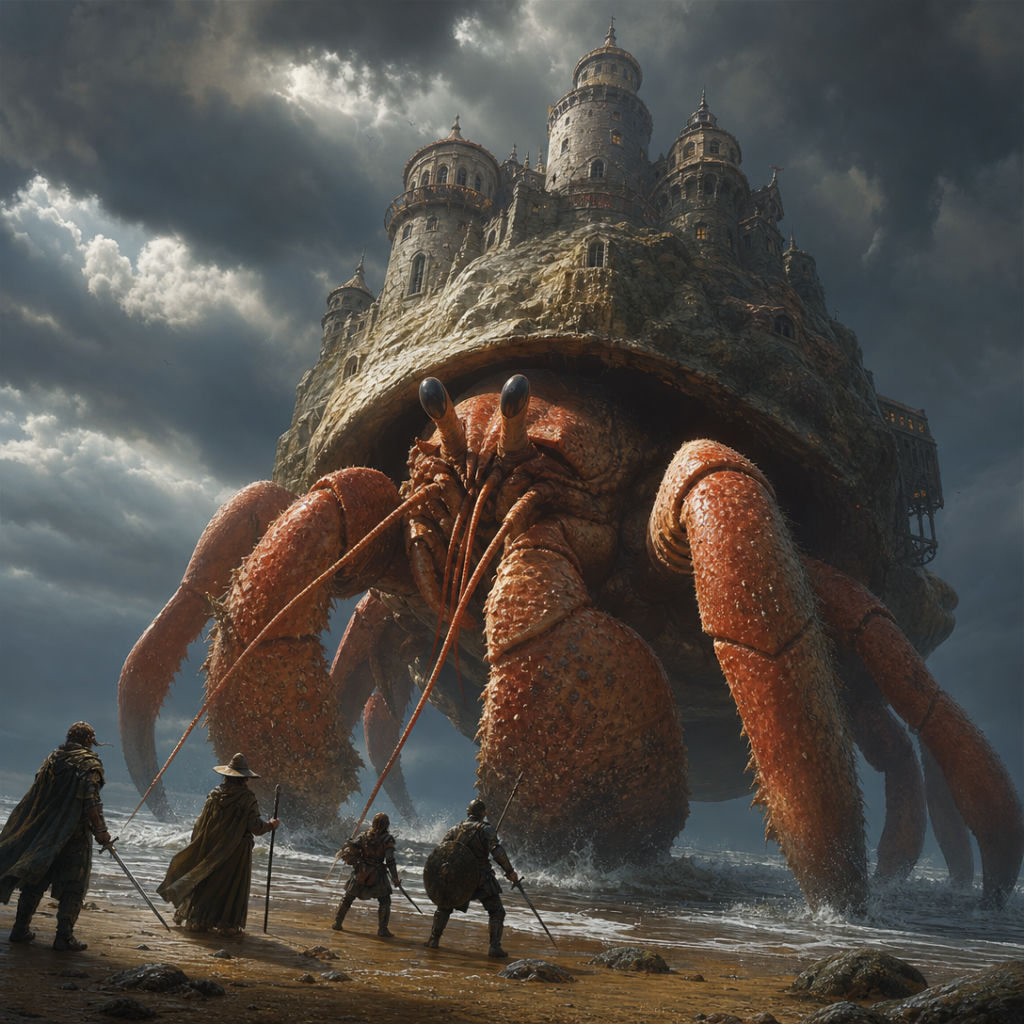

Running a kaiju in 5e — a monster so large it dwarfs the dungeon itself — looks impossible on paper. The action economy collapses, a single attack could erase a low-level party, and the usual “everyone surrounds it and swings” doesn’t work when the target is the size of a cathedral. But handled right, a giant-monster encounter becomes the most memorable session your table will play all year. The trick is to stop running it like a big monster and start running it like a place.
Here’s how to run a kaiju in 5e that’s spectacular, survivable, and unforgettable.
The core problem with giant monsters
A straight fight against a kaiju breaks the math of the game. One creature versus four heroes already strains the action economy, and when that one creature can flatten a character in a single blow, the encounter turns into a coin flip with no counterplay. Players feel helpless, not heroic.
So don’t run it as a slugging match. A kaiju isn’t a bigger ogre — it’s a moving environment, a disaster with a heartbeat. Reframe the whole encounter around that and the problems solve themselves.
Turn the monster into a dungeon
The cleanest way to run a kaiju in 5e is to make it the dungeon. The party doesn’t stand in front of it trading blows — they climb it, enter it, and move through it toward a goal. Its hide becomes terrain. Its wounds become entrances. Its body becomes a series of rooms with their own hazards.
This fixes everything at once. The action economy resets, because the party is navigating obstacles rather than soaking attacks from a creature with ten times their hit points. And it’s far more cinematic — scaling a living mountain beats poking its ankle from the ground every single time.
Give it weak points, not a health bar
A kaiju with a normal hit-point total is either a pushover or an unkillable wall, with very little in between. Skip the war of attrition. Instead, give it objectives — weak points, organs, anchors, a creature driving it from within — that the party has to reach and disable in sequence.
Now the encounter is a series of solvable problems instead of one impossible one. Each weak point is a set-piece with its own challenge, and progress is something the players can see and feel as they work their way toward the thing that finally brings the giant down.
Telegraph everything
A creature this size should never surprise the party with a kill. Its attacks are slow, vast, and visible coming — a shadow falling across the deck, a limb rising overhead, the ground tilting before it slams. Telegraph each one and give players a clear chance to react.
This keeps the encounter fair while preserving the terror. The dread of a kaiju isn’t a surprise hit; it’s watching the blow wind up and scrambling to get clear in time. Make the danger legible and your players will feel the scale without dying to it randomly.
Sell the scale
The whole appeal of a kaiju is bigness, so spend your descriptions there. Compare it to buildings and hills, not to other monsters. Show its effect on the world — waves thrown from each step, structures groaning, birds scattering, the sheer noise of it. The players should feel small, and that smallness is the point.
One enormous creature, described relentlessly at scale, will outlast a dozen ordinary fights in your players’ memory. Don’t undersell it. A kaiju earns the purple prose.
The coast is its natural home
A monster this large needs somewhere big enough to have hidden it, which is why the sea is the classic origin — a giant rises from the deep and comes ashore against a town too small to resist. The setting and the scale reinforce each other; for the surrounding toolkit, see our guide to coastal D&D one-shots.
A kaiju one-shot you can run tonight
For a worked example, The Gullet of Graw builds an entire adventure around exactly these techniques. The “castle” grinding toward the coast wasn’t built — it was grown: a hermit crab the size of a cathedral, wearing an old shipwreck and two centuries of shell. The party goes inside to find and stop whatever drives it, treating the living giant as the dungeon itself.
It’s a no-prep one-shot for two to three players that turns a kaiju into a place to explore rather than a wall to fail against. If you want the giant-monster session without engineering it from scratch, it’s built and ready.
Frequently asked questions
How do you run a kaiju in 5e without killing the party?
Don’t run it as a stand-up fight. Treat it as terrain to traverse and a set of weak points to disable, and telegraph its slow, massive attacks so players always have a chance to react.
Should a kaiju have a normal stat block?
Not really. A standard hit-point pool makes it either trivial or unbeatable. Replace the health bar with objectives — vulnerable points or an internal driver the party must reach and disable.
Why turn the monster into a dungeon?
Because it fixes the action economy and the spectacle at once. Climbing and moving through a giant creature gives the party solvable problems and a far more cinematic encounter than swinging at its feet.
How do I make a giant monster feel huge?
Describe it against the environment — buildings, hills, the sea — and show its effects: shockwaves, collapsing structures, scattering wildlife. Compare it to places, not to other monsters.
What level should a kaiju encounter be for?
Any level, if you build it as terrain and objectives rather than raw damage. Even a low-level party can take on a kaiju when the challenge is navigation and disabling weak points instead of trading hit points.
Run the giant
Make the monster a place, give it weak points, telegraph every blow, and never stop selling the scale.
Want a kaiju one-shot ready to run? Get The Gullet of Graw:
- PDF on Payhip — instant download
- Paperback on Amazon
- Ebook on Amazon