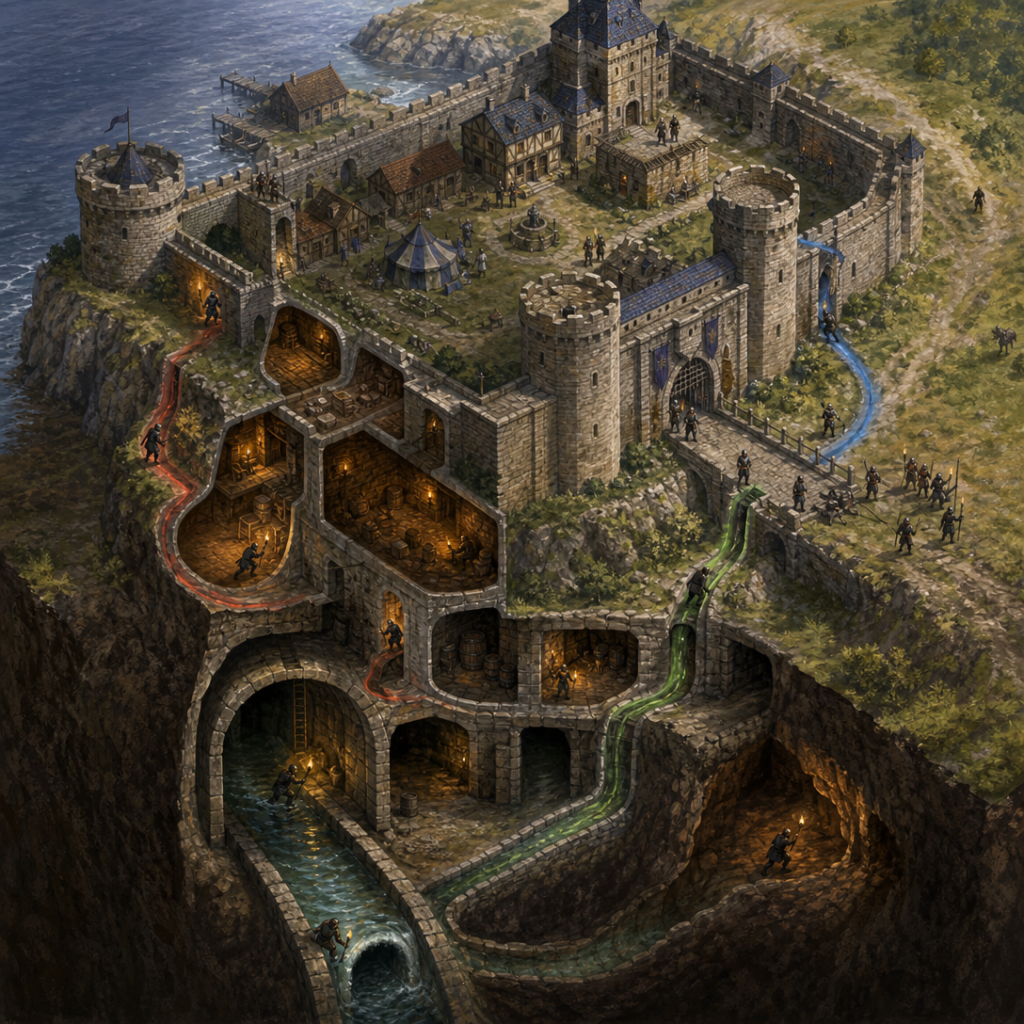

A fortress assault is the encounter players brag about for years and Game Masters dread for exactly one reason: a fortress is built to be unbeatable, and your party is four people. Walls, gates, garrisons, murder holes, alarm bells — a well-designed stronghold is a problem with no obvious solution, which is precisely what makes cracking one so satisfying. The trick is to stop running it as one giant fight and start running it as a puzzle with many doors.
Here’s how to run a fortress assault or infiltration that gives your players a fortress worth beating.
Build the fortress as a problem, not a level
Before anything else, design the stronghold as an obstacle with real defenses: where are the walls weakest, where do patrols overlap, what raises the alarm, who’s in command, and what do they do when they realize they’re under attack? You’re not laying out a sequence of rooms — you’re building a fortified problem for the players to solve from the outside in.
This matters because a fortress assault lives or dies on whether the defenses feel real. If the walls are just scenery, the encounter is a corridor crawl with extra steps. If the walls are a genuine obstacle the players have to think their way past, you’ve got a heist, a battle, and a dungeon rolled into one.
Stealth or storm: let them choose
The first big decision is the party’s, not yours. Do they go over the wall quietly, or through the gate loudly? An infiltration rewards planning, patience, and clever use of disguise and distraction. A storm rewards speed and force, betting that they can punch through before the garrison fully musters. Both should be viable.
The best fortress assaults let the party commit to one approach and then improvise when it inevitably breaks. A stealth plan that collapses halfway becomes a desperate fighting retreat; a frontal assault that stalls forces a scramble for another way in. Don’t punish them for the shift — that pivot is the most exciting part of the night.
The alarm is your best tool
A fortress assault needs a rising-tension mechanic, and the alarm is it. Track how alert the garrison is. Early on, the party moves against a sleeping stronghold. Each mistake — a downed guard found, a forced door, a missed save — ratchets the alert level up, and the fortress wakes around them.
This gives the players a meter they can feel and manage. Do they take the slow, quiet route and keep the alarm low, or move fast and accept that the place will be fully roused by the time they reach the objective? An escalating alarm turns the whole assault into a clock, and clocks make players sweat.
Layer the defenses
A real fortress doesn’t have one wall; it has rings. The outer wall, the courtyard, the inner keep, the final chamber — each is a distinct problem with its own guards, hazards, and ways through. Layering the defenses gives the assault a sense of progress and lets you escalate the danger as the party drives deeper.
It also rewards different skills at different depths. The outer wall might be a climb or a bluff past the gate; the courtyard a stealth-and-patrol problem; the keep a straight fight; the final room a confrontation with whoever runs the place. Variety across the layers keeps every member of the party useful.
Give the garrison a brain
The defenders should respond like people protecting their home. When the alarm rises, they don’t wait in their assigned rooms — they reinforce the breach, raise the drawbridge, move the prisoner, light the signal fire, send for help. A fortress that reacts feels alive and dangerous in a way a static one never will.
Historically, the most famous example of a stronghold falling is the storming of the Bastille — and part of what made it dramatic was a defending garrison making choices under pressure. Give yours the same agency and the assault becomes a contest of wits, not a checklist.
A fortress one-shot you can run tonight
For a complete fortress assault built around all of this, Storm the Bastille hands the party an impregnable black fortress, a starving city at its gates, and one job: breach the walls and free the realm’s most beloved prisoner before the tyrant can silence him. Infiltrate, storm, or raise the mob — the fortress is built to be cracked more than one way.
It’s a no-prep one-shot for two to three players and a worked example of a stronghold designed as a solvable problem rather than a wall of hit points. If you want the story side of breaking in — making the captive matter, running the escape — see our guide to D&D rescue missions. For the infiltration and planning side, our D&D heist adventure guide covers the full framework.
Frequently asked questions
How do you run a fortress assault in D&D?
Design the stronghold as a layered problem with real defenses, let the party choose stealth or force, and track a rising alarm. Run the garrison as people who react, and the assault becomes a puzzle rather than one massive fight.
Should players sneak in or attack directly?
Both should be options. Infiltration rewards planning and patience; storming rewards speed and force. The most memorable runs let the party pick an approach and improvise when it falls apart.
How do I make a fortress feel dangerous without a TPK?
Use an alarm meter instead of overwhelming numbers. Let the garrison wake gradually so the party can manage the threat through smart play, rather than facing the whole force at once.
What makes a fortress assault different from a dungeon crawl?
The party approaches from the outside against active, reacting defenders, and the layout is a defensive system rather than a sequence of rooms. Choice of entry and a responsive garrison are what set it apart.
How long should a fortress assault take?
It fits a single session if you keep the layers tight — a few defensive rings building to the objective. Scale the number of layers to the time you have.
Crack the walls
Build a real defensive problem, let the party choose their way in, track the alarm, and give the garrison the wits to fight back.
Want a fortress assault ready to run? Get Storm the Bastille:
- PDF on Payhip — instant download
- Paperback & Ebook on Amazon