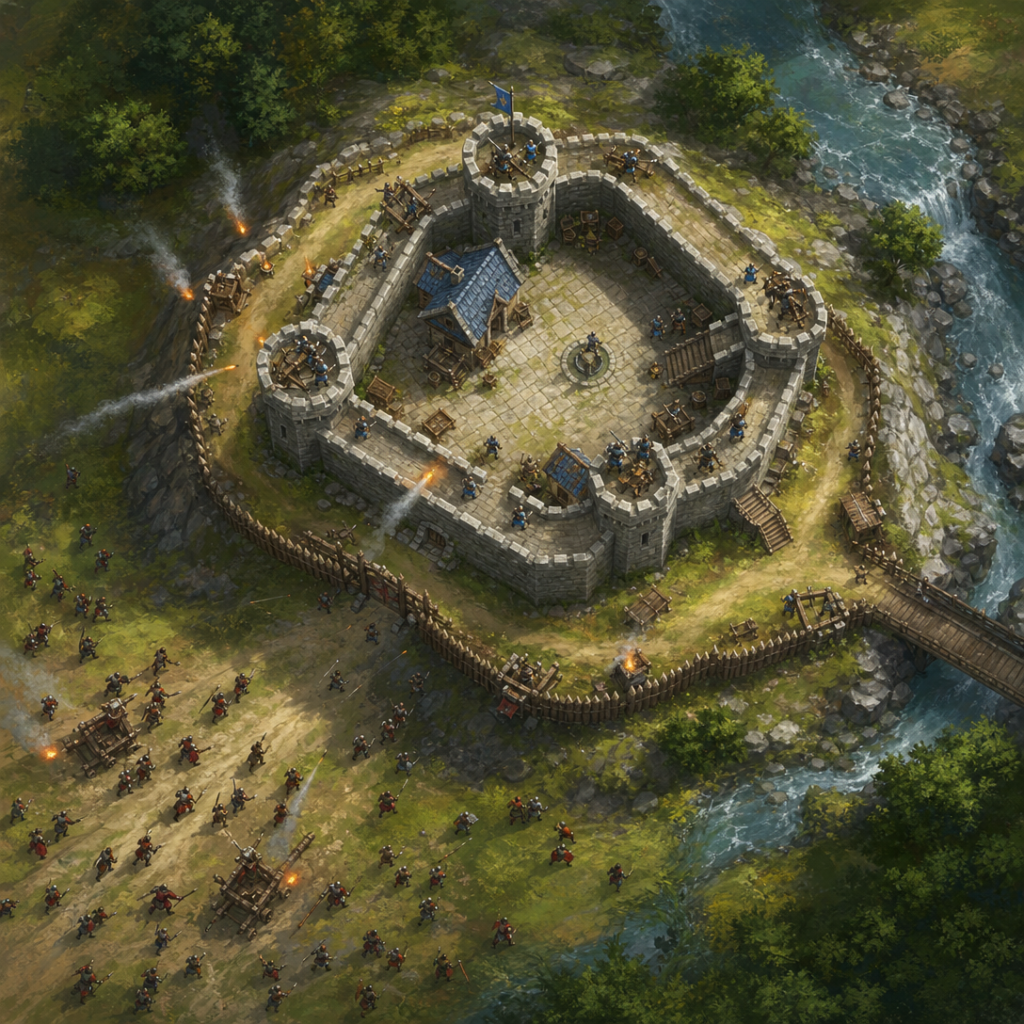

A siege encounter flips the usual shape of a D&D fight. Instead of the party advancing room by room, they dig in and hold while something larger comes to them — wave after wave against walls that won’t hold forever. Done right, a siege is one of the most dramatic things you can put on the table: a test of nerve and resources where the question isn’t “can we win this fight” but “can we last long enough.” Done wrong, it’s a slog of identical combats. The difference is all in the structure.
Here’s how to run a siege encounter that builds genuine tension instead of grinding the party down.
What a siege encounter actually is
A siege is a defense against attrition. The party holds a position — a keep, a cottage, a bridge, a circle of wagons — against a force too large to defeat outright, and victory means enduring rather than winning. The clock, not the enemy’s hit points, is what they’re really fighting.
That reframing matters. The moment players understand they can’t kill their way out, they start thinking like defenders: rationing, fortifying, choosing which side to reinforce. A siege encounter is at its best when it’s a resource puzzle wearing the costume of a battle.
Waves, not a wall of enemies
Never throw the whole attacking force at the party at once — it’s lethal, it’s unmanageable, and it ends the drama in one round. Break the assault into waves with breathing room between them. Each wave tests the defense; each lull lets the party react before the next.
This also solves the action-economy problem that makes mass combat so swingy. A handful of attackers per wave keeps the fight readable and survivable, while the steady return of the horde keeps the dread alive. The party never feels safe, but they’re never simply overrun either.
Resources and attrition
The heart of a siege encounter is the slow drain. Track what runs down — ammunition, spell slots, the integrity of the barricade, hit points nobody can recover mid-night — and surface those numbers to the players. When they can see the meter falling, every shot fired and every spell spent becomes a decision with weight.
Attrition is what turns a defense into horror. A trivial enemy in the first wave becomes a real threat in the fifth, not because it got stronger, but because the party got poorer. Let them feel that arc.
Give players defensive choices
A siege should be a series of decisions, not just a series of fights. Between waves, offer real options: fortify a weak point, ration the last potions, send someone on a dangerous run for supplies, sally out to disrupt the next assault, or hunker down and weather it. None should be obviously correct.
These choices are where the players’ fingerprints end up on the story. The keep they defended is their keep precisely because they chose how to hold it — which wall they sacrificed, which risk they took, what they spent to buy one more hour.
Protect the objective, and allow failure
The strongest sieges have something fragile at the center — a person who can’t fight, a ritual that can’t stop, a fire that can’t go out. The defense isn’t about the party’s survival alone; it’s about keeping that one thing intact while the world tries to take it.
And the threat of partial failure should be real. A wall can fall without the night being lost. An ally can be hurt, a resource burned, ground given up. A siege where losing something is possible is far tenser than one where the party either holds perfectly or dies — most sieges in history were won ugly, and yours should allow for that too.
The attacker’s side of the wall
Every siege has two sides, and the assault is its own kind of encounter — breaching defenses, picking between stealth and storm, racing the garrison. If you’d rather run the party as the ones breaking in, the techniques flip; see our guide to D&D rescue missions for storming a fortified position instead of holding one.
A siege one-shot you can run tonight
For a complete siege built around a single fragile objective, Dead of Night drops the party into a keep they have to hold for four nights while a priest performs an unbroken ritual to save a cursed child. He can’t fight and he can’t stop chanting — so the holding, wave after wave in the dark, is entirely on the party.
It’s a no-prep one-shot for two to three players and a working model of everything above: waves, attrition, defensive choices, and a center that must not fall. If you want to learn siege pacing by running one, it’s already assembled. (For the survival-horror flavor of the same scenario, see running a zombie one-shot.)
Frequently asked questions
What is a siege encounter in D&D?
It’s a defensive scenario where the party holds a position against a larger force and wins by enduring rather than defeating the enemy. The real opponent is the clock and the steady drain of resources.
How do I keep a siege from being a boring grind?
Run it as waves with lulls between, track dwindling resources, and offer meaningful decisions between assaults. The downtime choices and the rising attrition are what create drama.
How many enemies should each wave have?
Few enough to stay readable and survivable — a handful at a time rather than the whole force. The horde’s threat comes from its persistence across waves, not from overwhelming numbers in any single round.
What makes a siege feel high-stakes?
A fragile objective at the center that the party must protect, and the genuine possibility of partial failure. If something can be lost without the whole night ending, every wave carries weight.
Can a siege work for a small group?
Yes. Scale the waves to the party size and lean on resource pressure rather than enemy numbers. A two-to-three-player table can hold a position beautifully when the challenge is endurance, not body count.
Hold the wall
Run it in waves, drain the resources, offer real choices between assaults, and put something fragile at the center worth bleeding for.
Want a siege one-shot ready to run? Get Dead of Night:
- PDF on Payhip — instant download
- Paperback on Amazon
- Ebook on Amazon