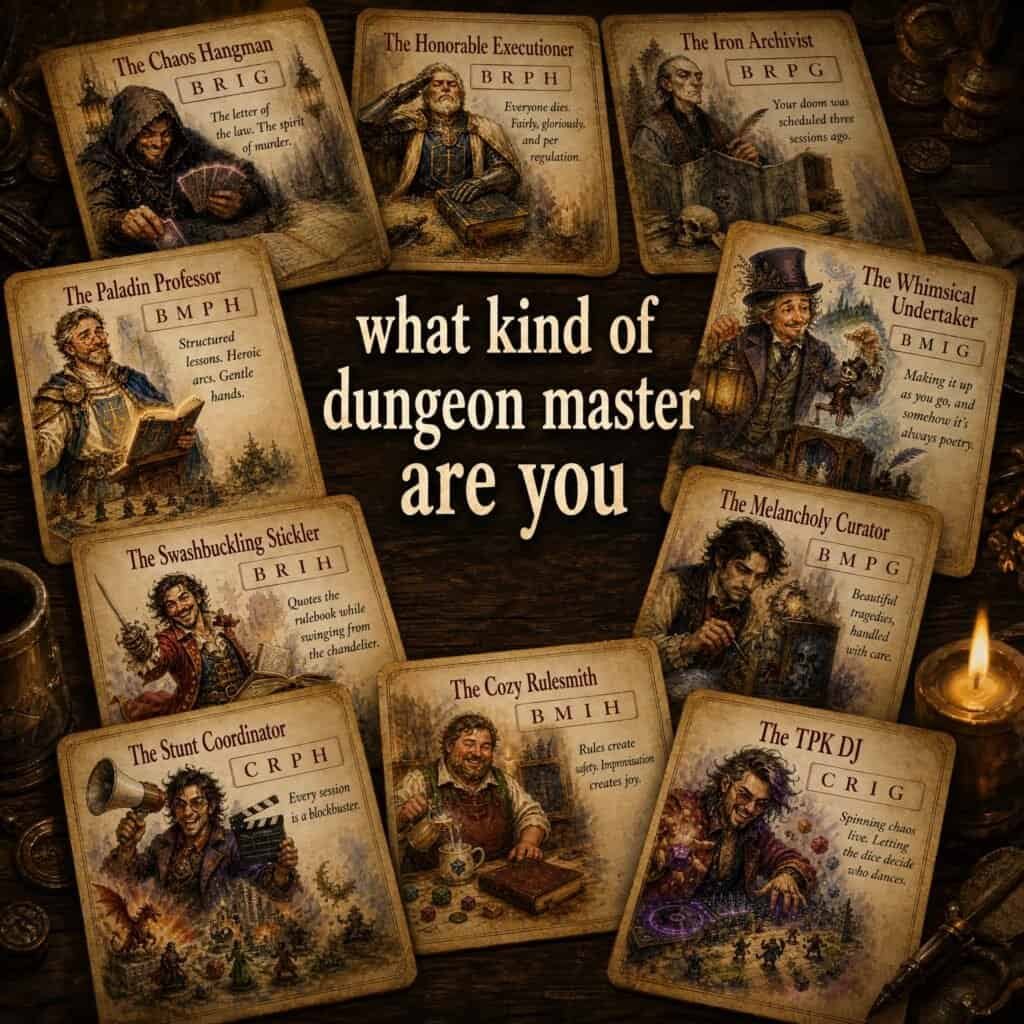

Every corner of the internet has a personality test. You have been sorted into a Hogwarts house, flattened into four Myers-Briggs letters, and told which Star Wars character you are at 1 a.m. more than once. But nobody had built the one that actually matters at our table: what kind of Dungeon Master are you — and what kind of player?
So we made it. What Kind of Dungeon Master Are You? is a free personality test for the whole table — one part 16Personalities, one part tavern brawl. Answer a handful of very-real table situations and it hands you a named archetype, a four-letter code, a breakdown of your style, and — the fun part — the people on the other side of the screen you would click with (and the one you would gloriously combust with).
Where it came from
Every zero-prep one-shot we publish is built on the same design language, a house style sheet we argue about constantly: how far do the rules bend, how merciful is the dice, how much is plotted versus invented on the spot, and what does the whole thing feel like. One night we realized that same style sheet describes Dungeon Masters just as well as it describes adventures. Turn it into questions and you have a mirror for the person behind the screen. That is the test.
Two tests, two sides of the screen
There are really two tests in one. Sit on the DM side and you will answer about how you run a table. Sit on the player side and you will answer about how you actually play. Each side has sixteen named archetypes — thirty-two in all — so whichever chair you live in, there is a fate with your name on it. You can take a quick twelve-question version for a fast read, or the honest twenty-question deep dive for a sharper one.
What the four letters mean
Your result is a four-letter code, one letter per style axis. For Dungeon Masters, the four axes are:
- The Rules — By the Book (B) vs. Cool Trumps Rules (C). Do you pause to consult the sacred texts, or does the load-bearing chandelier simply become canon?
- The Body Count — Ruthless (R) vs. Merciful (M). Are consequences consequences, or does a mysterious rescuer always happen to be nearby?
- The Prep — Plotted (P) vs. Improvised (I). Six color-coded hours of prep, or three bullet points and a dream?
- The Vibe — Grim & Gritty (G) vs. Bright & Heroic (H). Ash falling like gray snow, or dramatic sunsets and warm tavern hearthlight?
Put them together and you get codes like BRPG — the by-the-book, ruthless, plotted, grim Iron Archivist — all the way to CMIH, pure chaotic kindness, better known as the Yes-And Fairy.
The player side mirrors it, measuring what players actually do at the table:
- The Spotlight — Main Character (S) vs. Party Wingmate (W).
- The Approach — Tactician (T) vs. Pure Instinct (I).
- The Focus — Combat First (F) vs. Story First (R).
- The Rulebook — Letter of the Law (L) vs. Rules Schmules (V).
From the Min-Maxed Protagonist to the Golden Retriever, the sixteen player types cover everyone who has ever sat down with a character sheet and a snack.
You get an archetype, not a grade
No result is an insult. Every type is a real person you have gamed with — the Melancholy Curator who tucks players into beautiful, doomed worlds; the Murderhobo who sees a village and thinks “experience points”; the Party Heart who holds the whole thing together with snacks and strategically timed healing. You get a portrait, a tagline, and a breakdown of exactly how you like to play. The tone is affectionate roast: every answer is a little too relatable, and the “worst” result is just the session everyone tells stories about for years.
The best part: who you would click with
Because each DM axis has a natural counterpart on the player side, the test does not just name you — it tells you who you would thrive with across the screen. Every result lists your Soulmate (a perfect four-out-of-four match), your Great Matches, and your Beautiful Disaster: the pairing that would drive you both gently insane and make the best story of the campaign. Send your result to your DM, or to your players, and find out whether your table is a match made in the outer planes or a beautiful disaster waiting to happen.
Why we think it matters
Underneath the jokes, there is a real reason this exists. Most table friction is not about skill — it is about mismatched expectations. A grim, by-the-book DM and a rules-schmules door-kicker can have a wonderful time or a miserable one depending entirely on whether they talked about it first. A test like this is a painless session-zero conversation in disguise: it gets everyone naming how they like to play, laughing about it, and finding the people who would love their table. And yes — it is also just a genuinely fun thing to pass around your group at 1 a.m.
It is free, there is no login, and it takes two to five minutes. Whichever side of the screen you sit on, we think you will recognize yourself immediately.
Find your type
Take the test → and discover what kind of Dungeon Master (or player) you really are — then send it to your table and see who you would click with.