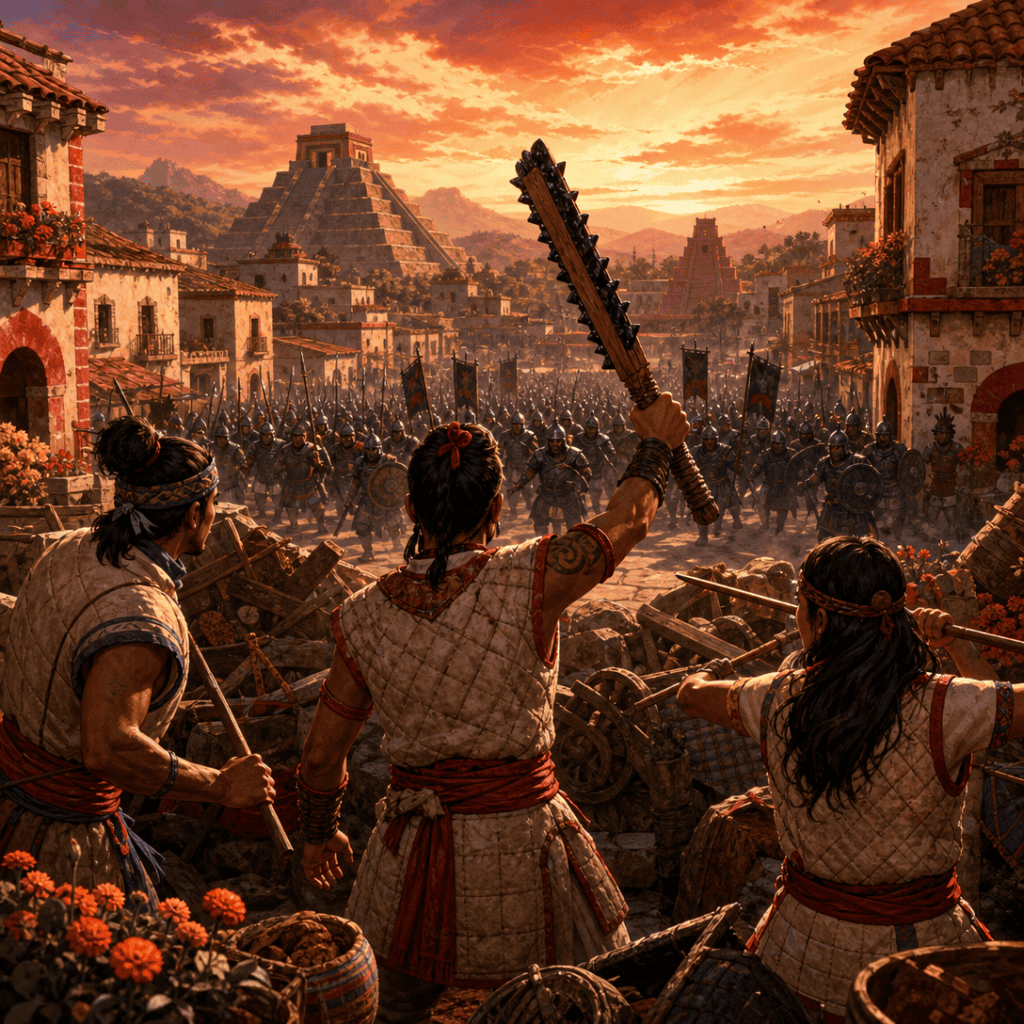

A D&D Cinco de Mayo one-shot, done right, isn’t a generic fiesta-themed dungeon crawl. The holiday has real historical roots — the Battle of Puebla, May 5, 1862, where a smaller Mexican force defeated the French Empire — and the themes that emerge from that history (community defense, underdog victory, regional pride) translate directly into D&D adventure design. This guide covers what Cinco de Mayo actually commemorates, three thematic angles that fit a one-shot, optional Mesoamerican setting elements, and the published one-shot built around the holiday.
What Cinco de Mayo Actually Is
A common misconception, especially in the US: Cinco de Mayo is not Mexican Independence Day. (That’s September 16, the Grito de Dolores.) Cinco de Mayo commemorates the Mexican Army’s victory at the Battle of Puebla on May 5, 1862, when a vastly outnumbered Mexican force defeated the French Empire’s invasion army.
The holiday is observed primarily in the state of Puebla in Mexico. Most of Mexico doesn’t mark the day. In the United States, Cinco de Mayo has become a much larger commercial event — often disconnected from its historical meaning — and that disconnect is something to be conscious of when running an adventure based on the holiday.
For a D&D one-shot, the holiday’s actual roots offer better material than the commercialized version. Underdog defense. Outnumbered defenders winning against a larger force. Regional pride. Community standing together. These are themes D&D handles well.
Three Thematic Angles for a Cinco de Mayo D&D One-Shot
1. The Outnumbered Defense
The closest direct analog to the Battle of Puebla. A small community — village, town, frontier outpost — is about to be attacked by a vastly larger force. The party isn’t there to save the world; they’re there to help the locals hold ground long enough for the larger force to give up, retreat, or be turned back. Tactical combat, terrain advantage, community stakes.
2. The Liberation Run
A region under occupation by an outside power. The party’s job is to coordinate with local resistance, sabotage the occupation force’s supplies, and create the opening for a larger uprising. This works especially well for groups that like asymmetric, espionage-style missions over straight combat.
3. The Festival Under Threat
The community’s annual celebration is also their moment of strategic vulnerability — everyone is gathered, everyone is celebrating, and the enemy knows it. The party is hired to keep the festival safe without ruining it, balancing protection with the community’s right to celebrate. This format lets the holiday’s atmosphere serve the adventure rather than just decorate it.
Optional Mesoamerican Setting Elements
If you want to lean into the Mesoamerican aesthetic — pre-Columbian Mexican culture rather than 19th-century Mexican-style settings — these elements work well as a setting layer. Use them with care. They’re not interchangeable, and they belong to living cultures.
Architecture. Stepped pyramids and ball courts instead of European castles and dungeons. Plazas open to the sky rather than narrow streets. Carved relief panels with detailed iconography.
Materials. Obsidian weapons (sharp as a razor, brittle on impact). Pyrite mirrors instead of glass. Jade as the high-value material, not gold. Cacao as ceremonial currency.
Books. Codices — folded screen books — instead of bound volumes. Pictographic and logographic writing rather than alphabetic. A spell scroll might be a folded screen, not a parchment roll.
Magic frameworks. Solar and lunar magic with strong deity associations. Calendrical magic (the 260-day ritual calendar pairs interestingly with class features). Bloodletting as a ritual sacrifice element — handle with care; this is where most D&D Mesoamerican settings have historically failed.
Combat units. Jaguar and eagle warrior orders. Atlatl spear-throwers. Cotton-armor-clad infantry. Different equipment and tactical assumptions than the Western European default.
If you go this route, do the reading. The Maya, Mexica (Aztec), Zapotec, Olmec, and other Mesoamerican civilizations were distinct cultures with distinct practices — they’re not interchangeable, and treating them as a single “Mesoamerican aesthetic” flattens real history.
Cultural Sensitivity Considerations
A few things to keep in mind:
Cinco de Mayo is Mexican, not Spanish. The names, language, and aesthetic elements should reflect Mexican (and ideally Pueblan or Mesoamerican) culture, not generic “Hispanic” or Spanish-Iberian elements. Spain was the colonial power that Mexico fought to be free of; conflating them flattens the holiday’s meaning.
Avoid the party-day caricature. Sombreros, mustaches, tequila as a plot device, and “fiesta” framing reduce the holiday to its commercialized US version. The actual holiday is about a military victory and community resilience. Build adventures around that, not around the party.
Get a sensitivity reader if possible. If you’re not from a Mexican or Mexican-American background, ask someone who is to read your draft. This is especially important for any adventure that touches Mesoamerican religious or ritual content.
Skip the stereotypes. No bandidos. No drug-cartel analogs. No “primitive” framing of pre-Columbian cultures (which were highly sophisticated). The Mexican-inspired adventure should treat its source material with the same respect you’d give a Norse-inspired or Celtic-inspired one.
Published D&D Cinco de Mayo One-Shots
Hold the Fifth is Anvil N Ink’s published Cinco de Mayo one-shot. It draws on the Battle of Puebla’s themes — community defense against an outside force — with Mexican-inspired setting elements rather than Spanish-colonial ones. Two hours, 2-3 players, level 2-3, structured around a small community holding ground against a larger force.
For other seasonal one-shots in the catalog, see D&D Holiday One-Shot Ideas. For the broader pillar, see the 4th of July one-shot pillar, which covers small-community defense from a different historical angle.
Frequently Asked Questions
Is Cinco de Mayo Mexican Independence Day?
No. Mexican Independence Day is September 16 (the Grito de Dolores). Cinco de Mayo commemorates the Mexican Army’s 1862 victory over the French at the Battle of Puebla. The two are often confused in the US.
What level should a Cinco de Mayo D&D one-shot be?
Levels 2-3 work well. The community-defense theme reads naturally for low-to-mid level parties — they’re competent enough to make a difference but not powerful enough to single-handedly resolve a military conflict. Higher levels turn the genre into a mass-combat session, which is a different format.
Can a Cinco de Mayo one-shot be set in a non-Mesoamerican fantasy setting?
Yes, if you keep the themes (community defense, outnumbered defenders, regional pride) and don’t pretend the cultural surface elements transfer cleanly. A small port town in a generic fantasy setting holding off an imperial invasion fleet is thematically a Cinco de Mayo adventure even without explicitly Mexican imagery.
How long should a Cinco de Mayo D&D session run?
Two to two-and-a-half hours. The community-defense format works as a tight three-act structure: arrival and assessment, the defense itself, the aftermath. Longer sessions risk losing the urgency.
Where can I find a published Cinco de Mayo D&D one-shot?
Hold the Fifth is Anvil N Ink’s Cinco de Mayo D&D one-shot. Two hours, 2-3 players, level 2-3, built around community defense rather than fiesta aesthetics.
Run a Cinco de Mayo Session This Month
The Battle of Puebla’s themes — small forces defending their community against larger ones, surprise victory, regional pride — translate directly into D&D one-shot design. Skip the commercial-holiday surface, lean into the historical roots, and treat the cultural source material with the care any other historically-grounded setting deserves.
Read the full review of Hold the Fifth — Anvil N Ink’s Cinco de Mayo D&D one-shot for 2-3 players. Two hours, level 2-3, structured around community defense.
For other seasonal one-shots, see the D&D Holiday One-Shot Ideas hub. For the related Independence Day pillar covering similar community-defense themes, see D&D 4th of July One-Shot.
The defenders were outnumbered. They held anyway. That’s the holiday.