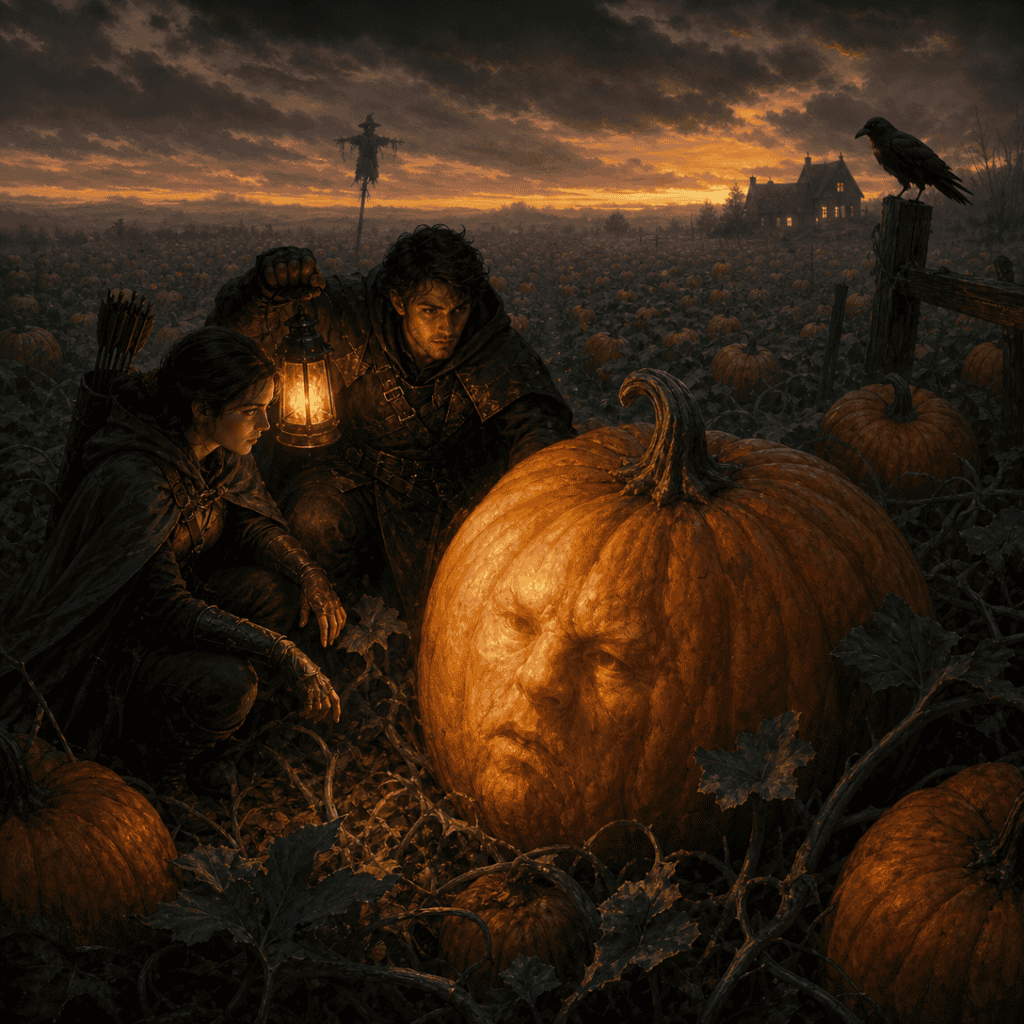

A D&D pumpkin patch horror one-shot is the format where folk horror meets the most familiar autumn setting in the world. The pumpkin patch is mundane — until it isn’t. The crop is wrong this year. The faces on the gourds are too detailed. The patch is producing pumpkins where none were planted. This guide covers why pumpkin patches work as horror settings, three opening hooks, how to design the patch itself, and the published Great Pumpkin one-shot built around the format.
Why Pumpkin Patches Work as Horror Settings
Folk horror’s central trick is making the familiar uncanny. A haunted castle is haunted from the start; the dread is announced before the players arrive. A pumpkin patch is a working farm. The party has been to one. They know what one is supposed to look like. When something is wrong, they notice — without having to be told.
This is exactly why the setting works. The horror gradient is steep: the party walks into a normal place and slowly realizes it’s not normal. By the time they want to leave, they’ve already invested in trying to understand what’s happening.
The setting is also self-contained. A pumpkin patch is bounded — fences, edges of fields, the farmhouse at one corner. The party can’t simply walk away. The patch has an inside and an outside, and the party is on the inside.
For 2-3 player tables, the constraint is a feature. Three players in a single field, walking the rows, finding the wrong gourd, hearing the wrong sound — the small party intensifies the isolation.
Three Opening Hooks for a Pumpkin Patch One-Shot
1. Hired for the Harvest
The party is hired (cheaply, suspiciously) to help with the season’s harvest. The farmer needs hands. The pay is adequate. The job seems straightforward. By the second day, things are wrong. This setup gives the party a reason to be in the patch, a reason to stay, and an NPC employer to investigate.
2. Lost in the Field
The party is traveling and gets lost during a storm. They take shelter at the only farm in sight. The farmer welcomes them. The barn is warm. Dinner is generous. By morning, the party realizes they can’t find the road back. The fields go on too long. This setup leans into the disorientation horror that pumpkin patches handle well.
3. Investigating a Disappearance
A traveler — or a child, or a friend of the party — went missing in the area. The last person to see them was the farmer at the pumpkin patch. The party arrives to ask questions. The farmer is helpful. Too helpful. This setup gives the session a clear investigative spine and an obvious antagonist from the start.
Designing the Patch Itself
A pumpkin patch for a horror one-shot needs four to six distinct zones:
The farmhouse. The social space. NPCs, dinner, conversation. Where most of the lying happens.
The barn. Tools, animals, the practical work of the farm. Often the first place where something is wrong but easy to dismiss.
The patch proper. Acres of pumpkins in rows. The largest space and the most disorienting.
The edge of the patch. Where the cultivated field meets the wild — a stand of trees, a stream, a fence line. Often where the horror leaks in.
The wrong row. A specific section of the patch where things are markedly worse. The party finds this in the second hour.
The center. The thing the wrong row points to. Whatever is causing the haunting, it’s here. The session’s climax happens at this location.
The Thing in the Patch
What’s actually wrong? Three options work for a folk-horror one-shot:
The pumpkins are alive. The fruit itself is the threat. Pumpkins move when no one is looking. Pumpkins watch. Pumpkins remember. The “monster” is the crop — and there’s a lot of it.
The pumpkins are containers. Each one holds something. Most are empty. Some hold fragments of memory, or souls, or pieces of an older being. The party doesn’t know which is which until they cut one open.
The patch is a doorway. The pumpkins themselves aren’t the threat — the patch is. Something planted long ago is using the cultivation cycle to come through. This year, the conditions are right. The party is here when it happens.
Pick one. Don’t try to layer all three.
Combat in Pumpkin Patch Horror
Combat works differently in folk horror than in dungeon crawls:
Animated pumpkins are weak individually, dangerous in numbers. If the patch is the threat, fights involve dozens of small enemies, not single bosses. Use minion rules — each one drops in a single hit, but they keep coming.
The terrain is the obstacle. Rows of vines, hidden depressions, mud after rain. The patch is harder to move through than open ground. Position matters.
The thing in the center is a single fight. Whatever is causing the haunting, the climactic encounter is one tough fight, not a wave. The session ends with the party either defeating or escaping it.
Common Pitfalls in D&D Pumpkin Patch Horror
Going too cute. Pumpkins have a campy reputation. If the session leans into “spooky pumpkins!” tone, the horror collapses. Keep it grounded. The pumpkins aren’t funny — they’re patient.
Front-loading the threat. Animated pumpkins attacking in scene one ruins the slow build. The first hour is wrongness, not violence. The pumpkins move only at the climax.
Forgetting the farmer. The NPCs of the farm are the heart of folk horror. The farmer who knows. The farmer’s wife who pretends not to. The hired hands who left last week and didn’t come back. Make these characters specific.
The patch with no edge. If the party can leave at any time, they will. Build in a reason they can’t — a storm, a missing companion, a deal they made, fog, time of day. The patch has to feel inescapable until the climax.
Published D&D Pumpkin Patch Horror
The Great Pumpkin is Anvil N Ink’s published pumpkin patch horror one-shot — Book 1 of the Shadows of Valdrus Halloween series. Two hours, 2-3 players, level 2-3, structured around the slow-build folk horror format above.
For the broader Halloween arc that builds out from this opening, see How to Run a 5-Week Halloween D&D Arc. For the bundled five-book series, see the Shadows of Valdrus collection.
For other folk-horror tones, see D&D Gothic Horror One-Shot. For broader horror design, see D&D Horror One-Shot Guide.
Frequently Asked Questions
What level should a D&D pumpkin patch horror one-shot be?
Levels 2-3. Folk horror works best when the party is competent but not overpowered. High-level parties trivialize most environmental haunting effects, and the slow-build dread that defines the format requires a party that feels at risk.
How long should a pumpkin patch one-shot run?
Two hours. Three acts: arrival and unease, exploration and complication, climax at the center of the patch. Sessions over 2.5 hours dilute the folk-horror tension.
Can a pumpkin patch horror session be played outside of October?
Mechanically yes, atmospherically no. The format depends on the autumn setting — harvest season, fading light, the weight of the year ending. Out of season, the format reads as costume horror.
Should I describe what’s wrong with the pumpkins immediately?
No. The first wrongness should be ambient — a sound, a smell, a count that’s off. The visible horror builds across the session. Players who see a possessed pumpkin in scene one stop being scared by scene two.
Where can I find a published D&D pumpkin patch horror one-shot?
The Great Pumpkin is Anvil N Ink’s published pumpkin patch D&D one-shot for 2-3 players. Two hours, level 2-3, folk-horror tone, slow-build structure.
Run a Pumpkin Patch Session This October
Folk horror in a familiar setting is one of D&D’s most underused formats. The pumpkin patch — bounded, autumnal, recognizable — is the perfect stage. The harvest is days away. Something is wrong with this year’s crop. Two hours, three players, one bad field.
Read the full review of The Great Pumpkin — Anvil N Ink’s published pumpkin patch D&D one-shot for 2-3 players. Two hours, level 2-3, the opening session of the Shadows of Valdrus Halloween arc.
For the full five-week Halloween arc structure, see How to Run a 5-Week Halloween D&D Arc. For the published series, see Shadows of Valdrus.
The patch was empty last year. This year the rows are full. The harvest is in three days. Run.