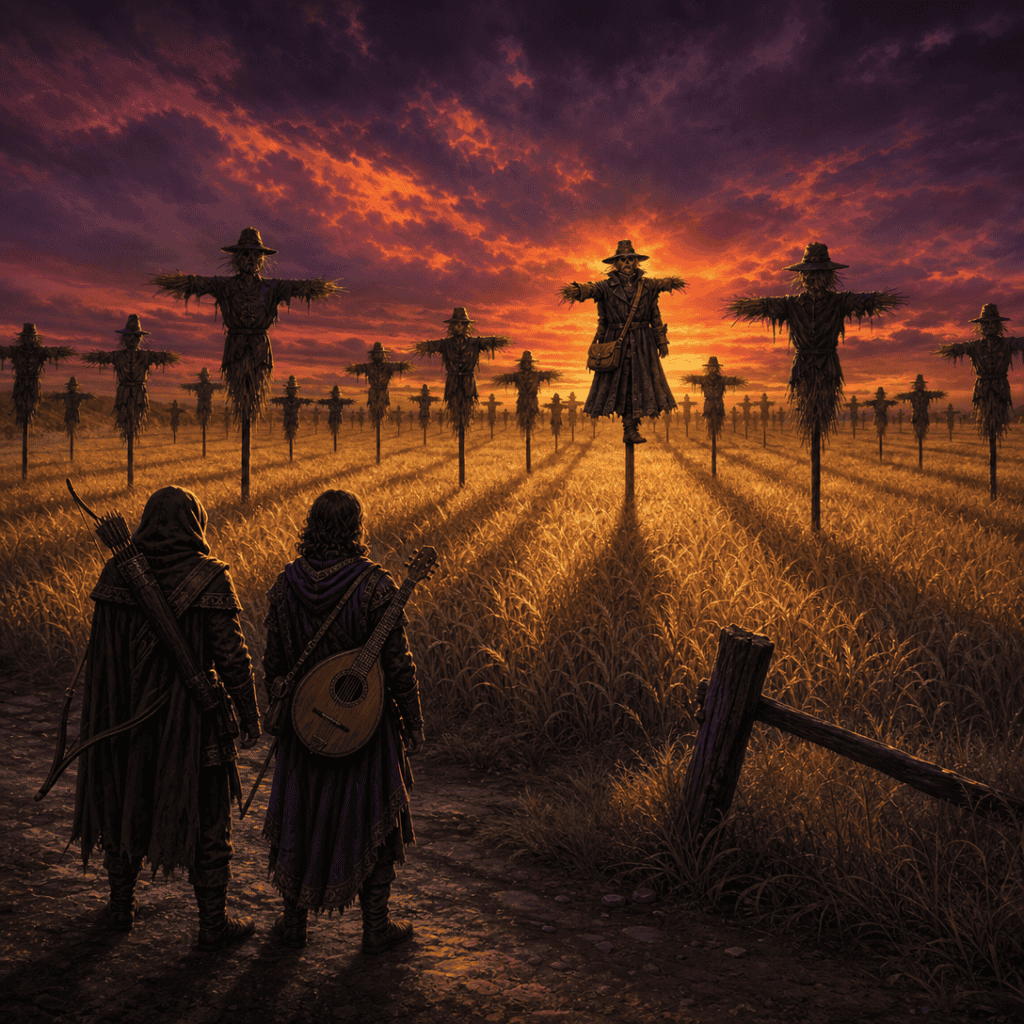

A D&D scarecrow folk horror one-shot is the format where the scarecrow is the antagonist — and the community knows. Unlike a haunted manor (where the threat is hidden) or a pumpkin patch (where the threat emerges from the harvest), a scarecrow horror session puts the threat out in the open. The scarecrows are visible. They’ve been visible for years. Travelers vanish on the road between villages, and the scarecrows in the surrounding fields are new, and there are more of them every season. This guide covers field-based dread design, three scarecrow archetypes, and the published one-shot built around the format.
What Makes Scarecrows Uniquely Unsettling
Scarecrows occupy a strange tonal space. They’re rural and familiar — every farm has them. They’re harmless by design — straw, sticks, old clothes. They’re put there by people, on purpose, with mundane intent.
That’s exactly what makes them work as horror. The horror isn’t supernatural. It’s intentional. Someone built the scarecrow. Someone chose to dress it. Someone decided where to plant it. When the scarecrow becomes wrong — when the dressing is too specific, when the placement is too deliberate, when the count keeps growing — the horror lives in the question of who is doing this and why.
Folk horror’s central trick is making the familiar uncanny, and scarecrows are already half-uncanny in the best of times. A small push and they tip into dread.
Field-Based Dread Principles
Open fields are harder to make scary than enclosed spaces. A few principles for running field-based folk horror well:
Use the horizon. A scarecrow visible at distance is more unsettling than one up close. The party sees it from far away, walks toward it, and the closer they get the more wrong it looks. The horizon does the work that walls do in dungeons.
Use the count. Ten scarecrows in a field is decoration. A hundred is something else. The exact number should feel deliberate but unexplained — too many for the size of the farm, too many for the harvest, too many in a way the locals won’t quite address.
Use motion at the edge of vision. The scarecrow doesn’t move when the party is looking at it. But when they turn away — when they’re walking past, when they’re focused on something else — the scarecrow may have shifted. May have. The DM never confirms. The players will fill in the dread themselves.
Use the absence of birds. Scarecrows are supposed to scare birds. If the field has no birds at all — if the silence is total — that’s the wrongness telling. Birds avoid these fields. The party should notice.
Three Scarecrow Archetypes
1. The Warning
The scarecrow is a sign. Every one represents someone who was “punished” — a thief, a stranger, an outsider, a debtor. The community puts them up to remind everyone what happens. The dressing is taken from the punished person; the body inside is straw, but the clothes are real. The threat the scarecrow communicates is implicit: cross us, and your clothes go on a pole.
Best for: Sessions about insular communities, the cost of crossing them, and the moral weight of leaving instead of confronting.
2. The Guardian
The scarecrow is animated. Not by the community — by something older. The scarecrows protect the fields, the harvest, the village. They move at night, when no one is watching. They’ve been doing this for generations. The community knows but doesn’t speak. The scarecrows are theirs, in a sense, but they’re not entirely controlled.
Best for: Sessions about communities that benefit from supernatural patronage and the cost of that patronage.
3. The Vessel
The scarecrow contains something. A bound spirit, a missing person, a piece of an older being. The community puts up new scarecrows when they need to — when something needs to be contained, or when the existing ones are losing their hold. Travelers who go missing in this region didn’t leave; they’re in the fields, dressed as straw figures, looking out.
Best for: Sessions about disappearances, complicity, and the horror of finding what happened to the missing.
The Community Knows
The defining feature of scarecrow folk horror is community complicity. The villagers aren’t innocent victims. They know. They’ve known for generations. The horror isn’t external — it’s woven into the community’s history, and breaking it means breaking the community.
Three principles for running complicit communities well:
Everyone has a different threshold. Some villagers have made peace with what happens in the fields. Others quietly hate it. A few are actively complicit. The party can find allies — but the allies are individuals, not the village as a whole.
The community defends itself. If the party threatens to expose what’s happening, the village responds — not with violence, necessarily, but with closing ranks. Doors stop opening. Help dries up. The party becomes the outsider in the story.
Children know but won’t say. The youngest villagers haven’t yet learned that this is the kind of thing you don’t talk about. They almost let things slip. Almost. A child’s near-revelation is one of the most effective folk-horror techniques in the format.
Daylight vs Nightfall Pacing
Scarecrow folk horror runs on a day-night cycle:
Day: Investigation. The party can examine scarecrows up close. They’re ordinary by daylight, mostly. The villagers are friendly, mostly. The horror is implied, not active.
Dusk: Wrongness intensifies. The shadows of scarecrows lengthen across the fields. The villagers head indoors earlier than they should. The party’s NPCs become evasive about whether they should still be out.
Night: Active threat. The scarecrows are dangerous after dark. The fields are not safe. The party either finds shelter or learns what the scarecrows do when no one is watching.
A two-hour session typically uses one full day-night cycle. The investigation happens during the day, the climax at night.
The Reveal: Who Put Them There
By the climax, the party has to learn what’s actually behind the scarecrows. Three reveals work:
The village elders. The community itself, generation after generation, has built and maintained the scarecrows for reasons that made sense centuries ago. The current generation may not even fully remember why. The reveal is that the antagonist is everyone.
The thing the scarecrows guard. The community is afraid of what’s in the fields, and the scarecrows are their protection. The reveal isn’t who put them there — it’s what they’re holding back. The party may not be able to remove the scarecrows without releasing what they contain.
The architect. A specific figure, sometimes still alive, sometimes not, who started this generations ago and whose system is still running. The community is downstream of one person’s old decision. The party has to decide whether to undo that decision and what happens next.
Common Pitfalls in D&D Scarecrow Folk Horror
The slasher scarecrow. Animated scarecrows charging the party with farming tools is a different genre. Folk horror works through dread, not action. Save active scarecrow combat for the climax, if at all.
The friendly village. If the villagers are warm, helpful, and innocent, the format collapses. The community has to feel slightly off — not hostile, just wrong in ways the party can’t immediately articulate.
Showing the threat too early. A scarecrow that obviously moves in scene one ruins the slow build. The first hour is wrongness. The visible threat is the climax.
Forgetting the why. Scarecrow folk horror without a community-level motive is just costume horror. The community has to want this — or have wanted this once, even if the current generation only inherited the system.
Published D&D Scarecrow Folk Horror
The Tall Man is Anvil N Ink’s published scarecrow folk horror one-shot — Book 3 of the Shadows of Valdrus Halloween series. The party investigates rural disappearances, discovers the scarecrows in the surrounding fields are new, and traces the pattern to the architects of the system. Two hours, 2-3 players, level 3, structured around the investigation-then-confrontation format.
For the broader Halloween arc, see How to Run a 5-Week Halloween D&D Arc. For the bundled five-book series, see the Shadows of Valdrus collection.
For other folk-horror tones, see D&D Pumpkin Patch Horror (week 1, similar rural setting). For broader horror design, see D&D Gothic Horror One-Shot and D&D Horror One-Shot Guide.
Frequently Asked Questions
What level should a D&D scarecrow folk horror one-shot be?
Level 3. The party should be competent enough to investigate without dying to ordinary hazards but not so powerful that the climactic encounter feels trivial. Level 2 parties survive but the boss fight is harder than it should be; level 5+ parties trivialize the threat.
How long should a scarecrow folk horror session run?
Two hours. One full day-night cycle. Three acts: arrival and investigation by daylight, escalation at dusk, climactic confrontation at night.
Can the scarecrows actually move?
Depends on the archetype. Warning scarecrows don’t move (they’re symbols). Guardian and vessel scarecrows do — but only at night, and only when no one is directly watching. The ambiguity of “did that just shift?” is more powerful than overt motion.
What’s the best class for a scarecrow folk horror session?
Bard and Rogue both excel — investigation, social manipulation, perception of the wrong details. Druid and Ranger fit thematically (rural setting, agricultural knowledge). Paladins struggle with the moral ambiguity of complicit communities, which can be a feature or a problem depending on the player.
Where can I find a published scarecrow folk horror D&D one-shot?
The Tall Man is Anvil N Ink’s published scarecrow folk horror D&D one-shot for 2-3 players. Two hours, level 3, Book 3 of the Shadows of Valdrus Halloween arc.
Run a Scarecrow Folk Horror Session This October
Scarecrow folk horror is the format where the threat is in the open and the community is the cover. The fields are full of figures that shouldn’t quite be there. The villagers won’t quite explain. Two hours, three players, one bad rural road. See more of the best D&D horror one-shots.
Read the full review of The Tall Man — Anvil N Ink’s published scarecrow folk horror D&D one-shot for 2-3 players. Two hours, level 3, the third session of the Shadows of Valdrus Halloween arc.
For the full Halloween arc, see How to Run a 5-Week Halloween D&D Arc. For other Halloween supporting articles, see D&D Pumpkin Patch Horror and D&D Crypt Crawl: Running a Necromancer’s Tomb.
The fields are full of figures. The figures aren’t moving. They will be.