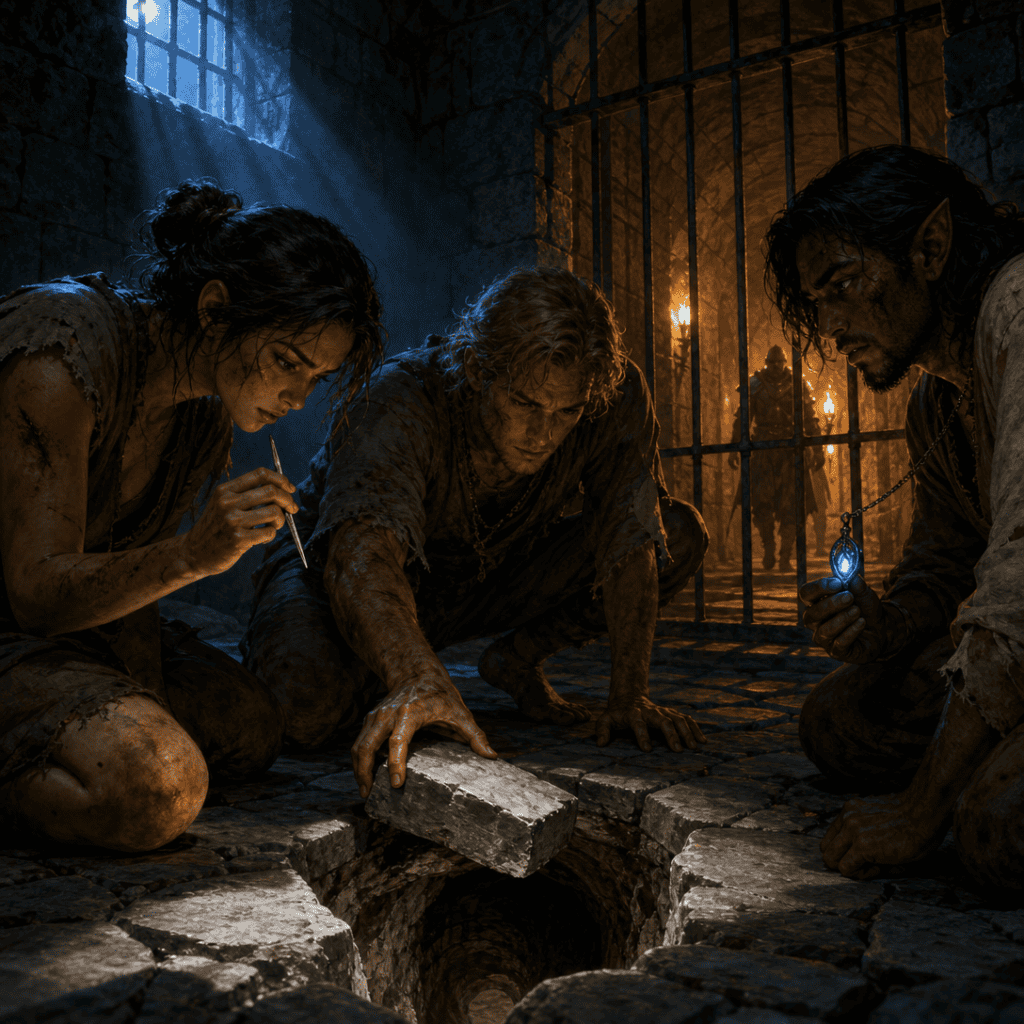

A D&D prison break one-shot is the format where the party starts with nothing and has to earn their way out. No gear. No spells they can’t cast unarmed. No allies. Just a cell, a guard schedule, and however much time the DM gives them before the next bad thing happens. This guide covers the opening hook, three escape path designs, how to make prison guards feel real without overwhelming the table with stat blocks, and the published one-shot built around the format.
Why Prison Break Works for One-Shots
Most D&D adventures start with the party already equipped. They have their weapons, their armor, their spells. Prison break inverts this. The party starts with nothing — and the first hour of the session is about getting back to baseline competence. Players have to earn what most adventures hand them.
This works for one-shots because it solves the “why are these characters together?” problem. They’re together because they’re all in the same prison. They’ve already met. They already have something in common. The session can skip the introduction and start at the inciting incident.
For 2-3 player tables, the format is even cleaner. With three players, every escape role has weight. The smart one plans. The strong one breaks. The fast one moves. Each character matters because the party doesn’t have backups.
The Opening: Stripped of Gear
The first scene of a prison break one-shot is inventory. The party wakes up (or arrives at the prison) without their equipment. The DM tells them what they have:
Allowed: Class features that don’t require components. Knowledge of spells the character knows. Personal items considered too inconsequential to confiscate (a pendant, a memory token, a small object that fits in a closed fist).
Confiscated: Weapons, armor, spell components, focus items, gold, anything mechanical. These are stored in the prison’s confiscation room — which becomes a session goal in itself.
Compromise: Each character keeps one personal item. The player describes what it is (a bone needle in their hair, a ring under their tongue, a thread in their sleeve). These items return to the player as creative tools, not mechanical advantages.
This setup forces the party to use what they have, not what they wish they had. It also tells the players that gear is going to matter — they’ll spend the session trying to get it back.
Three Escape Path Designs
1. The Stealth Path
The party escapes by avoiding being seen. Guard shifts, distractions, hidden routes through the walls. Stealth checks, sleight of hand, evasion. The session is built around three to four checkpoints — the cell exit, the corridor, the gear room, the outer wall — each with a different stealth challenge. Failure means alarm raised, not character death. The session can recover.
2. The Social Path
The party escapes by manipulating people. Convince a guard to look the other way. Bribe the cook for a uniform. Recruit another prisoner. Forge a release order. This path works best for charisma-heavy parties and rewards roleplay. Each social encounter has multiple paths to success — Persuasion, Deception, Intimidation, or just having a useful piece of information about the NPC’s life outside the prison.
3. The Force Path
The party escapes by fighting their way out. This is the loudest option and usually the worst — but for groups who want a high-action session, the format works. Limited combat resources (no spell slots, no armor, improvised weapons) make every fight desperate. The session becomes a running battle with the prison itself, getting more dangerous as alarms spread.
Most prison break one-shots use a mix — start with stealth, transition to social when stealth fails, end with force when social fails. The path the party takes is the path they reveal through their choices.
Designing the Prison
A good prison for a one-shot has six to eight distinct locations:
- The cell. Where the party starts. Small. Locked. Has a window or a vent or a loose stone — something to give the party a starting move.
- The corridor. Patrolled. The first stealth challenge.
- The common area. Other prisoners. Information. Possible allies or enemies.
- The gear room. Where the party’s confiscated equipment is stored. The major mid-session goal.
- The guards’ quarters. Information about schedules. Possible disguises.
- The warden’s office. Records, keys, the answer to a deeper question about why the party is here.
- The yard or outer wall. The final obstacle before escape.
- The escape route. Sewer, smuggler’s tunnel, magical portal, hidden gate. The actual exit.
Eight locations is more than the party needs to visit. The prison should feel larger than the path through it. The party chooses their route based on what they find.
Guards and Patrols
Don’t statblock every guard. Track three to four named guards with personalities; treat the rest as a hazard, not a fight. The named guards become the session’s NPCs:
The bored guard. Dislikes his job. Easy to bribe, distract, or talk past. The party’s friendliest opportunity.
The competent guard. Pays attention. Notices things. The party’s hardest stealth obstacle.
The brutal guard. Hurts prisoners for fun. The session’s combat antagonist. The party will want to fight him by the end.
The warden. Knows more than the party expects about why they’re here. The session’s social and informational climax.
Guards rotate on a schedule the party can learn. Spending session time observing the rotation is a real strategy.
The Complication That Escalates
Prison break one-shots benefit from a mid-session complication that changes the situation. Three options work:
Another prisoner is also escaping. Someone else has the same plan, and they’re moving faster. The party either races them or partners with them. The complication is whether to trust them.
The prison is about to be raided. An external force — bandits, a rival faction, the warden’s enemies — is attacking the prison from outside. The party can use the chaos, but the chaos is also dangerous.
The party isn’t supposed to be here. Mid-escape, the party discovers they were imprisoned by mistake — or worse, deliberately, for reasons connected to a larger story. The escape is no longer just an escape; it’s the start of an investigation.
One complication. Not all three. The escalation should make the session harder to win, not impossible.
Common Pitfalls in D&D Prison Break One-Shots
Punishing players for being captured. Some players hate prison sessions because they feel like the DM is taking their toys away. Frame the imprisonment as a setup, not a punishment. Make the escape worth doing.
The unwinnable prison. So many guards, so many checkpoints, so many alarms that no plan can succeed. Players check out. Build prisons that have at least three plausible paths to escape.
The endless prison. Twenty rooms, dozens of NPCs, exhaustive map. Prison break one-shots run two to three hours. The prison should be small enough to navigate in that time.
Forgetting the gear. If the party never gets their gear back, the session feels incomplete. Make the gear room a major scene. Make recovering equipment satisfying.
Published D&D Prison Break Adventures
Dead Time is Anvil N Ink’s flagship prison break one-shot. The party wakes up in cells with no memory of how they got there, has to navigate a prison that has its own secrets, and discovers their imprisonment is connected to something larger. Two hours, 2-3 players, level 2-3, designed around all three escape paths.
Other catalog adventures with prison-break elements: The Slab is the action-movie prison heist (the party breaks IN to extract someone); The Bandit’s Keep uses prison-break structure for a stealth rescue; Chains of Abeir handles the same format with a dragonborn rescue framing.
For broader rescue mission design, see D&D Rescue Mission One-Shot. For heist-genre crossover, see D&D Heist Crew Roles for 2-3 Player Tables.
Frequently Asked Questions
What level should a D&D prison break one-shot be?
Levels 2-3 work best. The party is competent enough to handle unarmored combat and skill challenges, but not so powerful that walls and locks are trivial. Higher-level parties trivialize most prison-break challenges with magic.
Should I let the players keep some of their gear?
Each character keeps one personal item — described creatively, not mechanically. This gives players a starting move without giving them their full kit. Total gear loss feels punitive; total gear retention undercuts the format.
How long should a D&D prison break session run?
Two to two-and-a-half hours. Three acts: cell escape, prison navigation, outer escape. Each act is roughly forty minutes. Sessions that run longer lose the urgency.
What’s the best class for a prison break adventure?
Rogue and Bard both shine — Rogue for stealth and Sleight of Hand, Bard for social manipulation and improvised tools. Monks (no weapons or armor needed) and Sorcerers (innate spellcasting without components) also work well. Pure spellcasters who depend on components struggle.
Where can I find a published prison break D&D one-shot?
Dead Time is Anvil N Ink’s published prison break D&D one-shot for 2-3 players. Two hours, level 2-3, supports stealth, social, and force escape paths.
Run a Prison Break Session This Month
The prison break one-shot is one of the most reliable session formats in D&D. Clean opening, three viable paths, built-in time pressure, satisfying gear recovery. Two hours, three players, one bad cell.
Read the full review of Dead Time — Anvil N Ink’s published prison break D&D one-shot for 2-3 players. Two hours, level 2-3, structured for stealth, social, or force escape.
For other escape and rescue formats, see D&D Rescue Mission One-Shot. For prison-break-adjacent titles, try The Slab, The Bandit’s Keep, and Chains of Abeir.
The cell is just a room. The walls are just walls. What gets the party out is what they bring with them.