
By Anvil N Ink Publishing · Updated May 2026 · 6 min read
An action movie-style D&D one-shot replaces slow dungeon exploration with momentum: a cold open dropped straight into a crisis, a ticking clock, two or three escalating set pieces, and one decisive confrontation. Give the session a single clear objective, put a hard deadline on it, and stage every scene as a physical problem rather than a conversation. For a 2–3 player table that runs about two and a half hours.
This format comes out of a simple observation: standard fantasy pacing falls apart on contact with an action premise — nobody wants to study a 40-room map when the chemical rockets launch at dawn. Cut everything that isn’t a clock, a choice, or a fight, and what’s left is the genre. That subtraction is where most of the advice below comes from.
What makes a D&D one-shot feel like an action movie?
Three things separate an action one-shot from a normal session: a cold open that starts mid-emergency, a visible countdown that never resets, and escalation where each set piece raises the stakes from the last. Skip the tavern. Open with the players already running.
The genre lives on forward motion. Screenwriter Blake Snyder’s Save the Cat beat sheet — the structure under most modern action films — hits a major reversal roughly every fifteen minutes. You can’t time D&D that precisely, but the principle holds: if more than twenty minutes pass without a new threat, a new clock, or a new choice, the air goes out of the room. The one genuine rule for these sessions is that the players should never feel safe, only briefly ahead.
How do you build relentless pace into a single session?
Use a hard deadline the players can see, then make every scene cost them time. A bomb at dawn, a sinking structure, a hostage with hours to live — the device matters less than its visibility. Announce time elapsed out loud after each scene so the pressure is felt, not assumed.
Structure it as three acts inside the standard two-and-a-half-hour window. Roughly: 30 minutes to establish the threat and the clock, 90 minutes of escalating set pieces, 30 minutes for the climax and fallout. Cut travel. Cut shopping. Cut anything that doesn’t move toward or away from the objective. When a scene stalls, introduce a complication rather than waiting for the players to find the exit — reinforcements arrive, the floor gives way, the timer jumps forward.
| Act | Time | Job |
|---|---|---|
| 1 — Cold open | ~30 min | Drop into the crisis; reveal the clock and the objective |
| 2 — Escalation | ~90 min | Two or three set pieces, each worse than the last |
| 3 — Climax | ~30 min | The villain, the choice, the consequence |
How do you write a villain worth the third act?
The best action antagonists have a point. Give the villain a goal the players can almost sympathize with and a deadline of their own, so the final confrontation is a collision of two plans rather than a boss with a health bar. A sympathetic motive is optional — not every villain needs one — but a legible one is mandatory.
Let the players negotiate. The strongest moment in an action climax is usually the offer the villain makes: surrender the objective and walk away, or fight and risk everything. That choice is where the genre earns its keep, and it only works if the antagonist has been visible and consistent from act one.
How do you scale action-movie set pieces for 2–3 players?
Two or three characters can’t soak the same punishment as a full party, so trade enemy quantity for enemy positioning and terrain. One well-placed sniper on a catwalk, a collapsing bridge, or a single elite with minions creates more tension than a mob — and far less bookkeeping. Skill checks should decide how hard a fight is, not whether it happens; combat stays in every act.
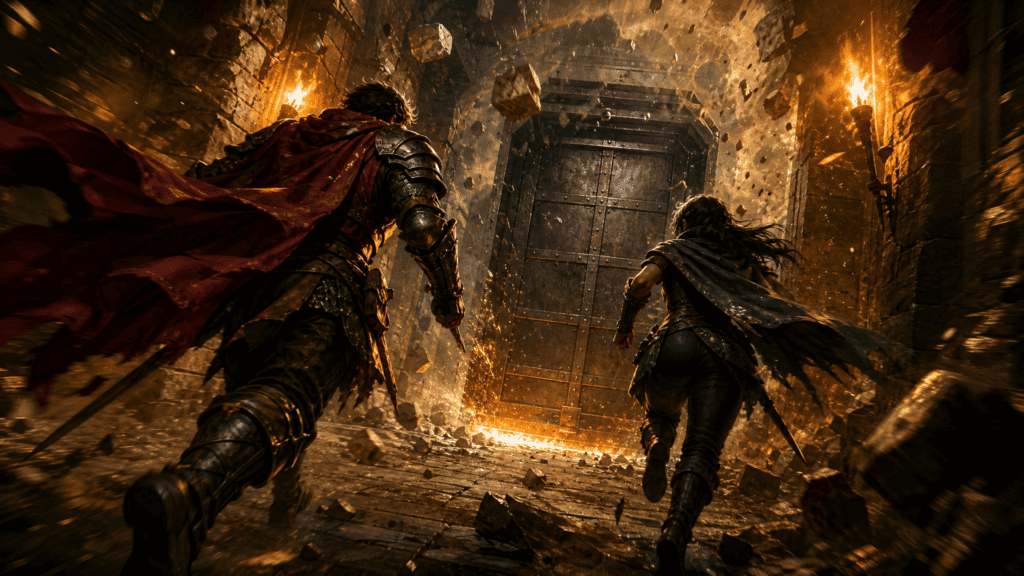
The strongest scene in an action one-shot is rarely the biggest fight. In Anvil N Ink’s action prison one-shot, it’s a corridor with a closing blast door and a guard the party can either fight or bluff — two players, one timer, one door. That’s the whole genre in miniature. If you want the technique broken down further, the guide to running heists in D&D and the ticking-clock adventure guide both go deeper on pressure mechanics for small groups.
What action one-shot can I run tonight?
If you want a complete, zero-prep example rather than building from scratch, The Slab is a working model of every principle above — an island-prison action thriller for 2–3 players with hostages, a chemical-weapon clock, and a sympathetic antagonist, built to run in 2–3 hours. Dead Time and The Score apply the same pacing to a prison riot and a one-night heist.
Key Takeaways
- Open mid-crisis — skip the setup and start the players in motion.
- Use one visible, non-resetting clock and announce elapsed time aloud.
- Build three acts inside ~2.5 hours: 30 / 90 / 30 minutes.
- Escalate — every set piece should be worse than the last.
- Trade enemy numbers for terrain and positioning at a 2–3 player table.
- Give the villain a legible goal and a deadline, and let the players negotiate.
Frequently Asked Questions
How long should an action movie-style one-shot run? Aim for 2–3 hours for a 2–3 player group. The compressed structure is part of the genre — a four-hour action one-shot loses its urgency.
Do I need combat in every scene? No, but you need pressure in every scene. Chases, sabotage, and tense negotiations all count. Combat appears in every act; skill checks set its difficulty.
Can this work for new players? Yes — it’s arguably better for them. Clear objectives and a visible clock give beginners obvious goals, which is easier than open-ended exploration.
What level should the characters be? Levels 2–3 work well for a 2–3 player action one-shot — enough toolkit to feel capable without the bookkeeping of higher tiers.
About the Publisher
Anvil N Ink Publishing writes small-group D&D 5e one-shots and guides designed for 2–3 players and a single 2–3 hour session. Browse the full library of small-group adventures for 2–3 players.
Get Your Copy
Choose your preferred format