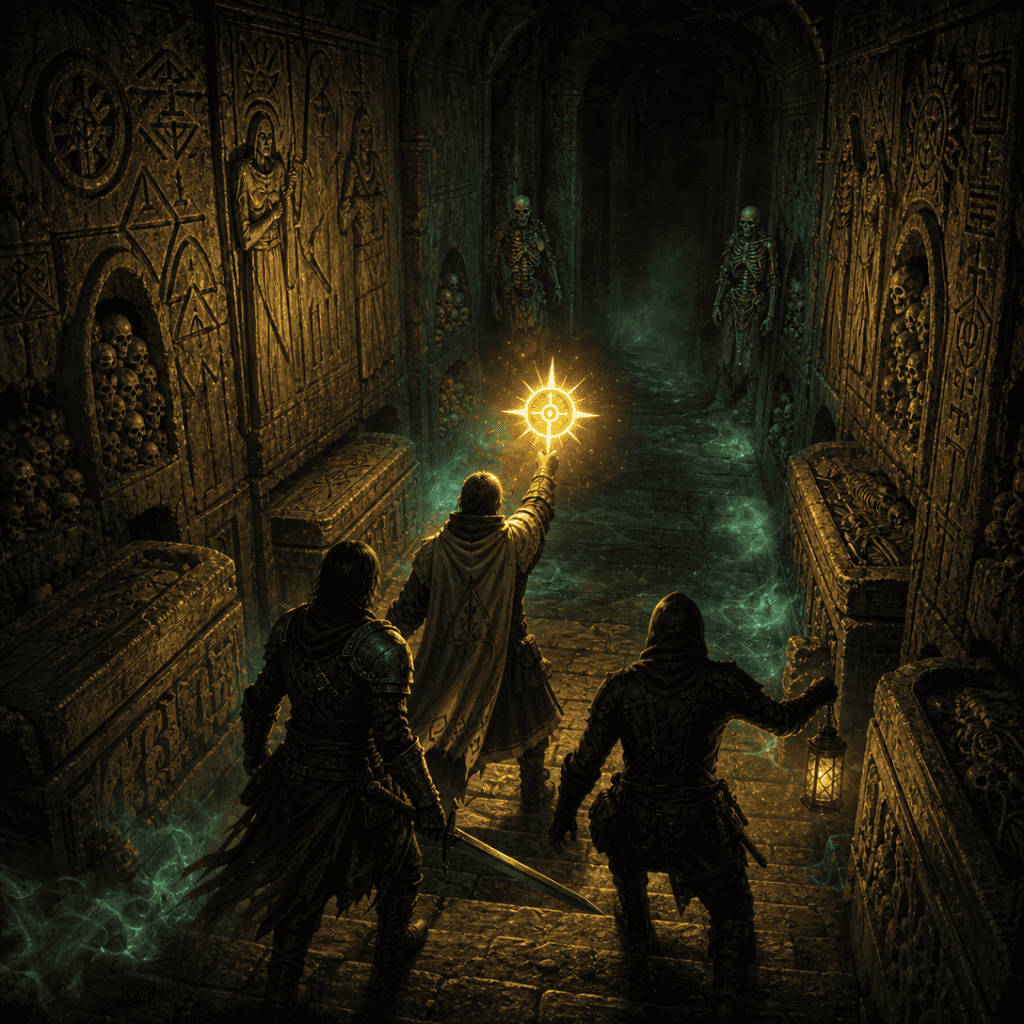

A D&D crypt crawl is one of the cleanest one-shot formats in the game. Self-contained location, vertical or linear progression, escalating danger with each chamber, and a climactic reveal at the bottom. The necromancer’s tomb adds a specific antagonist, a coherent threat, and an answer to the question “why is this place full of undead?” This guide covers crypt design, three structural variants, undead encounter pacing, and the published one-shot built around the format.
Why Crypts Work as One-Shot Dungeons
Most D&D dungeons sprawl. The party explores branching corridors, decides what to skip, and the DM has to design twice as much content as the party will see. Crypts solve this. A crypt has natural geometry — a single descent, room by room, with the antagonist or the prize at the bottom. The party can’t reasonably skip rooms, because the only way down is through. This is exactly the structure a one-shot needs.
Crypts also handle pacing. Each room can be a discrete encounter — a guardian, a trap, a riddle, a vision, a fight. The DM doesn’t need to think about pacing across the whole adventure; they think about pacing room to room, and the descent imposes the larger arc.
For 2-3 player tables, the format scales naturally. Smaller parties don’t get bogged down in branching exploration. The crypt structure forces forward motion without forcing combat. Each chamber matters because there are fewer of them than in a sprawling dungeon.
Three Crypt Structures for One-Shots
1. The Linear Descent
Eight to ten chambers in a straight vertical or horizontal line. Each chamber escalates the threat. The party fights or solves their way through chamber 1, then 2, then 3. No branches. No options. The structure is a corridor with rooms attached.
Best for: Tight two-hour sessions where the DM wants tight pacing and the party wants a clear forward path.
2. The Family Tomb
A central hub with three to five branching wings, each holding a member of the buried family. The party can explore wings in any order. The climax is in the central crypt, accessible only after they’ve visited at least two wings. This structure rewards investigation — each wing tells part of the family’s story, and the full picture only emerges from multiple wings.
Best for: Investigation-heavy sessions with a mystery layered into the dungeon crawl.
3. The Necromancer’s Lair
The crypt was built as a tomb but has been retrofitted by a living necromancer. The upper chambers are decayed and original. The lower chambers are active workshop. Old undead in the upper rooms; freshly raised undead in the lower rooms. The structure is split — historical at top, in-progress at bottom — and the descent is also a journey from “what happened here” to “what’s happening here right now.”
Best for: Sessions with a clear antagonist and combat-heavy climax.
The Necromancer’s Signature
What makes this crypt different from any other? The necromancer’s signature. Every necromancer has one — a specific way they raise, bind, or modify the dead. Three signatures that work for one-shots:
The collector. The necromancer raises specific people for specific reasons. Each undead in the crypt was chosen — a healer, a lockpicker, a translator. The party finds notes explaining why each was raised. The undead aren’t generic; they have names and histories.
The augmenter. The necromancer modifies bodies. Bone scaffolding. Stitched-together combinations. Bodies that have been “improved” with parts from other corpses. This signature is body-horror adjacent — handle with care, but it lands hard when it works.
The binder. The necromancer doesn’t raise the dead — they bind souls into living vessels (animals, constructs, objects). The crypt is full of haunted items rather than animated corpses. Each one was a person.
Pick one. The signature should be visible from the first chamber and obvious by the third.
Undead Encounters: Variety Beyond Zombies
The biggest mistake in crypt-crawl one-shots is filling every room with zombies. Vary the encounter types:
Skeletal warriors. Classic. Decent combat but predictable. Best in early rooms.
Ghosts. Incorporeal, immune to most physical damage. Force the party to use radiant or magical attacks. Slow the pace.
Wights. Intelligent undead with class features. Can talk, plan, and lead other undead. Best as mini-bosses.
Animated objects. Bone-furniture, weaponized statues, bound chains. Fits the necromancer’s signature if they’re a binder.
The honored dead. An undead who isn’t hostile. A trapped soul who wants help, an old guardian who only attacks if disrespected, a former apprentice who has regrets. One per session, max — they’re a tone shift, not a recurring beat.
The necromancer themselves. Fresh corpse or living spellcaster, depending on the reveal. The session climax.
Atmosphere and Dread
Crypts have natural atmosphere — but it has to be reinforced, not assumed. Three principles:
Use the dead as scenery. Bones in alcoves. Sealed sarcophagi. Bodies prepared for raising but not yet raised. The party should feel that they’re walking through a place full of the dead, even when nothing is attacking.
Sound matters. The drip of water, the scratch of something moving in another chamber, the wind through carved skulls that whistles. Crypts are quiet places that punish silence with unsettling sounds.
Cold and damp as constants. The crypt is colder than outside. Fingers stiffen. Torches gutter. This isn’t a mechanical penalty — it’s atmospheric texture that reminds players where they are.
The Reveal at the Bottom
By the climax, the party has to confront whatever the necromancer’s plan actually is. Three reveal types work:
The ritual in progress. The necromancer is mid-ritual when the party arrives. Interrupting the ritual is the win condition. Combat happens, but the goal isn’t just killing the necromancer — it’s stopping the magic.
The successor. The necromancer is already dead — has been for years. What the party has been encountering is their final undead servant, still carrying out the master’s plan. The “boss fight” isn’t the necromancer; it’s the bound enforcer who outlasted them.
The bargain. The necromancer is alive and willing to talk. They have something the party wants — information, a cure, a relic. The session climax is a negotiation, not a fight. Players who only know combat solutions struggle with this; players who lean into roleplay love it.
Common Pitfalls in D&D Crypt Crawls
The zombie hallway. Five rooms in a row, each with three zombies. Boring even on the first run. Vary the encounters; vary the threats.
The unkillable necromancer. Too many lair actions, legendary resistances, plot armor. Players who can’t reasonably win check out. Make the climax winnable; make the cost of winning matter.
The empty crypt. No bodies, no atmosphere, no signature — just a dungeon with skeletons in it. Crypts need death imagery to register as crypts.
Skipping the necromancer’s why. Why is the necromancer doing this? What do they want? If the answer is “they’re evil,” the session has no theme. Give the necromancer a motive specific enough that the players could, in theory, sympathize with it.
Published D&D Crypt Crawl Adventures
Below the Field is Anvil N Ink’s published crypt crawl one-shot — Book 2 of the Shadows of Valdrus Halloween series. The party investigates a small village’s family crypt and discovers that the necromancer’s signature is connected to events the party already encountered in week 1. Two hours, 2-3 players, level 3, structured around the necromancer’s-lair format.
For the broader Halloween arc this fits into, see How to Run a 5-Week Halloween D&D Arc. For the bundled five-book series, see the Shadows of Valdrus collection.
For other folk-horror tones, see D&D Pumpkin Patch Horror (week 1 setting). For broader horror design, see D&D Horror One-Shot Guide and D&D Gothic Horror One-Shot.
Frequently Asked Questions
What level should a D&D crypt crawl one-shot be?
Levels 3-4. The party needs at least one character with the ability to deal radiant or magical damage (to handle ghosts and incorporeal undead), and ideally a Cleric or Paladin. Level 2 parties survive but struggle with the boss; level 5+ parties trivialize the encounter ladder.
How long should a crypt crawl session run?
Two to two-and-a-half hours. Eight to ten chambers, fifteen to twenty minutes per chamber on average. The crypt should feel deep but not exhausting.
What’s the best class for a crypt crawl?
Cleric and Paladin both shine — turn undead, radiant damage, divine protection. Wizards with Necromancy specialization create interesting tension (their abilities overlap with the antagonist’s). Rogues do well with traps. Bards bring social flexibility for the bargain reveal type.
Should every chamber have combat?
No. Two to three combat encounters across eight chambers is plenty. The other chambers should have traps, puzzles, atmospheric scenes, or NPCs (the honored dead, the bound soul). Pure combat crawls exhaust players; varied chambers keep them engaged.
Where can I find a published crypt crawl D&D one-shot?
Below the Field is Anvil N Ink’s published necromancer’s-tomb crypt crawl D&D one-shot for 2-3 players. Two hours, level 3, Book 2 of the Shadows of Valdrus Halloween arc.
Run a Crypt Crawl Session This Month
The crypt crawl is one of D&D’s most reliable one-shot formats — clean structure, escalating threat, climactic reveal. Add a necromancer with a signature and a motive, and the session has theme as well as structure. Two hours, three players, one descent.
Read the full review of Below the Field — Anvil N Ink’s published crypt crawl D&D one-shot for 2-3 players. Two hours, level 3, the second session of the Shadows of Valdrus Halloween arc.
For the full Halloween arc, see How to Run a 5-Week Halloween D&D Arc. For other Halloween supporting articles, see D&D Pumpkin Patch Horror.
The crypt was sealed for a reason. The reason is still down there.