
By Anvil N Ink Publishing · Updated May 2026 · 7 min read
To run body horror in D&D, you make the body itself the dungeon: flesh as terrain, disease and mutation as threats, and the players’ own anatomy as something that can be violated. The technique only works with table consent established up front. Lean on restraint and implication over splatter, and tie every grotesque image to a choice so the horror means something. A focused body horror one-shot runs cleanly in 2–3 hours for 2–3 players.
Gore is easy to write and rarely frightens anyone. A draft that goes wall-to-wall viscera plays like a butcher’s inventory — numbing, not unsettling. What actually lands is quieter: a vein the party has to wade through that’s still warm. Restraint is the whole craft here.
What is body horror in D&D, and does it work at the table?
Body horror is dread aimed at the body — transformation, infection, violation of the boundary between self and not-self. It works at a tabletop precisely because players are already inhabiting a body they care about: their character’s. Threaten that integrity and the fear gets personal in a way a dragon never manages.
It is, however, the most consent-sensitive genre in the hobby. Done carelessly it’s just a gross-out; done well it’s the most memorable session a group will run all year. The difference is almost entirely setup, not severity. The principle worth internalizing: body horror is the genre where less explicit detail produces more fear, every single time.
How do you set up body horror without losing the table?
Get explicit buy-in before the session, not during it. Use the standard tabletop safety tools — the X-Card and “lines and veils.” A line is content the group won’t touch at all; a veil is content that happens but “off-camera.” These come from John Stavropoulos’s widely used TTRPG Safety Toolkit and Ron Edwards’s original “lines and veils” framing, and they’re standard practice for a reason.
Frame the pitch honestly: tell players this one is mature body horror, name the broad themes, and ask where their lines are. Far from spoiling the fear, a clear agreement increases it — players who feel safe in the room are willing to be genuinely disturbed by the fiction. Without that agreement, the first grotesque beat makes someone shut down, and the session is over whether or not anyone says so.
How do you describe body horror without going too far?
Use specific, restrained detail and let the player’s imagination finish the picture. One precise, wrong sensory note — a warmth where there should be none, a texture that yields when it shouldn’t — lands harder than a paragraph of anatomy. Describe the implication and the aftermath; cut away before the splatter.
Pace the reveals. Open with the uncanny (something is subtly off), build to the unmistakable (the players understand what they’re standing in), and reserve the truly grotesque for one or two earned beats. Constant intensity numbs a table within twenty minutes — the same fatigue that flattens an over-gory opening. Silence and a slow reveal do more work than volume.
How do you turn anatomy and disease into encounters?
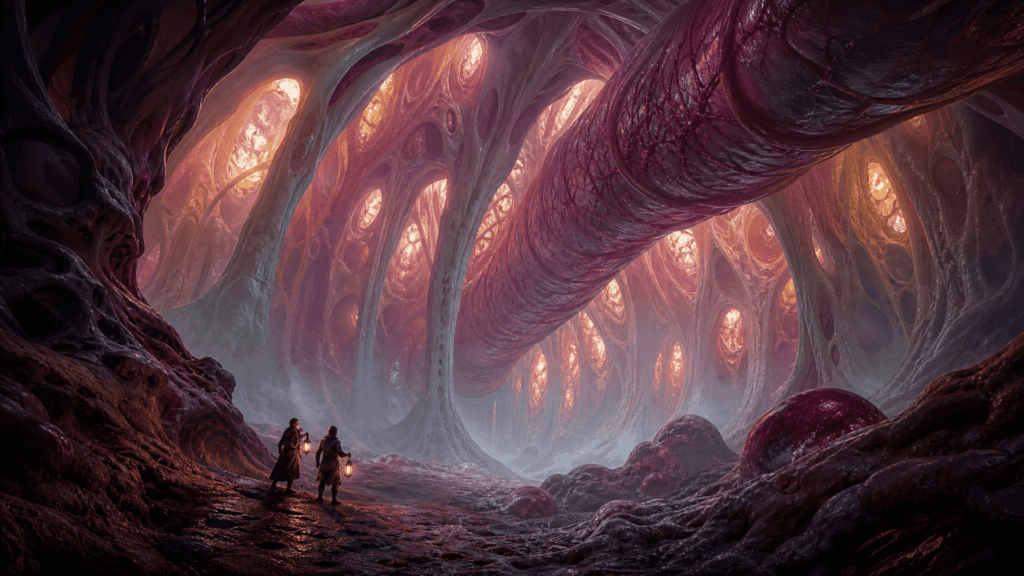
Make the body load-bearing in the mechanics, not just the description. Treat organs and cavities as rooms, infection or mutation as a clock, and the environment itself as the thing trying to kill them — constricting passages, digestive hazards, antibodies that behave like guards. Combat still appears in every act; the setting just makes each fight grotesque.
For a 2–3 player group, keep encounters lean and positional rather than throwing crowds at a small party. A single transformed NPC the players knew, or one environmental hazard with a countdown, carries more weight than a swarm. If you want the full mechanical breakdown, the guide to running horror one-shots covers tension and survival pacing, and the gothic horror guide handles the slower-burn variant for haunted settings.
| Element | Normal dungeon | Body horror version |
|---|---|---|
| Terrain | Stone corridors | Veins, cavities, organ chambers |
| Clock | Torches burning down | Infection or mutation spreading |
| Guards | Patrolling enemies | Antibodies, transformed former allies |
| Treasure | Gold and loot | Something the body was protecting — at a cost |
What body horror one-shot can I run tonight?
For a complete, ready-to-run example, The Colossus Autopsy sends 2–3 players into the decaying anatomy of a 60-foot storm giant — tactical exploration, moral weight, and genuinely unsettling imagery, built for adult tables in 2–3 hours. For a different flavor of visceral horror, The Spider’s Seminary trades anatomy for an infestation the heroes were supposed to clean up and didn’t. Both pair well with the techniques above.
Key Takeaways
- Body horror targets the character’s body — that’s why it lands harder than a monster.
- Establish consent first with the X-Card and lines and veils; it deepens fear rather than diluting it.
- Restraint beats splatter — one precise wrong detail outperforms a paragraph of gore.
- Pace reveals: uncanny, then unmistakable, then one or two earned grotesque beats.
- Make the body mechanical — organs as rooms, infection as a clock, antibodies as guards.
- Keep encounters lean and positional for a 2–3 player table.
Frequently Asked Questions
Is body horror appropriate for every table? No. It’s an adults-by-default genre and absolutely requires consent and safety tools. If the group isn’t on board, run a different kind of horror.
How is body horror different from regular horror? Regular horror threatens you from outside — a monster, a haunting. Body horror threatens you from inside: your body, your form, your identity. The call is coming from inside the character.
Won’t talking about lines beforehand spoil the surprise? No. You name broad themes, not specific beats. Players knowing “this is body horror” still won’t know what’s in the next room — and the safety net is what lets them stay scared.
Can I run body horror for 2 players? Yes. A small group is ideal — the intimacy concentrates the dread, and lean, positional encounters suit two characters better than a swarm.
About the Publisher
Anvil N Ink Publishing writes small-group D&D 5e one-shots and guides for 2–3 players and a single 2–3 hour session. Explore more small-group adventures and guides for 2–3 players.
Get Your Copy
Choose your preferred format