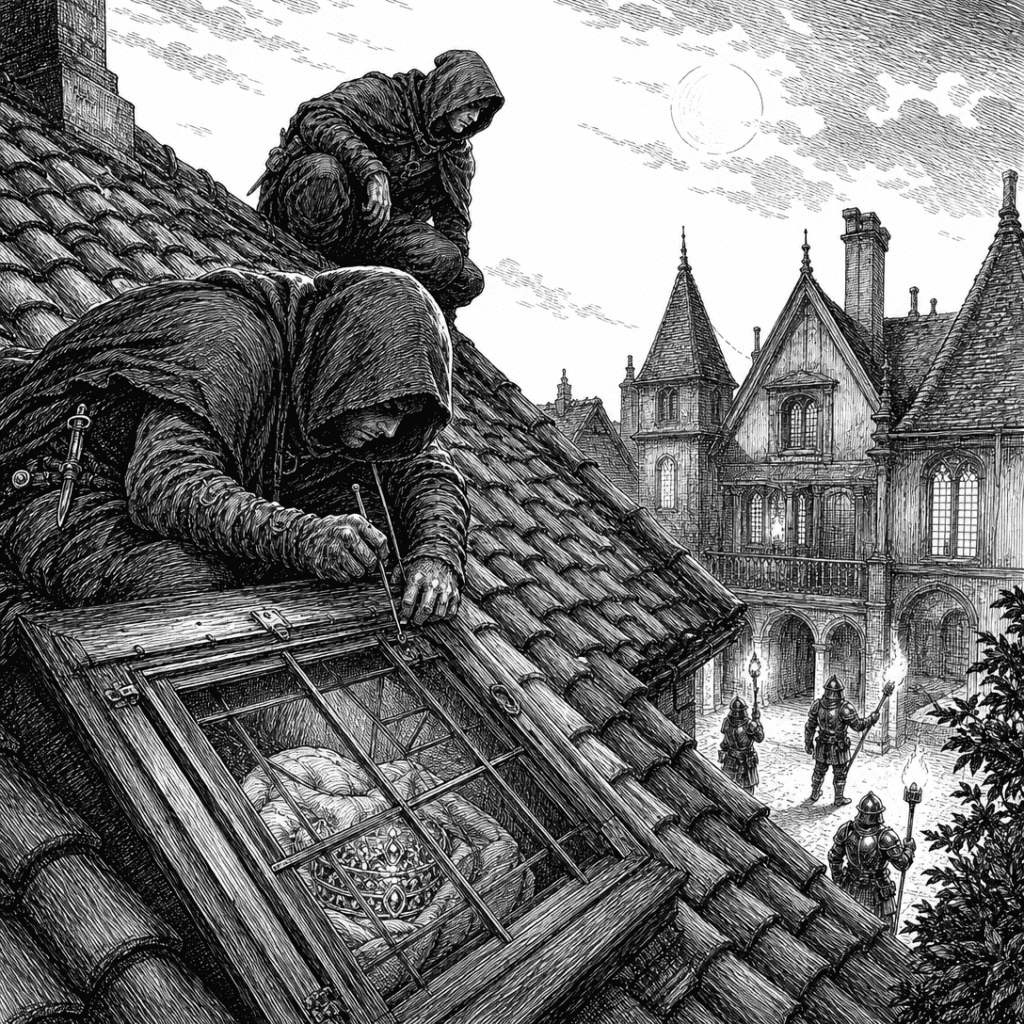

The best D&D heist one-shots pack a full caper — case the target, slip past the guards, grab the prize, and escape — into a single 5e session for a small group. This ranked roundup covers seven ready-to-run heist one-shots from Anvil N Ink, each built for 2–3 players at low levels with zero prep, sorted by the kind of job your table wants to pull tonight.
A good heist is one of the hardest sessions to improvise and one of the most satisfying to run from a script that already solved the hard parts — the timeline, the guard patrols, the “what if they just kick the door in” contingencies. Every adventure below is a complete, cold-readable one-shot, not a campaign you have to prep. If you want the mechanics behind them, our guide to running a D&D heist and heist crew roles for a 2–3 player team cover the how; this page covers the what to run.
Which D&D heist one-shot should you run?
Pick by the job, not the level — every one of these runs for two or three players in a single evening. Start with The Score if you want the classic urban vault job; branch out from there by tone.
| # | Adventure | The job | Players | Best for |
|---|---|---|---|---|
| 1 | The Score | A classic urban vault job — case it, crack it, get out | 2–3 | The definitive first heist one-shot |
| 2 | The Last Train to Hellion | A Weird West train heist that turns into a haunting | 2–3 | Genre mash-up and rising dread |
| 3 | The Merchant’s Vault | An urban infiltration with a hard timeline | 2–3 | Tables who want a tight clock |
| 4 | Last Stein Standing | A brewery caper built for a duo | 2 | Two-player nights with a comedic streak |
| 5 | The Slab | An action-movie prison heist — break in, not out | 2–3 | High-octane, set-piece energy |
| 6 | Yule Be Sorry | A Christmas heist with holiday trimmings | 2–3 | A seasonal December session |
| 7 | The Winter Ball Heist | A gala infiltration in formal wear | 2–3 | Social-first capers and disguises |
What makes a good D&D heist one-shot?
A good heist one-shot solves the three problems that make heists hard to run: information, timing, and failure. The party needs to learn the target without a slog of exposition, feel a clock without a real-world timer, and survive a blown plan without the session collapsing.
The strongest capers use a “three ways in” clue structure so a missed roll never dead-ends the job, a visible escalation track so tension climbs whether or not the plan holds, and written contingencies for the moment the party does something nobody scripted — because in a heist, they always do. The classic heist-film shape — the pitch, the crew, the plan, the complication, the twist — maps cleanly onto a single 5e session when the adventure does that structural work for you. Each pick above is built on that spine.
How do you run a heist for 2–3 players?
Give a small party specialists, not a full crew. With two or three players you cannot cover every heist role, so the best small-group capers hand each character a clear lane — the face, the infiltrator, the muscle — and design the obstacles so any pair can improvise past a gap. Our heist crew roles guide breaks down which roles matter most for a duo or trio, and ten things worth stealing covers what makes a target worth the risk. For the full method, see how to run a heist in D&D without it becoming a disaster.
Key takeaways
- The best D&D heist one-shots pack a full caper into one 5e session for 2–3 players, with zero prep.
- The Score is the best starting point — a clean urban vault job.
- Pick by tone: Weird West horror (Last Train to Hellion), a tight urban clock (The Merchant’s Vault), a two-player caper (Last Stein Standing), or a seasonal job (Yule Be Sorry).
- Small-group heists work best when each character has a clear specialist lane and the obstacles allow improvisation.
- Look for three-ways-in clues, a visible escalation clock, and written contingencies — the marks of a heist that survives a blown plan.
Frequently asked questions
What is the best D&D heist one-shot for beginners? The Score. It teaches the case-it-then-crack-it rhythm cleanly, runs for 2–3 players in a single session, and uses pre-generated characters and cold-readable boxed text so a new group can play it the night they open it.
Can you run a heist with only two players? Yes. Last Stein Standing is built specifically for a duo, and most of the others include two-player scaling. A heist is actually a natural fit for a small party, since a tight crew of specialists is genre-appropriate.
How long does a heist one-shot take? Each of these is designed for a single 2–3 hour session. The escalation clock keeps the pace up, so a focused table finishes the job in one evening.
Do I need to prep a heist adventure? No. Every adventure here is zero-prep — the timeline, maps, guard patrols, and contingencies are already written. Skim the act you are about to run and play.
About Anvil N Ink Publishing
Anvil N Ink Publishing makes zero-prep, 5e-compatible one-shots for 2–3 players, solo RPGs, and LitRPG fiction. The heist one-shots above are part of a small-group catalog built for the table most people actually have — see the full list of the best D&D one-shots for 2 players and more ready-to-run one-shot ideas.