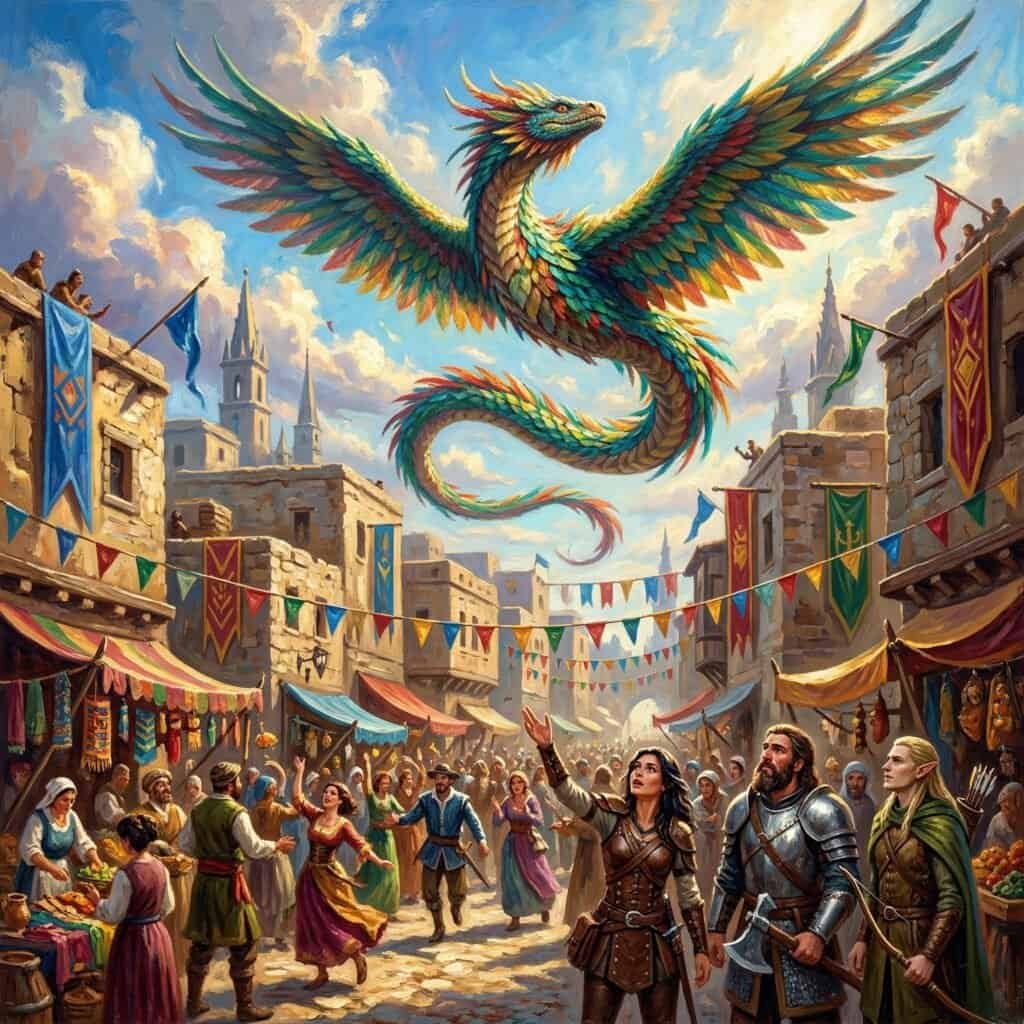

A Cinco de Mayo D&D one-shot draws on one of history’s most compelling underdog stories: the Battle of Puebla, where a smaller, outgunned Mexican force held off a French army that had not been defeated in nearly fifty years. That premise — defend what you have against overwhelming odds, with everything on the line — translates directly into the kind of D&D session that gets talked about long after the dice are put away.
This article covers the cultural context that makes this holiday worth exploring at your table, how to bring Mesoamerican mythology into D&D effectively, what makes a Cinco de Mayo one-shot feel distinct from a generic adventure, and the Anvil N Ink one-shot built specifically for this occasion.
Cinco de Mayo and D&D: Why This Holiday Works at the Table
Cinco de Mayo is not Mexican Independence Day — a common misconception worth clearing up before you run a session themed around it. It commemorates the Mexican army’s unexpected victory over French imperial forces at the Battle of Puebla on May 5, 1862. The French were better equipped, better funded, and expected to win decisively. They did not. The Mexicans held the city.
That story is D&D at its core. A smaller force with local knowledge and genuine stakes defending something that matters to them against an army that assumed victory. The defenders were not exceptional soldiers — they were people who had something worth protecting and the will to protect it. The outnumbered defenders, the desperate last stand, the victory that nobody in the enemy camp thought possible: this is the shape of a great one-shot.
The holiday also carries themes that resonate across cultures: community, resistance, the underdog, and celebration in the face of hardship. These themes do not require detailed historical knowledge to feel meaningful at the table. They are universal story beats that players engage with instinctively.
Mesoamerican Mythology in D&D
Bringing Mesoamerican mythology into D&D enriches the aesthetic considerably beyond what the standard Monster Manual offers. A few elements worth incorporating:
The Feathered Serpent
Quetzalcoatl — the feathered serpent deity associated with wind, air, learning, and the dawn — is one of the most visually striking figures in Mesoamerican mythology. In D&D terms, the Couatl is the closest direct analogue: a winged, feathered serpent of lawful good alignment associated with truth and protection. A Couatl as a guardian NPC, an oracle, or a reluctant ally gives the adventure an immediately distinctive visual identity while staying within official D&D rules.
The Sun and the Fifth World
Aztec cosmology organised existence into successive worlds or “suns,” each destroyed and replaced. The current world — the Fifth Sun — was created through sacrifice and is maintained by ongoing offerings. This cosmological weight translates well into D&D stakes: the adventurers are not just defending a city. They are defending the continuation of the world as it exists. The enemy is not just an army. They are agents of cosmic disruption.
Jaguar Warriors
The elite Jaguar Warriors of the Aztec military were among the most feared fighters in Mesoamerica, identifiable by their jaguar-skin armour and helmets. As D&D characters or NPCs, they offer a visually striking alternative to standard knight or soldier archetypes. A Jaguar Warrior NPC allied with the players brings immediate personality and cultural specificity to the battlefield.
The Dead and the Living
Mesoamerican cultures had a notably different relationship with death than the European traditions that underpin most D&D settings. Death was not an ending but a transition — the dead remained connected to the living, could be honoured and consulted, and had continuing roles in the world. Ancestor spirits as a game mechanic — advice from the dead, favour earned through proper offerings, warnings from those who came before — add a layer of meaning to the setting that feels distinct from standard D&D undead tropes.
Running Mesoamerican Cultural Elements Respectfully
Using another culture’s mythology and history as D&D source material is worth approaching thoughtfully. A few principles that help:
Treat the mythology as meaningful, not decorative. Quetzalcoatl is not a cool monster — he is a deity with genuine significance in living traditions. Using him as a neutral or positive figure (as the Couatl stat block already does) is appropriate. Using him as a villain or a joke is not.
Distinguish between holiday and history. Cinco de Mayo as celebrated in the United States is substantially different from the holiday as observed in Mexico, and both are distinct from the historical event. Be clear in your session framing about which you are drawing from and why.
Keep the human stakes central. The most respectful approach to historical and cultural material in D&D is to focus on the people — what they were protecting, what they were willing to risk, what the victory meant to them. The mythology and aesthetics are context. The human stakes are the story.
Hold the Fifth: The Anvil N Ink Cinco de Mayo One-Shot
Hold the Fifth is the Anvil N Ink Cinco de Mayo adventure — a D&D 5e one-shot for 2-3 players built around the underdog defence premise. The setup draws directly on the Battle of Puebla: a smaller force, a city worth defending, an enemy who assumed this would be easy.
The adventure runs in a single session of 2-3 hours. Pre-generated characters are included — no character creation required before play. The structure gives players meaningful choices at each stage of the defence rather than a linear march through predetermined encounters.
What the adventure includes:
- A four-act structure built around the defence of five outpost locations, each with its own tactical situation and resolution options beyond direct combat
- A saboteur subplot running through the adventure — someone in the defence is not what they seem, and players who pay attention to the right details can identify and confront them before the final act
- A cipher payoff that rewards players who engage with the investigation thread alongside the main defence
- Grakhul One-Tusk as the primary antagonist — a commander whose tactical intelligence makes him a genuine threat rather than a damage sponge
- Multiple resolution paths for each outpost that account for different party compositions and player preferences
The adventure is available on Payhip and Amazon. Details and purchase links at anvilnink.com.
Running a Cinco de Mayo D&D Session: Practical Tips
A few things worth thinking about before you run any Cinco de Mayo D&D content:
Set the Atmosphere
The aesthetic of a Mesoamerican-inspired D&D setting is visually rich — stone architecture, vivid colour, featherwork, market squares, volcanic landscape. Give players two or three specific sensory details in your opening description: the smell of copal incense, the sound of a distant crowd, the specific orange of the afternoon light on stone walls. These details cost nothing and immediately transport players into a setting that feels different from a standard European fantasy.
Establish the Stakes Early
Players should understand what they are defending and why it matters within the first five minutes of play. Not through a long briefing — through what they can see. The people in the streets. The market that has been running on that corner for three generations. The temple on the hill that has been there longer than anyone can remember. Stakes that players can see are stakes players care about.
The Underdog Feeling
The whole point of a defence adventure is that winning should feel unlikely from the inside. Show players the scale of what is coming. Let them feel the weight of what they are up against. The victory means more if the players genuinely believed, at some point during the session, that they might not pull it off.
For more on the broader calendar of seasonal D&D adventures, the complete guide to the best D&D one-shots covers how holiday and occasion-based adventures fit into a one-shot calendar. The Día de los Muertos adventure is next in the cultural pipeline — a different holiday, a different set of themes, a different adventure structure.
Frequently Asked Questions: Cinco de Mayo D&D One-Shot
Do players need to know anything about Mexican history to enjoy the adventure?
No. The adventure is self-contained — the briefing at the start of the session gives players everything they need to understand the stakes. Historical knowledge enriches the experience but is not required for engagement. The underdog defence premise communicates itself immediately regardless of historical context.
Is this adventure appropriate for players unfamiliar with Mesoamerican mythology?
Yes. The Mesoamerican elements — the feathered serpent, the cosmological stakes, the jaguar warrior aesthetic — are introduced through description and NPC interaction rather than assumed knowledge. Players encounter these elements as part of the world they are playing in, not as pre-existing knowledge they are expected to bring.
How does Hold the Fifth handle the defence structure mechanically?
The five outpost locations each have their own tactical situation that resolves independently. Players choose which outpost to address next, giving them agency over the sequence of the defence. Each outpost can be resolved through direct combat, strategic improvisation, negotiation, or a combination. No outpost requires any specific approach, which means different parties will solve the same defence in recognisably different ways.
What level do characters need to be for this adventure?
Hold the Fifth is designed for characters at levels 3-5. The pre-generated characters included in the adventure are built at this level. If you are running with your own characters, any party in that range with standard equipment works without adjustment.
Can this adventure be run without the holiday context?
Yes. The underdog defence structure, the saboteur subplot, and the boss encounter all function as a complete adventure regardless of the Cinco de Mayo framing. If you want to run it at a different time of year, strip the specific holiday references from the briefing and keep everything else. The adventure holds up independently of its occasion.
Ready to run it? Hold the Fifth — the Anvil N Ink Cinco de Mayo D&D one-shot — is available now on Payhip and Amazon. Pre-generated characters included, 2-3 hour runtime, designed for 2-3 players. Visit anvilnink.com for the full details and purchase links.
A Cinco de Mayo D&D one-shot works because the holiday’s central story is already D&D: outnumbered defenders, impossible odds, and a victory that nobody on the other side saw coming.