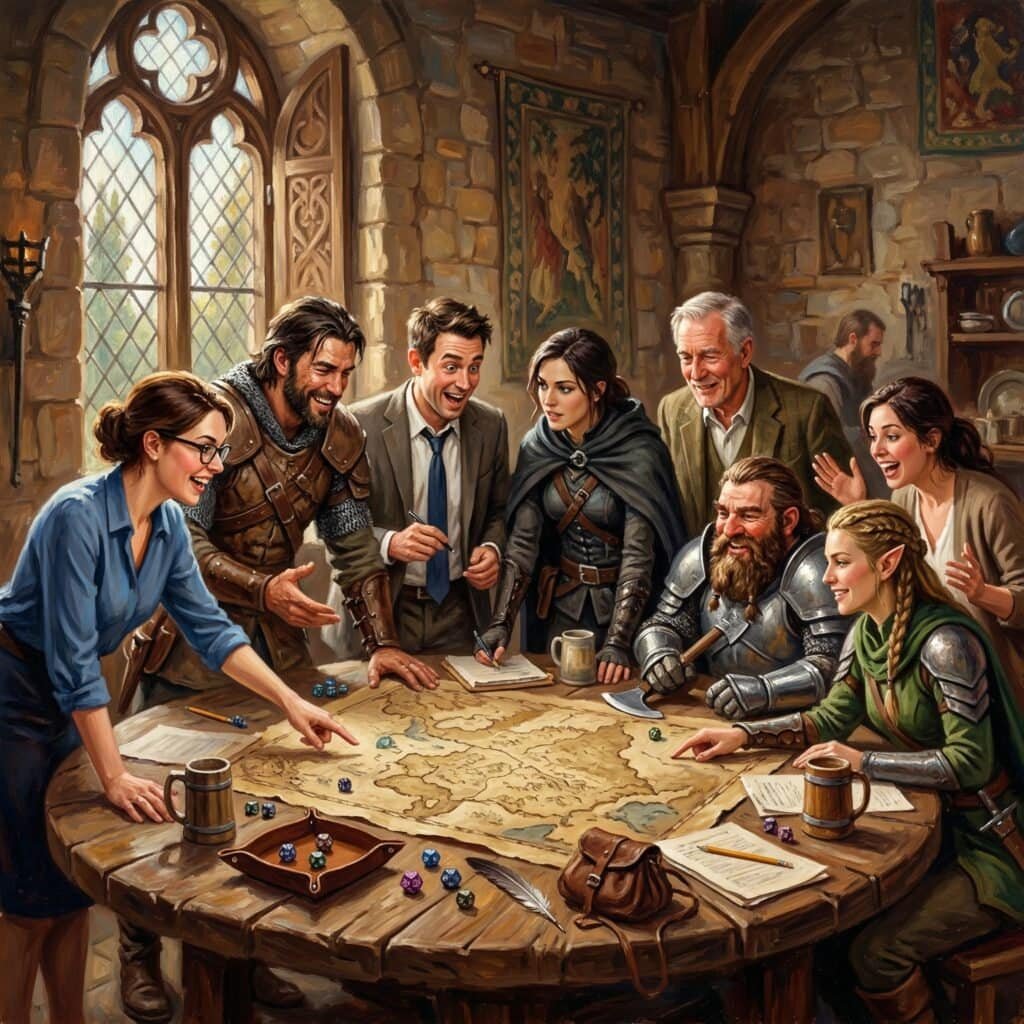

D&D team building is one of the most underused options available to anyone planning a corporate or professional group event. Most team building activities produce the same outcomes: a few hours of mild discomfort, a catered lunch, and a return to work the following Monday where nothing has actually changed. A well-run D&D one-shot produces something different — a shared experience with genuine stakes, real collaborative decisions, and a story the group made together.
The reason it works is the same reason D&D works at any table: the game requires everyone to contribute, rewards different skill sets, and produces situations that nobody planned for in advance. That combination — collaboration under uncertainty, with real decisions and real consequences — is exactly what good team building is supposed to create. Most activities simulate it. D&D actually does it.
Why D&D Works for Professional Team Building
Corporate team building has a reputation problem, and most of that reputation is earned. Activities that feel forced, patronising, or designed for a different kind of person than the people in the room consistently fail to produce the connection they are supposed to create.
D&D sidesteps this problem in a specific way: it asks nothing of participants except willingness to try something. It does not require physical ability. It does not require specific cultural knowledge. It does not advantage extroverts over introverts or vice versa — in fact, D&D is one of the few group activities where someone who is quiet in meetings can be unexpectedly decisive in a crisis, and where someone who talks constantly in normal settings may find themselves listening carefully because the game rewards it.
The skills D&D develops and surfaces are also genuinely transferable. Decision-making under incomplete information. Resource allocation. Communication when the plan changes. Listening to what other people notice that you missed. These are not metaphors for professional skills. They are the same skills, in a different context.
Designing the Right Session for a Professional Group
A D&D team building session for a professional group is not the same as a regular D&D game night. The design choices are different.
Keep Mechanics Minimal
A professional group event is not a D&D tutorial. The goal is collaborative storytelling with light mechanical scaffolding — not a comprehensive introduction to the ruleset. Strip the session down to: roll a die when the outcome is uncertain, add a number if it is relevant, the DM tells you what happens. Most of D&D’s mechanical complexity can be handled invisibly by the DM, with players experiencing the outcomes without needing to manage the systems producing them.
Focus on Decision Points, Not Combat
Combat is the most mechanically intensive part of D&D and the least interesting for a team building context. A session built around investigation, negotiation, and collaborative problem-solving produces richer team dynamics than a session built around who rolls the most damage. Design or choose an adventure where the interesting decisions are about what the group wants to do, not about which character uses which ability.
Pre-Generated Characters Are Essential
Nobody in a professional team building context should spend time building a character. Hand out pre-generated sheets with two or three sentences of personality description. The character is a vessel for the player’s decisions — keep it accessible enough that they can pick it up and start playing immediately.
Session Length
Two hours is the right length for a professional group session. Long enough to develop a genuine story arc and produce the shared experience you are after. Short enough to maintain energy and fit into a typical half-day event format. A well-designed one-shot with minimal mechanical overhead runs comfortably in two hours with a group that has never played before.
What Roles Emerge in a D&D Team Building Session
One of the most useful outcomes of a D&D team building session is the roles that emerge naturally. People who are quiet in meetings speak up at the table. People who defer in normal work contexts make confident decisions in the fiction. People who are usually confident discover that they default to waiting for someone else to go first when the situation is genuinely uncertain.
None of this needs to be pointed out during the session — doing so would be patronising and would break the fiction. But the DM (or a facilitator observing the session) can note what they see and use it as the basis for a post-session conversation about team dynamics if the group wants that level of debrief.
Common patterns that surface:
- The person who gathers information before committing to a plan versus the person who acts and adjusts
- The person who notices what other players said three scenes ago versus the person who responds only to what is immediately in front of them
- The person who advocates for a plan versus the person who identifies the risks in the plan that everyone else missed
- The person who holds the group together when the plan falls apart versus the person who needs a clear direction to function effectively
These are team dynamics, not character flaws. The session surfaces them in a context that is low-stakes enough to be interesting rather than threatening.
Who Should Run the Session
The DM role for a team building session should go to someone experienced. This is not the right context for a first-time DM. The group has no prior frame of reference, the adventure needs to run smoothly without visible friction, and the DM needs to be watching the group dynamics as they facilitate the game — which requires enough experience that the mechanical side is automatic.
Options:
Internal DM: If someone in the organisation already plays D&D and is a confident DM, they are the ideal choice. They understand the professional context, know the people involved, and can personalise the adventure accordingly.
Hired DM: Professional DMs available through platforms like StartPlaying Games can be hired for a private corporate session. They bring experience with mixed-experience groups, can customise the session to the organisation’s context, and free the organiser to participate rather than facilitate. This is often the cleanest option for a formal team building event.
Facilitated Session: Some organisations use a light facilitation frame around a D&D session — a brief setup explaining what the group is doing and why, the session itself, and a short structured debrief afterward drawing connections between what happened in the game and what the team wants to think about in their actual work. This adds about thirty minutes to the total event but produces more transferable value.
Adventure Selection for Team Building
The adventure needs to require genuine collaboration, offer multiple solution paths, and produce at least one moment of crisis or unexpected development that tests the group. A few formats that work well:
Heist: The planning phase alone produces team building value — groups have to divide responsibilities, communicate about their approach, and coordinate. The execution then tests whether the plan was actually as good as it seemed. The Merchant’s Vault delivers this structure for small groups. Scale the complication level for larger teams.
Investigation: Each player finds different information that the group needs to synthesise. Requires listening, communication, and the ability to hold someone else’s insight as important even when you did not find it yourself. The Crimson Ceremony is a good example — four suspects, distributed evidence, a conclusion that requires the group to compare notes.
Defence: The group must protect something together against a threat that exceeds any one character’s ability to handle. Produces natural leadership moments and tests the group’s ability to act cohesively under pressure. Hold the Fifth, the Cinco de Mayo adventure, works in this format.
For the full range of adventure formats and how they differ in play, the complete guide to the best D&D one-shots covers genre, runtime, and player count considerations in detail.
Making the Case Internally
If you are pitching D&D team building to colleagues or leadership who are unfamiliar with the format, a few framings that help:
It is a collaborative problem-solving exercise with a narrative wrapper. The story is the engagement mechanism. The problem-solving and communication are the actual activity. Most people who resist “playing D&D” are fine with “a collaborative decision-making exercise where your choices have real consequences.”
It surfaces things that structured activities cannot. You cannot design a team building activity that reveals how someone behaves when the plan changes and resources are limited — except by creating a situation where the plan actually changes and resources are actually limited. D&D does this naturally.
It works across experience levels. D&D requires no prior knowledge, no physical ability, and no specific cultural background. It advantages nobody by design. That universality is genuinely rare in team building options.
Frequently Asked Questions: D&D Team Building
What if some team members are uncomfortable with fantasy or gaming?
Make participation genuinely optional. A team building activity that people resent attending produces worse outcomes than no team building at all. For groups with significant resistance, frame the session as a collaborative storytelling exercise rather than D&D specifically. Once people are playing, most resistance dissolves within the first fifteen minutes. The game sells itself; the framing just gets people to the table.
How large a group can you run D&D team building for?
One session works best for four to six players including the DM. For larger teams, run simultaneous parallel sessions with the same adventure — groups compare results and approaches afterward, which produces its own interesting conversation about different ways to solve the same problem. Two groups of five is more effective than one group of ten.
How do you debrief a D&D team building session?
Keep it light and optional. The most useful debrief is one or two open questions: what decision surprised you most, and what does that tell you about how the group works? Heavy-handed facilitation that forces connections between the fiction and real work dynamics can feel forced. Trust the experience to do most of the work, and let the debrief surface what naturally emerged rather than trying to manufacture insights.
Is D&D team building appropriate for remote teams?
Yes. Online D&D using video conferencing and a shared virtual table works well for remote team building. The collaborative dynamic translates — arguably better than many in-person team building alternatives that require physical co-location. A remote session requires a DM who is comfortable running online and a platform the group can access without installation barriers.
How do you handle someone who dominates the session?
The DM addresses this naturally through the mechanics — creating situations where the quieter players have specific information or abilities that the dominant player needs, giving each character moments that are clearly theirs, and pacing the session so that everyone has multiple scenes where they are the focus. An experienced DM manages spotlight distribution as a standard part of running a game; in a team building context it is simply more deliberate.
Planning a D&D team building session? The Ready Adventure Series from Anvil N Ink includes complete zero-prep one-shots with pre-generated characters and 2-3 hour runtimes — exactly the format a professional group session needs. Browse titles on Amazon or get the full library with the Complete Collection on Payhip.
D&D team building works because it does what most team building activities only claim to do: put people in situations where they have to actually collaborate, and let the results speak for themselves.