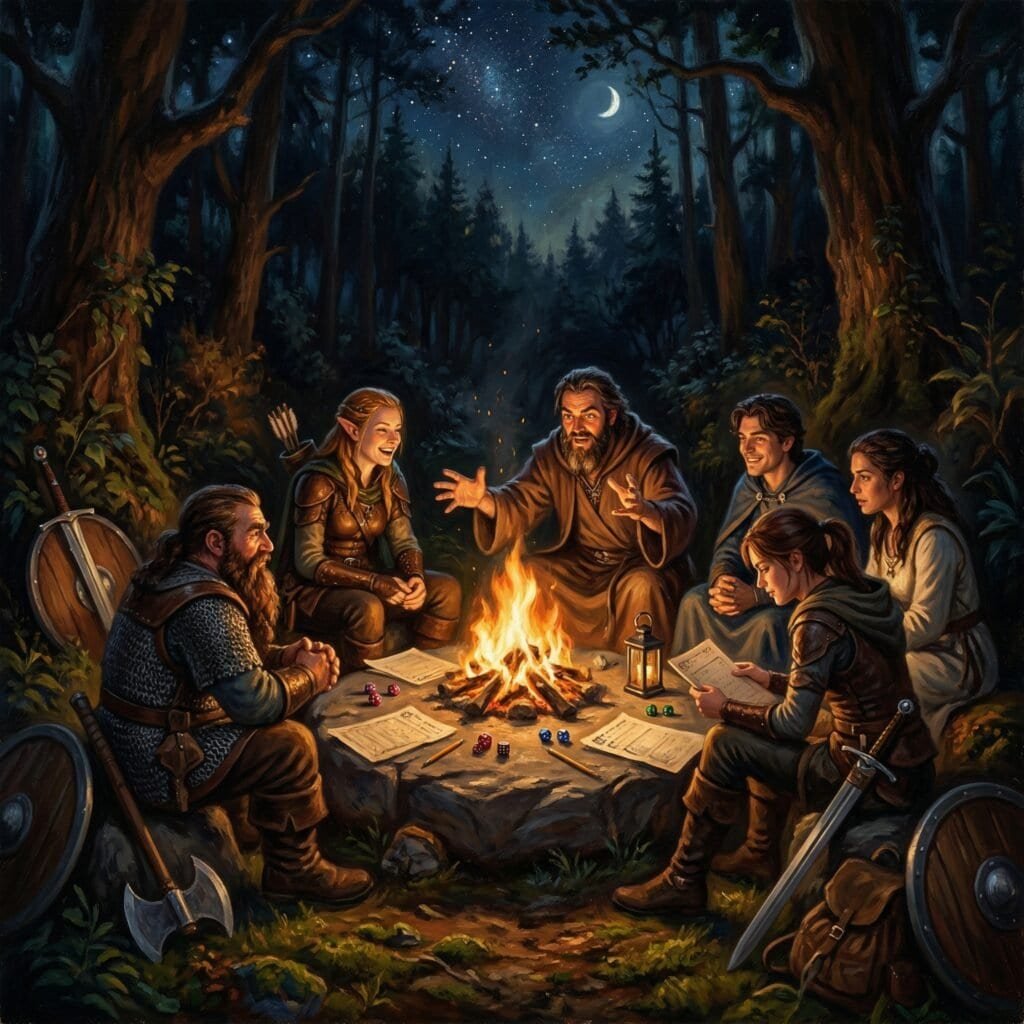

A D&D camping trip removes every excuse not to play. No screens competing for attention. No one checking their phone every ten minutes. No background noise from a city street or a busy house. Just a fire, a clear sky, and a group of people who have already committed to being present together for the duration of the trip. That is the ideal conditions for a D&D session, and most people who bring the game to a camping trip come back wanting to make it a tradition.
This guide covers how to run D&D off the grid — what to bring, how to adapt the format for outdoor play, which adventures work best in the camping context, and how to make the fire, the stars, and the environment part of the session rather than just background.
Why Camping Is the Best Possible D&D Setting
Every DM knows that atmosphere matters. Dim lighting, the right music, a quiet room — these things change what is possible at the table. A campfire at night delivers atmosphere that no indoor setup can replicate. The darkness outside the fire circle becomes the dungeon. The sounds of the forest become the sounds of the wilderness your characters are travelling through. The fire itself is the tavern hearth, the torch in the dungeon, the campfire your characters are huddled around.
The camping context also removes one of the biggest barriers to sustained D&D play: competing priorities. At home, there is always something else someone could be doing. At a campsite, there is not. The session gets the group’s full attention by default, and that sustained attention produces the kind of immersive session that is rare at a regular game table.
There is also something specific to the camping context that mirrors the D&D experience: you are already outside of ordinary life. You are already in a space where the normal rules are slightly suspended, where the physical environment is different, where the group is relying on each other in small practical ways. That baseline makes the transition into a fictional shared world considerably easier than it is in a living room.
What to Bring
Running D&D off the grid requires slightly more preparation than a regular session, but far less than most people assume. The essentials:
Printed Materials
Print everything before you leave. Adventure text, pre-generated character sheets, any reference material the DM needs. You will not have reliable internet access. Do not assume you can look anything up. A printed copy of the adventure in a waterproof bag or folder is non-negotiable.
Dice
Bring physical dice — one set per player if possible, backup sets in the DM’s bag. Dice apps require phone battery and screen light, both of which are better conserved for other uses. Physical dice also feel more correct around a campfire in a way that is hard to articulate but immediately obvious once you are playing.
Lighting
The campfire provides atmosphere but not reading light. Each player needs enough light to read their character sheet. Headlamps are the practical solution — hands-free, pointed exactly where needed, and they preserve night vision for the rest of the group when not in use. A small lantern at the centre of the table supplements the fire for the DM’s reference materials.
A Flat Surface
Dice roll off uneven ground and get lost in the dark. A folding camp table, a large cutting board, a flat rock, or even a groundsheet stretched across a cooler provides enough surface for dice and character sheets. Battle maps are impractical in a camping context — theatre of the mind is the right format for outdoor play.
Weather Protection
Paper and dice do not like rain. A tarp or awning over the play area protects both. A zip-lock bag for character sheets and dice provides backup if the weather turns unexpectedly. Plan for conditions to be worse than the forecast and pack accordingly.
Adapting the Format for Outdoor Play
A camping D&D session needs a few adjustments from a standard indoor game to work well in the environment.
Theatre of the Mind Only
Leave the battle maps and miniatures at home. Theatre of the mind — pure description, no physical representation of positioning — is actually better suited to a campfire context because it keeps everyone’s attention on the DM and on each other rather than on a map. The darkness outside the fire circle handles combat atmosphere better than any tactical grid could.
Shorter Sessions or Clear Stopping Points
Camping days are physically active. People are tired earlier than they would be at home. Plan for a 90-minute to 2-hour session rather than a full three-hour run. If the group is energised and wants to continue, you can extend. If people are fading, a natural stopping point lets everyone rest without the session feeling cut short.
Lean Into the Environment
The forest sounds, the fire, the darkness, the weather — all of these are free atmosphere that most DMs would kill to replicate indoors. Use them deliberately. If an owl calls outside the fire circle, something just moved in the trees near the party’s camp. If the wind picks up, the storm the characters were warned about is arriving sooner than expected. If the fire pops loudly, something just happened nearby. The environment is your co-DM; let it contribute.
Simplified Rules
In low light, referencing complex rules tables is slow and breaks immersion. Run the session from memory as much as possible, making confident rulings and checking references only when genuinely necessary. Players who are in the right environment will follow a confident DM over a technically precise one every time.
Adventures That Work Around a Campfire
The camping context suits some adventure formats considerably better than others.
Wilderness and Survival
The obvious match. An adventure set in a wilderness environment — forest, mountain, coastal — resonates immediately with players who are sitting in exactly that kind of environment. Survival mechanics, weather events, and creature encounters all land harder when the players are already outdoors. The Frostfall survival adventure works well in this format — the environmental stakes mirror the physical context.
Horror
A campfire horror one-shot is one of the most atmospheric D&D experiences available. The darkness beyond the fire circle, the sounds of the forest, the isolation — these are genuine horror atmosphere elements that no indoor lighting setup can replicate. Spider’s Seminary and Little Lambs both work well in this context for groups that want that kind of evening. Establish safety tools before you start, and choose based on what you know about the group’s comfort with horror content.
Mystery
A mystery adventure around a campfire has an intrinsic atmosphere of secrets and revelation. The fire circle feels like a place where truth gets told. Investigation scenes feel different outdoors — more intimate, more weighted. The Crimson Ceremony’s four-suspect structure plays out well in an extended camping session where the group has time to discuss between scenes.
Folklore and Fairy Tale
Stories told around fires are the oldest form of the fairy tale tradition. A dark fairy tale one-shot in this context feels genuinely ancestral rather than just thematic. The Twelve Dancing Princesses, Pay the Piper, or Breadcrumbs all carry the right weight for a campfire setting. The dark fairy tale D&D guide covers the full range of this genre if you want to build your own campfire tale.
For the complete overview of adventure formats and genres, the guide to the best D&D one-shots covers what makes each format work and which adventures suit which contexts.
Making the Campfire Part of the Session
The fire is not just background. A few ways to bring it into the fiction:
Use it as a framing device. The characters are sitting around their own campfire. The DM is describing what happened during the day’s travel. The session begins with the group already in the world, already in the environment, already present in the fiction before anyone has rolled a die.
Let it mark time. As the fire burns down, the night deepens. The world outside the light gets darker. The session naturally creates a sense of passing time that indoor sessions cannot replicate. When the fire is at its peak, the danger is at its peak. When the embers are low, the session is reaching its close.
Use it for dramatic moments. A piece of paper burned in the fire is a message destroyed. A torch passed from one character to another is a moment of trust. The fire itself is a resource — it can be maintained or let die, and what happens to it can matter to the story.
Frequently Asked Questions: D&D Camping Trip
How do you handle dice rolling in the dark?
Keep a small patch of light — a headlamp pointed at the rolling surface, or a lantern nearby — specifically for dice rolls. Designate a flat surface everyone rolls on so dice do not disappear into the dark. If a die goes off the surface and cannot be found, reroll. Simple rule, no argument.
What if it rains during the session?
Have a covered backup location — a tent porch, a vehicle, a cooking shelter. Know before the session starts where you would move to if weather turns. Moving a session mid-play is disruptive but manageable if the backup location is already identified. Moving it mid-play when nobody knows where to go is chaotic.
Can you run D&D without a table — just sitting around the fire?
Yes. Clipboards or hardback books work as individual writing surfaces for character sheets. Dice can roll on a small cutting board or camp plate in the centre of the group. The informal seating arrangement actually suits a campfire session — the circle feels right for a group of adventurers sharing a fire.
How do you keep track of character sheets and notes without good light?
Simplify what players need to track. For a single session, hit points, one or two key abilities, and the character’s core personality note is enough. Everything else the DM can manage or hand-wave in the moment. Players who are not reading their character sheet every round are players who are more engaged with the story.
Is a camping D&D session appropriate for children?
Yes, with the right adventure and the right tone. Keep sessions shorter for younger children, choose age-appropriate content, and make sure the outdoor environment is genuinely safe and comfortable before adding the cognitive overhead of a game. Children who are cold, tired, or unsettled by the outdoor environment cannot engage with D&D. Children who are comfortable and excited will engage more fully outdoors than they would indoors.
Looking for the right adventure for your camping trip? The Ready Adventure Series from Anvil N Ink includes zero-prep one-shots with pre-generated characters — easy to print, easy to run by firelight. Browse titles on Amazon or get the full library with the Complete Collection on Payhip.
A D&D camping trip works because the environment does half the DM’s job for free — and the half that remains is the most fun part anyway.