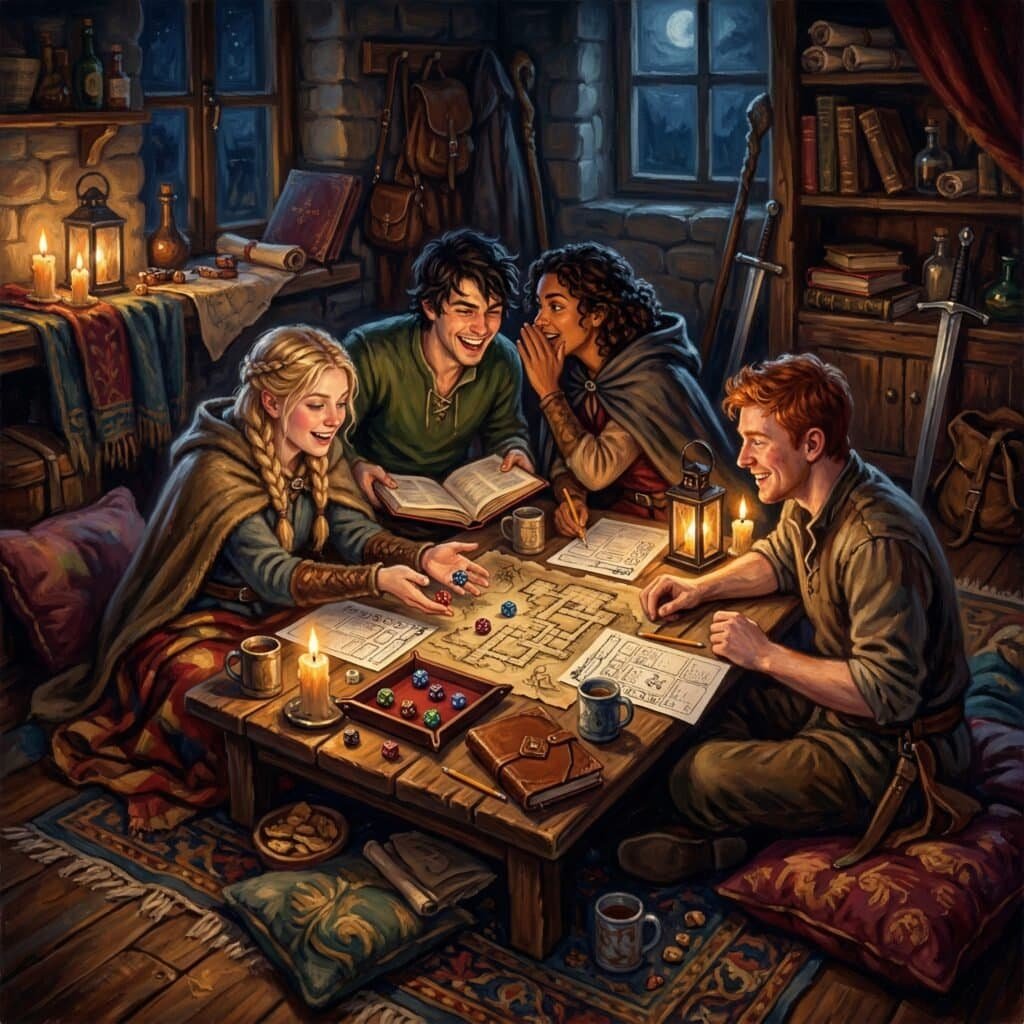

A D&D sleepover is one of the best things you can do with an overnight format that most sleepover activities completely waste. The standard sleepover itinerary — films, snacks, staying up too late talking about nothing — is fine. A D&D one-shot followed by continued play into the night, with characters who persist across the evening and a story that develops over multiple sessions separated by sleep and breakfast, is genuinely memorable in a way that watching films together is not.
This guide covers how to structure a D&D sleepover for kids and teens, how to choose adventures that work in an overnight format, and how to make the most of the extended time window that a sleepover provides without burning everyone out before midnight.
Why Sleepovers Are the Ideal D&D Format
D&D normally has a time constraint. You have three hours, maybe four, and then people go home. The sleepover removes that constraint entirely. Players can stop when they are tired, pick up again in the morning, and continue the story over breakfast. That extended timeline changes what is possible at the table.
A single one-shot in the evening is the obvious approach, and it works well. But the sleepover format also supports something more ambitious: a short campaign across two sessions, with the natural break being sleep itself. Session one runs in the evening. Players go to sleep with unresolved questions — what is behind the door, who sent the letter, what the monster actually wants. They wake up and continue. The overnight break becomes part of the narrative experience.
This is something that no other format produces. The story continues even while the players are not at the table, because their minds keep working on it.
Structuring the D&D Sleepover
A sleepover D&D session has more flexibility than a standard game night, but it still needs structure to work well. A few approaches that succeed consistently:
The Single One-Shot (Evening Only)
Run a complete one-shot adventure in the evening — 2-3 hours — and leave the rest of the night for other activities. The D&D session is the anchor event, not the entire sleepover. This works best for groups where not everyone is equally enthusiastic about extended play, or where the host wants a guaranteed endpoint to the formal gaming.
The Two-Part Adventure
Design or choose a two-part adventure specifically for the overnight format. The first session ends at a natural cliffhanger — the party has entered the dungeon but not yet reached the boss, or they have identified the culprit but have not yet confronted them. The second session runs in the morning over breakfast. Each part runs 90 minutes to two hours. Total play time is three to four hours, spread across the overnight.
The Open Adventure
For groups with strong D&D enthusiasm, run an open-ended session that continues as long as players want to keep playing. Set a “lights out” time, but within that window, let the session run at whatever pace the group sustains. Some groups will play until midnight; some will wrap at ten and move to something else. The open format accommodates both without forcing either.
Age Considerations
The right approach varies considerably by age group.
Ages 8-10
Keep the session to 60-90 minutes and prioritise spectacle over complexity. This age group responds to vivid description, clear heroes and villains, and moments where their character does something obviously impressive. Dice rolls should produce dramatic results — successes are heroic, failures are funny rather than consequential. End the session before attention flags, on a high note, and leave them wanting more rather than waiting for it to be over.
Ages 11-13
This is the sweet spot for sleepover D&D. Old enough to engage with genuine narrative complexity, young enough to be fully invested in the adventure. Two-hour sessions work well. Moral choices with real consequences start to land at this age. NPCs with distinct personalities become memorable rather than confusing. The overnight format is genuinely exciting rather than just extended.
Ages 14+
Treat them like adult players with a slightly shorter attention window. They can handle full D&D 5e mechanics, complex moral situations, and extended sessions. The main adjustment for a teen sleepover is tone — keep it engaging and avoid anything that feels patronising. Teens who feel like they are being talked down to disengage fast. Teens who feel like they are being taken seriously as players stay invested indefinitely.
Choosing the Right Adventure
For a sleepover context, the adventure needs to feel like an event, not just a session. A few qualities that matter specifically here:
A strong central mystery or hook. Something that players will be thinking about during the overnight gap. The best two-part adventures end their first session with an unresolved question that is compelling enough to dream about. What is the monster actually protecting? Who sent the anonymous warning? What is behind the locked door that nobody has been able to open?
Discoveries that reward continued play. Each session should reveal something that changes what the players thought they knew. A sleepover adventure that front-loads all its revelations in the evening session leaves nothing for the morning. Space the significant discoveries across both sessions so the second session feels like a payoff rather than an epilogue.
Age-appropriate content. For younger groups, horror is off the table. Moral complexity should be accessible — choices between clear options rather than genuinely ambiguous situations. For teen groups, both horror and moral complexity can work well, with appropriate safety conversations before play starts.
From the Anvil N Ink catalog, the adventures that work best in an overnight format are those with investigation threads that players can continue thinking about between sessions. The Crimson Ceremony has four suspects and enough distributed evidence that players will genuinely debate who did it before the second session. The Extraction Job has a midpoint revelation that changes everything — structurally perfect for an overnight break between sessions one and two.
For the full range of adventure options, the complete guide to the best D&D one-shots covers every genre and format. The guide to D&D for 3 players is worth reading if the sleepover group is small — the dynamics of a three-player party suit the intimate sleepover context particularly well.
The Morning Session
If you are running a two-part adventure, the morning session has a different energy from the evening one. Players are rested but slightly scattered — they are thinking about breakfast, about going home, about whatever else the day holds. The morning session needs to move quickly and deliver on the promises the evening session made.
A few things that help:
- Open with a brief recap — not a long summary, just two or three sentences about where the adventure ended and what the group was trying to figure out. This re-anchors everyone without requiring them to remember every detail.
- Move to the climax faster than you would in a standalone session. The morning session should be the payoff, not more setup. If there were three more scenes planned before the final confrontation, cut two of them.
- End on a genuine conclusion. The morning session should feel complete, not like another cliffhanger. Players who go home with an unresolved story feel frustrated; players who go home with a finished story feel satisfied and want to do it again.
Practical Sleepover Setup
A few logistics worth thinking about before the session:
- Lighting: Dim lighting in the evening session creates better atmosphere than overhead lights. A lamp or two, maybe some candles if the age group is appropriate, changes the feeling of the room significantly.
- Snacks accessible during play: Things that do not require putting down dice — finger food, drinks with lids. Hunger kills concentration faster than almost anything else.
- Character sheets somewhere safe overnight: If running a two-part adventure, put the character sheets somewhere they will not be sat on, spilled on, or lost between sessions. A folder or an envelope per player works.
- A clear signal for when the session is over: Especially for younger groups, a clear ending ritual — the DM declaring the session complete, a moment of acknowledgment for what the group accomplished — helps transition out of the fiction. Endings that trail off produce more “wait, are we still playing?” confusion than endings that are deliberate.
Frequently Asked Questions: D&D Sleepover
What age is right for a D&D sleepover?
Eight is a reasonable minimum for active play participation. Younger children can participate in a spectator or assistant role. For a full two-part adventure across an evening and morning session, eleven or twelve is the age where the format really clicks — old enough to stay invested in an unresolved story overnight, young enough to be genuinely excited about it.
How do we handle a player who falls asleep during the session?
Let them sleep. Their character takes a rest, falls behind, or finds a safe spot to wait. Do not stop the session for one player who has run out of energy. If multiple players are falling asleep, that is the signal to wrap for the evening and continue in the morning.
Can we run a full campaign across multiple sleepovers?
Yes, and it is one of the most satisfying ways to run a campaign for a group that cannot meet weekly. Each sleepover is two sessions of a longer story. The characters persist, the stakes develop, and the overnight gaps become part of the narrative rhythm rather than interruptions to it.
What if parents are skeptical about D&D for their kids?
Invite them to observe for fifteen minutes at the start of the session. Most parental skepticism about D&D dissolves when they actually see what happens at a table — collaborative storytelling, creative problem-solving, kids engaged with each other rather than staring at screens. The activity sells itself; it just needs to be seen.
How do pre-generated characters work across a two-part adventure?
Keep the character sheets between sessions — either the DM holds them overnight or each player keeps their own. Note any changes to hit points, spell slots, or equipment at the end of the evening session so the morning session starts with accurate character states. A short rest between sessions is a reasonable narrative justification for partial resource recovery.
Planning a D&D sleepover? The Ready Adventure Series from Anvil N Ink includes zero-prep one-shots with pre-generated characters — easy to run as a standalone evening session or as the first part of a two-part overnight adventure. Browse titles on Amazon or get the full library with the Complete Collection on Payhip.
A D&D sleepover works because the story does not stop when the dice go away — it continues in the players’ heads overnight, and picks up again in the morning with everyone wanting to know what happens next.