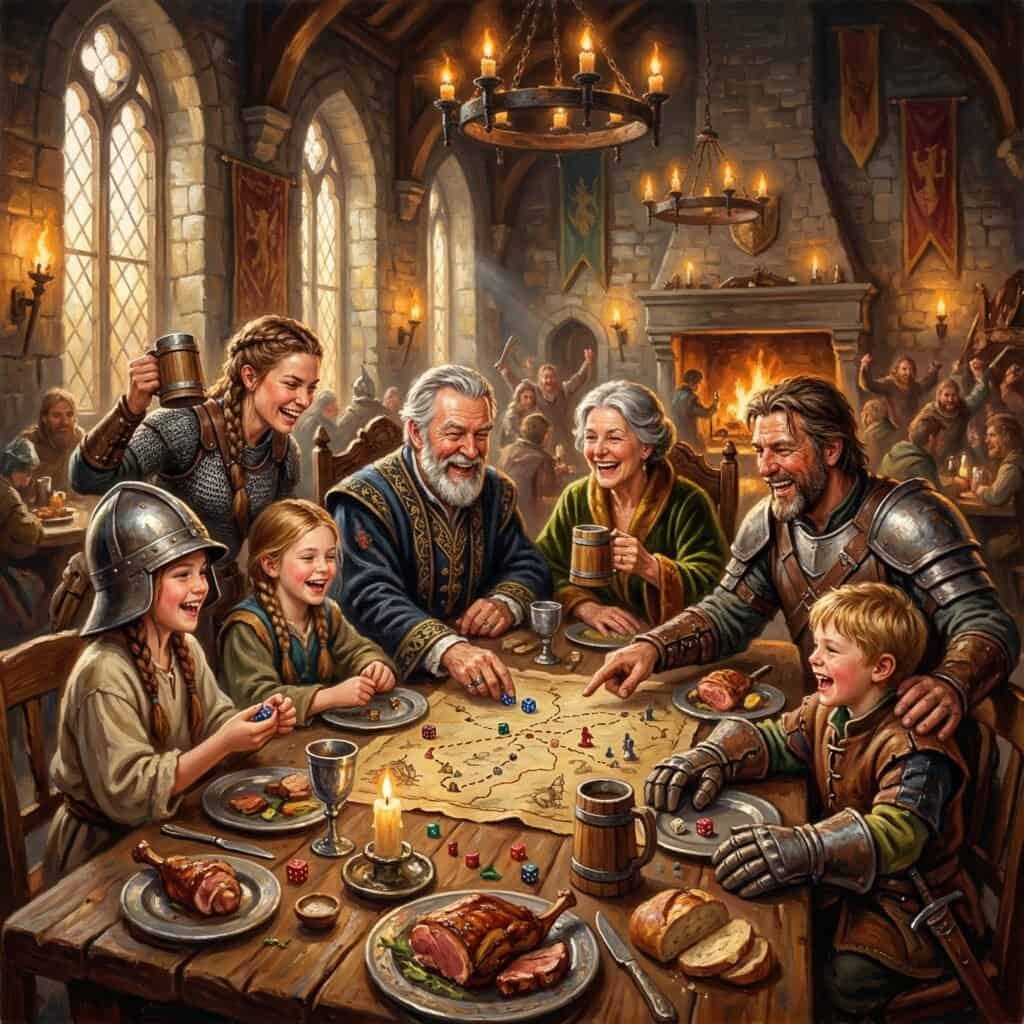

A D&D family reunion session is one of the most ambitious things you can attempt at a tabletop — and one of the most rewarding when it works. You are asking people across multiple generations, multiple experience levels, and multiple relationships to sit down together and make something collaborative happen. That is genuinely difficult. It is also genuinely worth doing, because a family that has a shared story to tell afterward has something that no amount of food and polite conversation produces.
This guide covers how to actually pull it off: structuring the session for multigenerational groups, handling the experience gap between someone who has been playing D&D for twenty years and a seven-year-old who picked up a d20 for the first time this afternoon, choosing an adventure that works across that range, and what to do when things go sideways in the ways that family events always go sideways.
The Core Challenge of Multigenerational D&D
Most D&D sessions assume rough parity across the table — similar experience levels, similar engagement styles, similar expectations. A family reunion session has none of that. You might have a retired grandparent who has never heard of D&D, a teenager who has been watching Critical Role for two years and has Very Strong Opinions About How This Should Be Run, a child who wants to be a dragon, and a parent who is quietly terrified of saying something wrong in front of the whole family.
The solution is not to find an adventure that perfectly serves all of those people simultaneously — that adventure does not exist. The solution is to design the session so that each person has a role that fits them specifically, and that the adventure structure accommodates widely different engagement styles without anyone feeling left out or overwhelmed.
Assigning Roles That Fit Each Person
Pre-generated characters for a family reunion session should be assigned rather than chosen. The DM should know the family well enough to match character personality to player personality — the quiet uncle gets the character who is observant and says less but notices more, the loud cousin gets the character who leads from the front, the grandparent who is skeptical about the whole thing gets the character with the practical skill set and the dry sense of humour.
For very young children (under eight), consider giving them a special role rather than a full character sheet. The party’s animal companion, which they control and describe but which does not have complex mechanics. The narrator of what the group is doing, which lets them participate in the storytelling without managing a stat block. A junior adventurer who helps the adult next to them make decisions, which keeps them engaged without putting the full weight of a character on them.
For teenagers with significant D&D experience, give them a character with enough mechanical depth to engage them, and consider explicitly asking them to help newer players rather than dominate the session. Framing this as a responsibility rather than a constraint usually lands well — experienced players often genuinely enjoy helping others learn, when given the opportunity to do so as a positive contribution rather than as a correction.
Keeping Mechanics Simple Enough for Everyone
A family reunion is not the place for full D&D 5e rules as written. Strip the mechanics down to the essentials: when the outcome is uncertain, roll a d20. Higher is better. The DM will tell you if the number is enough. That is the entire rules explanation that anyone needs to start playing.
Handle the complexity yourself as DM. Advantage and disadvantage happen behind the screen. Saving throws happen without explaining what they are. The only number a player needs to know is what to roll and what they got. The DM interprets everything else and translates it into fiction.
This approach does lose some of what makes D&D mechanically interesting. For a dedicated game group, that is a problem. For a family reunion, it is correct — the goal is a shared story, not a rules tutorial.
Choosing an Adventure for a Family Reunion
Three criteria matter specifically for this context: it must start immediately without explanation, it must have enough variety in scene types that different players get to contribute different things, and it must have a satisfying ending that the whole group can celebrate together.
Best Adventure Formats for Family Reunions
Community protection: The village is in danger and the adventurers need to save it. Clear stakes, obvious heroism, and a structure that lets every character contribute. The ending is always a celebration, which suits the reunion context. This format also scales well — adding more “villagers to save” is a simple way to give additional players meaningful things to do.
Recovery mission: Something important has been taken from someone the players care about. The emotional stakes are personal rather than abstract. Works especially well when the thing being recovered connects to something in the family context — a family heirloom, a beloved location, something that the family actually values.
Comedy: For families where the tone needs to stay light, an absurdist premise played straight produces the right energy. The Golden Rest — a retirement home for adventurers — works across age groups because the humour comes from the situation rather than from requiring anyone to be funny.
Formats to Avoid
Horror of any kind is off the table for a family reunion with children. Morally complex adventures that require sustained engagement with difficult themes do not suit a multigenerational group where some players are seven and some are seventy. Heist adventures that require careful information tracking during the planning phase can lose younger players who are not following every detail.
For the broader range of one-shot options and what makes each format work, the complete guide to the best D&D one-shots covers genre and player count considerations. For guidance on running D&D specifically for younger players, the D&D with kids guide covers age-appropriate adjustments and how to structure a session for children alongside adults.
Managing the Session When Things Go Sideways
Family events go sideways. Someone arrives late. The child needs a snack break twenty minutes in. Two relatives have not spoken since Christmas and are sitting next to each other. The teenager is visibly bored and checking their phone. A grandparent is confused about what they are supposed to be doing.
The DM’s job in these moments is to keep the session moving without making anyone feel bad about the disruption. A few practical tools:
Give the late arrival an entrance. When someone joins mid-session, do not pause everything to catch them up. Have them arrive as a new character or a returning ally — “you recognise a figure approaching from the road” — and incorporate them into the scene already happening. This is more fun than a recap and does not penalise players who were already engaged.
Build in natural break points. A session for a family reunion context should have a clear midpoint beat — a moment of relative calm between the setup and the climax — where a five-minute snack break happens naturally. Plan for it rather than hoping the adventure runs uninterrupted.
Let the confused player watch. If someone is genuinely lost and does not want to be rescued from that feeling, let them observe for a few minutes. Most people who feel lost at the start of a D&D session find their footing within ten minutes of watching other people play. Forcing engagement before someone is ready is counterproductive.
Give the bored teenager something to do. If an experienced player is disengaged, give their character a specific responsibility: they are the one who notices the thing nobody else spotted, or they are the one the key NPC specifically wants to talk to. A player with a clear role re-engages faster than a player who is waiting for something interesting to happen.
Making It About the Family, Not Just the Game
The best family reunion D&D sessions use the adventure as a vehicle for something that is genuinely about the specific family playing it. A few ways to do this without rewriting the entire adventure:
- Name NPCs after family members — minor characters, town residents, the shopkeeper who helps the group. People notice when their name appears in the fiction and it immediately generates the right kind of laughter.
- Make the thing being protected something that connects to the family specifically — a tradition, a location, something that has meaning in the family’s shared history.
- Give the oldest and youngest players a scene together — a moment where the experienced elder character helps the young one, or where the young one notices something the elder missed. These moments land because they mirror the actual family relationship.
Frequently Asked Questions: D&D Family Reunion
What age is appropriate for a family reunion D&D session?
Six or seven is a reasonable minimum for active participation with simplified rules. Younger children can participate in a spectator or junior helper role. The upper age limit is whatever age the adults in the family are — D&D has no age ceiling, and older players who are willing to try it often become the most enthusiastic converts.
How long should a family reunion D&D session run?
Ninety minutes to two hours is the right target for a multigenerational group. Younger children lose focus after ninety minutes regardless of how engaging the session is. Two hours keeps adults engaged without outlasting the kids. Build in one break at the midpoint and plan to finish cleanly rather than running long.
What if some family members refuse to participate?
Do not push. Make participation genuinely optional and keep the table positioned so observers can watch without feeling obligated to join. Reluctant observers who watch for twenty minutes and then ask if they can play are common. Observers who feel pressured into participation and then resent it are also common, and significantly less fun for everyone.
Do we need dice or can we use something else?
Physical dice are ideal — they are tactile, they feel like a proper game prop, and they give children something to hold and roll that makes them feel part of the action. A dice rolling app works if physical dice are not available. For very young children, a simple coin flip for uncertain outcomes removes the need to understand numbered dice at all.
How do we handle a child who wants to do something completely impossible?
Say yes and figure out what happens. A child who wants to be a dragon does not need to be corrected — they need a dragon-shaped pre-generated character, or they need the DM to describe their character as the most dragon-like adventurer in the region. The fiction is flexible. The child’s engagement is the priority.
Planning a family D&D session? The Ready Adventure Series from Anvil N Ink includes zero-prep one-shots with pre-generated characters and clear structure — the right foundation for a multigenerational table. Browse titles on Amazon or get the full library with the Complete Collection on Payhip.
A D&D family reunion session works because it gives everyone at the table — regardless of age, experience, or how they normally relate to each other — a shared story to tell afterward.