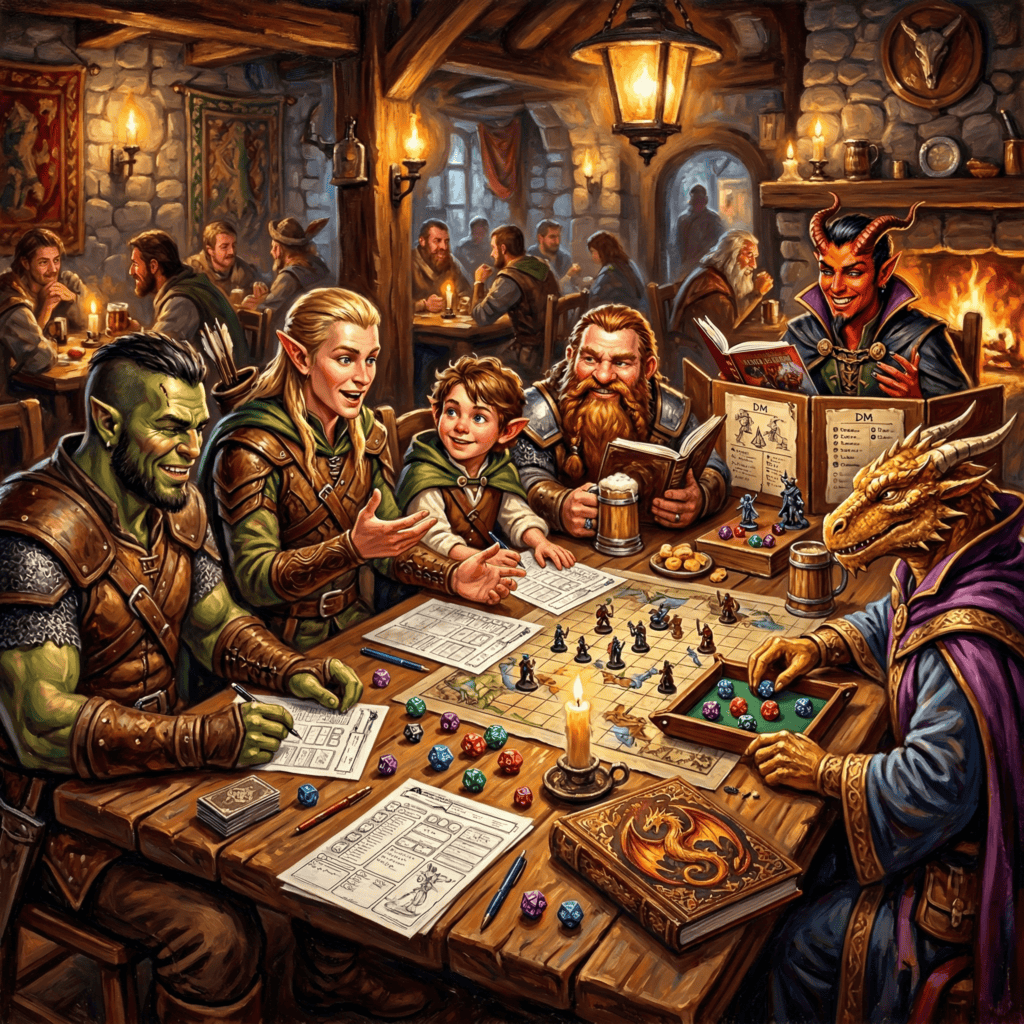

Adding a D&D one-shot to a regular games night is one of the lowest-friction ways to introduce D&D to people who already enjoy tabletop games. The group is already assembled, already in the right headspace for sitting around a table making decisions together, and already comfortable with the social contract of a game night. The only question is whether D&D fits that context — and with the right adventure and the right approach, it fits better than most people expect.
This guide covers how to slot a D&D one-shot into a games night without it feeling like a pivot to a different hobby, how to handle the mixed-experience situation that almost every games night produces, and which adventure formats work best when the goal is a fun evening rather than an introduction to a new roleplaying campaign.
Why Games Night Is the Best Place to Try D&D
Most first D&D experiences happen in one of two contexts: someone organises a dedicated D&D session, which carries expectations and stakes, or someone stumbles into a public open table at a game store, which is fine but impersonal. Neither is ideal.
A regular games night is a better introduction because the social context is already established. These are people who already like games. They already know how to be at a table together. They already have a shorthand for “let’s try something” without it being a big commitment. A D&D one-shot in this context is just the next game on the night — not a lifestyle change, not a new identity, just something to play.
That lower stakes framing produces better first sessions. Players who are not worried about whether they are doing D&D correctly are free to just play. And players who are just playing are the ones who have a good time.
Choosing the Right Slot in the Evening
Where you put the D&D session in the games night lineup matters more than most people realise.
Not first. Starting the evening with D&D before the group has warmed up socially produces a stiffer session than you want. Let the group arrive, settle, play something fast and familiar first — a card game, a party game, something that gets everyone laughing and comfortable. Then move to D&D.
Not last. The end of a games night is when energy is lowest and people are already calculating their journey home. A D&D session that starts at the point when people are ready to leave will feel rushed, get cut short, or not happen at all.
The middle slot. After the warmup game, before people start to wind down. The group is engaged, comfortable, and has enough evening left to give the session the time it deserves. For a two-hour one-shot, this means starting no later than halfway through the expected games night duration.
Format: Keep It Self-Contained
A games night D&D session is not the start of a campaign. It is a complete experience, like any other game on the table. The adventure needs to start and finish in the same session, with no loose ends that require follow-up and no characters that anyone needs to remember for next time.
One-shots are the correct format for this context. A well-designed one-shot runs 2-3 hours, has a clear start and finish, and leaves players with a complete story rather than a chapter break. If the session is good enough that the group wants to continue, that conversation happens after the session ends — not as a structural dependency built into the adventure.
Pre-generated characters are essential. Nobody at a games night should spend thirty minutes on character creation before play starts. Hand out sheets with brief personality notes and start playing immediately. The character creation conversation can happen later, if the group decides they want to run a campaign.
Handling Mixed Board Game and D&D Experience
A regular games night group almost always includes a mix of people: some who have played D&D before, some who have played other roleplaying games, some whose tabletop experience is entirely board games and card games, and occasionally someone who does not play games much at all but shows up for the social occasion.
This mix is not a problem. It is actually an advantage. Board gamers are already comfortable with rules, turns, and strategic decision-making. Card gamers are comfortable with resource management and probability. The D&D-specific skills — improvisation, in-character thinking, collaborative storytelling — are the ones they are less familiar with, and those are the ones the session itself teaches most effectively.
The adjustment for a mixed-experience group:
- Have one experienced player or the DM briefly explain the three things that happen in D&D: you describe what your character does, the DM tells you if you need to roll, and the result shapes the story. That is genuinely all anyone needs to start playing.
- Assign experienced players to sit next to newer ones, so mechanical questions can be answered quietly without stopping the session.
- Choose an adventure where the first decision is obvious and low-stakes — something that gets everyone making choices before they are worried about whether they are doing it correctly.
Adventure Formats That Work for Games Night
Not every one-shot format suits a games night context. The best ones share a few qualities: fast starts, clear objectives, and enough variety in scene types that different players get to shine at different moments.
Heist
The planning phase of a heist adventure is essentially a strategy game — the group has information, identifies roles, and builds a plan. Board gamers engage with this phase immediately because it maps onto skills they already have. The execution phase then tests the plan against reality, which produces exactly the kind of improvised problem-solving that makes D&D distinct from board games. The Merchant’s Vault runs this structure cleanly for 2-3 players; scale the complication level for larger groups.
Comedy
An absurdist premise played completely straight produces the right kind of games night energy. The Golden Rest — a retirement home for adventurers — requires no prior D&D knowledge and generates consistent laughter through situation rather than performance. Nobody needs to be funny. The premise does the work and the players respond to it.
Mystery
Board gamers take to mystery adventures naturally because the core activity — gathering information, identifying patterns, reaching a conclusion — is familiar from deduction games. The difference is that D&D mysteries are social and improvisational rather than mechanical. Players who are comfortable with Clue or Sherlock Holmes Consulting Detective will engage with the investigation phase readily. The Crimson Ceremony works well in this format.
Avoid on a First Games Night
Horror requires buy-in and sustained atmospheric commitment that a casual games night context makes difficult to achieve. Dungeon crawls heavy on tactical combat slow the pacing for groups that are not already fluent with D&D combat mechanics. Save both for later sessions once the group has decided they want to play D&D regularly.
For the full range of options sorted by genre and runtime, the complete guide to the best D&D one-shots covers what makes each format work at the table. For newer players in the group, the guide to D&D one-shots for beginners covers what makes an adventure genuinely accessible.
Running the Session Without Killing the Games Night Vibe
The biggest risk of adding D&D to a games night is that it becomes A Whole Thing — too serious, too slow, too much pressure to engage in a way that does not feel natural for a casual evening. A few things prevent this:
Keep the tone light. A games night D&D session is not the place to explore heavy themes or moral complexity. Save that for a dedicated session. Pick an adventure that has genuine stakes but does not require sustained emotional weight.
Move quickly. In a games night context, pacing is faster than in a dedicated D&D session. If a scene is not moving, move it. Skip descriptions that do not add to the experience. Get to the next interesting decision as quickly as possible. Players who are in a games night mindset will follow a faster pace more readily than a slower one.
Be explicit that this is one game among several. Frame the session as “let’s play this for a couple of hours and then see what else we feel like” rather than “we are playing D&D tonight.” The former is games night energy. The latter sets expectations that may not fit the evening.
Frequently Asked Questions: D&D Games Night
How long does a games night D&D session actually take?
With a zero-prep published one-shot and a group that has played games before, two hours is a realistic runtime. Add fifteen minutes for character sheet distribution and the initial explanation, and plan for the session to wrap in two hours fifteen minutes total. This fits comfortably in the middle of a four to five hour games night.
Do we need a dedicated DM or can we rotate?
For a first session, one dedicated DM produces a much better experience than rotating. The DM needs to know the adventure and manage the session — splitting that across multiple people adds friction. If the group enjoys the session and wants to make D&D a regular feature, rotating DM duties is worth exploring. For the first time, keep it simple.
What if the group wants to keep playing past the end of the one-shot?
That is the right problem to have. Have a conversation after the session about whether the group wants to run a campaign or make D&D a regular feature of games night. The one-shot served its purpose — now the group can decide what they want to do with that experience.
Can we add D&D to every games night?
Yes, if the group wants it. A rotating format — one-shot D&D every second or third games night, other games in between — works well for groups that enjoy D&D but also enjoy the variety of a traditional games night. The one-shot format is specifically designed for this kind of occasional play without the commitment of a regular campaign.
What is the minimum number of people for a games night D&D session?
Three total — two players and a DM — is the practical minimum for a games night context. Two players and one DM produces a focused, intimate session that works well. The complete guide to D&D for 2-3 players covers what makes small-group D&D distinct and how to run it well.
Ready to add D&D to your games night? The Ready Adventure Series from Anvil N Ink includes zero-prep one-shots with pre-generated characters and 2-3 hour runtimes — the right format for a games night session. Browse titles on Amazon or get the full library with the Complete Collection on Payhip.
A D&D one-shot fits a games night better than most people expect — because the skills that make someone good at games night are the same skills that make someone good at D&D.