
By Anvil N Ink Publishing · Updated May 2026 · 6 min read
Publisher’s note: this is one of our own titles, so the breakdown below is honest about what works, what doesn’t, and who it’s for — not a sales pitch.
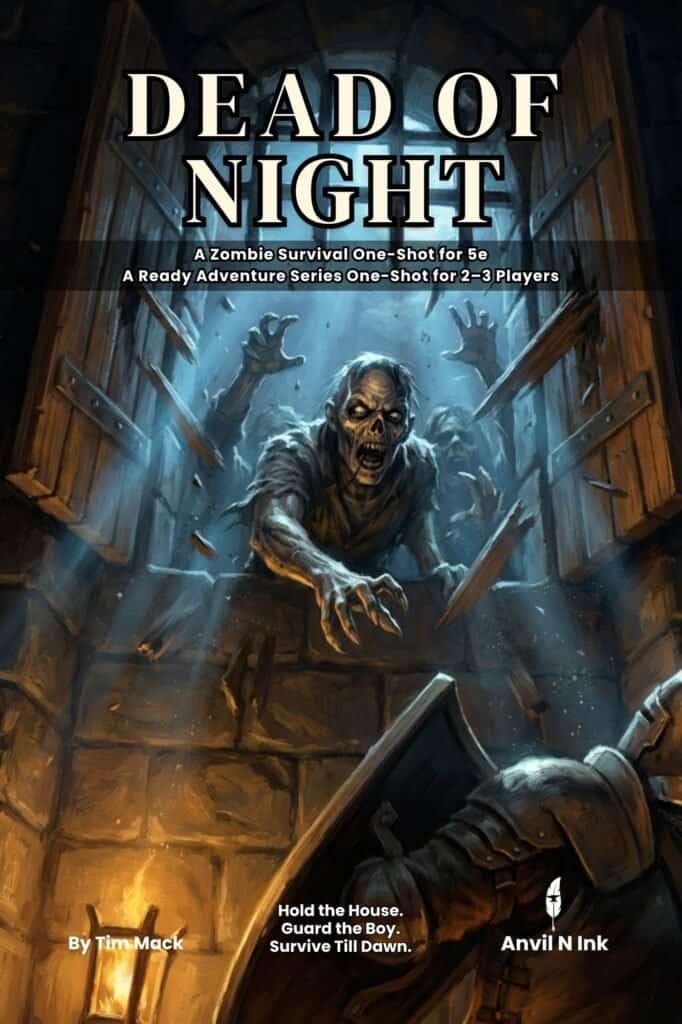
Dead of Night is a D&D zombie survival one-shot for two to three players at levels 2-3, built to run in a single session. The party fortifies a remote stone keep, scavenges the ruined countryside by day, and holds against escalating waves of the undead by night — until a century-old Death Knight arrives to claim a cursed child. It works best for small tables that like tension, hard choices, and a sunrise they have to earn.
A lot of one-shots promise survival horror and deliver one fight in a dark room. Dead of Night is built so the dread comes from attrition — the door that never quite holds, the resources that never quite stretch — instead of a single big monster. The whole four-night structure is shaped around that idea rather than a single climactic encounter.
The design leans on a single idea: the priest’s chant is both the clock and the lifeline. It grants the party a hard-won short rest each dawn, and the moment it breaks, the adventure is lost. That one rule turns a zombie survival adventure into a protection mission with real stakes.
The difference is the clock. A dungeon crawl ends when the rooms run out; a boss one-shot ends when the boss drops. A siege survival one-shot ends when the sun comes up — and getting there is the whole game.
About Anvil N Ink Publishing. Anvil N Ink publishes the Ready Adventure Series — zero-prep, 5e-compatible one-shots for small groups. Light the lamps, bar the door, and hold until dawn.
Running a whole spooky season?
This is one of many ready-to-run Halloween one-shots. See the full lineup sorted by theme, gothic, folk, undead, coastal, cosmic, and comedy-horror, all 5e and zero prep.
See all Halloween one-shots →What’s Included in Dead of Night?
Dead of Night is a complete, ready-to-run one-shot of roughly 80 pages, structured as a four-act siege with a day-and-night rhythm. You get everything needed to run it cold, with no prep beyond reading it once.| Element | What You Get |
|---|---|
| Structure | Four acts across four in-world nights, plus a full epilogue |
| Scavenge sites | Five fully detailed locations, each a skill-challenge scene |
| Creatures | Three statted undead, from shambling hordes to a Death Knight boss |
| NPCs & characters | Two key NPCs and four ready-to-play pre-generated characters |
| Maps | A keep battle map and a regional terrain map of every site |
| Support | Read-aloud text throughout, opening and closing hooks, and “what if” guidance |
Who Is This D&D Zombie Survival One-Shot For?
This adventure is tuned for two to three players at character levels 2-3, and for Game Masters who want a high-tension night without a week of prep. It is not a sprawling sandbox; it is a focused, escalating siege with a clear objective and a hard time limit. It suits a small group especially well — the math of “more entry points than defenders” is the heart of the tension, and it bites hardest at a table of two or three. Newer GMs can run it because every encounter includes tactics, contingencies, and read-aloud text. Experienced GMs get enough moving parts — the scavenge economy, the chant mechanic, the four-phase finale — to keep it interesting. If your table prefers pure social intrigue or open exploration, this tighter, combat-forward survival horror one-shot will feel more on-rails than you want, and that is by design.How Long Does Dead of Night Take to Run?
Dead of Night is designed to run about three to four hours for a group of three — longer than a typical two-to-three-hour one-shot, because it spans four nights of fiction. The waves are deliberately sized to resolve quickly, so the time goes to tension and decisions, not slogging through bloated combats. The day phases are skill challenges rather than extra fights, which keeps the pace moving, and the bulk of the page count is GM-facing reference you skim rather than read aloud. A confident GM who moves briskly through the early nights and saves the air for the final assault can land it inside a single evening. Plan for a long session, not a quick filler slot.Strengths and Weaknesses
Honest pros and cons, so you can buy the right adventure rather than the wrong one. Strengths: The prepare-by-day, survive-by-night loop gives players a real strategic decision every morning, and the consequences land that same night. The Death Knight is built to be outlasted rather than slain, which lets him be genuinely frightening for level 2-3 characters without becoming an unwinnable wall. And the protect-the-child core gives the finale an emotional weight most survival one-shots skip. Weaknesses: It runs longer than the two-to-three-hour Ready Adventure norm, so it is a full-evening commitment, not a quick filler. The structure is linear by nature — you are holding one location, not roaming — so groups who crave open exploration should look elsewhere. And it leans on the GM to pace the four nights; run them all at full intensity and the table can fatigue before the real climax. The middle nights are meant to breathe.How Does Dead of Night Compare to Other Survival One-Shots?
Most one-shots in this space fall into one of three shapes. Here is where a zombie survival one-shot like this one sits against the common alternatives.| Format | Core Loop | Best For |
|---|---|---|
| Standard dungeon crawl | Move room to room, clear encounters | Exploration and loot |
| Single boss showdown | Build-up to one climactic fight | A short, punchy session |
| Dead of Night (siege survival) | Fortify, scavenge, hold escalating waves to dawn | Tension, resource decisions, a last stand |
A Look Inside: The Scavenge-and-Siege Loop
Here is the rhythm in practice. On the second morning, the party can reach exactly one of five locations and return before dark. The abandoned monastery holds a blessed cross that will weaken the Death Knight on the final night. The collapsed barn holds timber that reinforces a window for every night that follows. They cannot have both. Whichever they choose, they are back at the keep by dusk to brace for a wave larger than the last — and the choice they made that morning is the difference between a window that holds and one that splinters inward at the worst possible moment. By the fourth night, every one of those small decisions is either paying off or coming due, all at once, with a Death Knight at the door and the sky going grey too slowly. That is the engine of the whole adventure: prepare in daylight, pay in the dark.Where to Buy Dead of Night
Dead of Night is available in paperback and Kindle on Amazon, and as a PDF on Payhip for tables who prefer a digital copy at the table. Use the buttons above to grab whichever format fits your group.Key Takeaways
- Dead of Night is a D&D 5e zombie survival one-shot for 2-3 players at levels 2-3.
- The loop is prepare by day, survive by night, across four escalating nights.
- A protected NPC’s chant is both the clock and the only source of rest.
- The Death Knight finale is designed to be outlasted, not necessarily defeated.
- It runs about three to four hours — a full evening, not a quick filler.
- Best for small groups that like tension, hard choices, and a hard-won ending.
Frequently Asked Questions
Can I run Dead of Night with three players? Yes. It is balanced for two to three players at levels 2-3, with scaling notes for smaller or larger groups built into the stat blocks. Do I need anything besides the book? No. It is a complete one-shot with stat blocks, four pre-generated characters, maps, and read-aloud text. You need dice and the core fifth-edition rules, available in the 5e System Reference Document. Is there a battle map? Yes — a printable map of the keep, plus a regional terrain map showing where each scavenge site sits. How dark is it? It is survival horror with a cursed child at its center, so the tone is grim. It carries content warnings up front, and the ending is built to be hopeful and earned. How is it different from a dungeon crawl? You are not clearing rooms — you are holding one location against rising waves while preparing for a known threat. The tension comes from attrition and choice, not exploration. Dead of Night is part of our Ready Adventure Series of zero-prep, 5e-compatible one-shots for small groups.About Anvil N Ink Publishing. Anvil N Ink publishes the Ready Adventure Series — zero-prep, 5e-compatible one-shots for small groups. Light the lamps, bar the door, and hold until dawn.
Get Your Copy
Choose your preferred format