
By Anvil N Ink Publishing · 9 min read
Anvil N Ink published this title, so the breakdown below is upfront about both its strengths and its weaknesses.
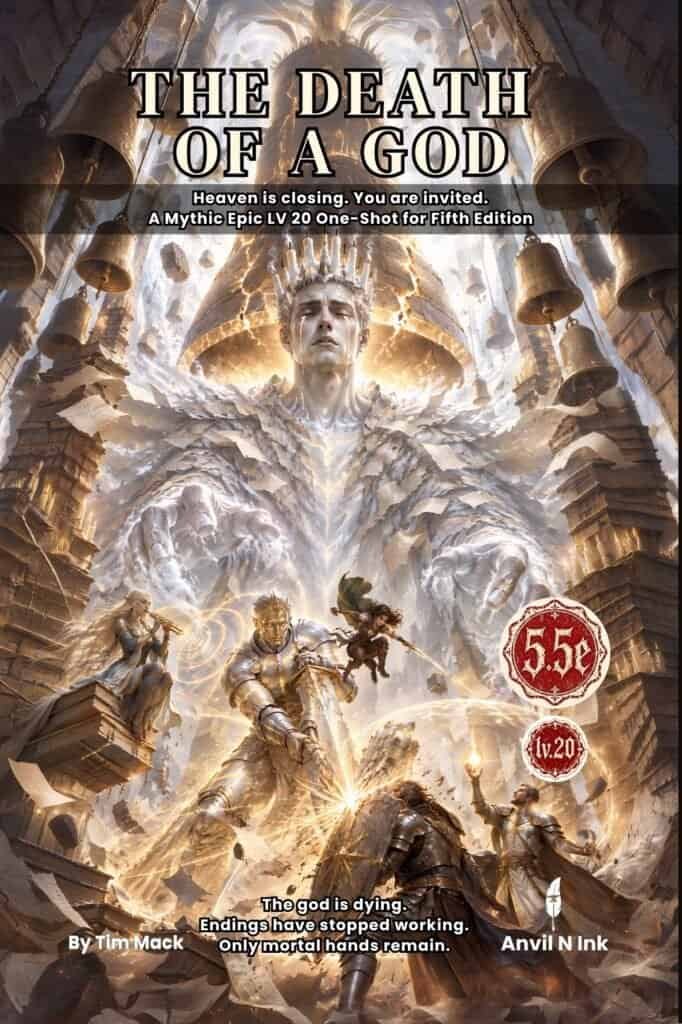
The Death of a God is a level 20 D&D one-shot for 5e: a complete, zero-prep mythic epic in which the God of Endings is dying tonight, and he has hired your legends to see it done right. It runs in one four-to-five-hour session for 3-5 players, uses the 2024 rules, and is written so a Game Master who has never run a level 20 table can open it and play.
Most level 20 play happens at the end of a long campaign, if it happens at all. Few groups ever get there, and the ones that do often find the published material thin, because almost nothing is written for heroes who can cast wish and shrug off death. This book is built for exactly that table, and for the much bigger group of players who have always wanted to know what level 20 feels like without spending three years getting there. If you want the opposite end of the scale, our review of The Harvest Tithe covers a level 0 funnel where nobody has a class at all.
How the story unfolds
For three thousand years Vessalon, the God of Endings, has closed every ending in the world: deaths and harvests, last pages and last looks, the ends of wars and the ends of fevers. Now his own ending has come, and endings turn out to be load-bearing. The dead linger past their time. Wounds refuse to close. A lich-king’s phylactery cracks and will not finish breaking. Somewhere, a war that should have ended yesterday is still being fought.
The heroes are legends with humble roots. Kings know their names, but the god did not choose them for the dragons they slew. He chose them for small deeds done before anyone knew them: a sickhouse door held for nine days in a fever, a dead man’s letters delivered, a vigil sung alone in the rain, a stranger given the full rites at dawn. Every year all four come home to the same one-room temple for the Vigil of Endings. Tonight the temple bell rings once for no reason, and the door opens onto a long grey road.
Act One is an audience with a dying god in a throne room run like a clerk’s office the size of a cathedral, and it ends in the first breach of a realm coming apart. Act Two hears the petitions of the dying realm and splits: end a war that cannot end, or recover a stolen book of last words from a library that keeps them all. Both roads cross the Sea of Unwept Tears. Act Three descends a candle stair to the Ember Vault and the tomb of the mortal the god used to be. Act Four climbs back up past the last guardian of the Halls to the court, where everything is decided.
What makes this level 20 D&D one-shot different
A clock that keeps everyone honest
The night runs on the Last Tolling, a bell count that starts at twelve and only goes down. Crossing the grey road rings it. Waiting too long rings it. Honest grief at the right moment buys a little time back. The count when the party reaches the court decides how hard the final trial will be, so every earlier choice still matters at the end. If it ever reaches zero, the god dies mid-sentence and the book hands you an emergency court to run instead.
A trial fought as a battle
Waiting at the end is a pale claimant with a legal right to the god’s last power and a case that is hard to argue with. The climax, the Crucible of the Court, is combat and courtroom at once. On their turns the heroes can fight or testify, and every testimony won strips the claimant of a power or a Legendary Resistance, while every one lost lets him strike the speaker. Players who never shine in a damage race get to win the fight with a speech about the worst night of their character’s life.
High-level magic that deepens the story
Level 20 heroes can teleport, cast wish, and come back from the dead, and this book plans for all of it. The Rules of the Halls say exactly what happens when the party tries: teleportation works anywhere inside the realm but cannot leave it, divination is answered by the god in person, and a hero who dies is filed by the office and returned once, with a card that reads OWES ONE ENDING. Every fight has a round-one plan and every creature has tactics, so the GM is never improvising a CR 27 boss from a bare stat block.
What’s included in The Death of a God
The book runs to 112 pages, and everything a Game Master needs is on the page.
- Four acts and fourteen scenes, with read-aloud text, skill checks with DCs, and an off-rails fallback in every scene
- The Last Tolling, a bell-count clock with act ceilings, vigil rites, and thresholds that change every fight
- Nine original creatures with full stat blocks up to CR 27, each with a round-one tactics plan
- Four ready-made level 20 heroes, a Champion fighter, a Thief rogue, a Lore bard, and a Life cleric, plus a Deed Worksheet for bringing your own characters
- Rules of the Halls for wish, teleportation, divination, resurrection, and banishment
- Seven maps: an area reference map and six battle maps
- Six opening hooks, eight What If contingencies, and five campaign seeds tied to the three endings
Want just the battle maps?
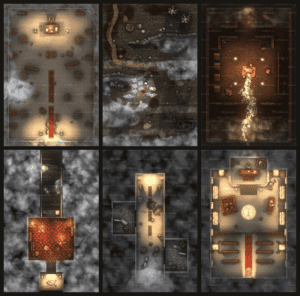
The full-color VTT and battle maps for all six fights, from the Throne Office to the Court, are sold on their own as The Death of a God Battle Maps on Payhip for $2.99. The pack has DM versions keyed to the book, clean player versions with no labels, and Universal VTT files with walls for Foundry and Owlbear Rodeo. If you own the PDF or paperback, they are free: the code is printed inside the book.
We built every one of these maps in Ink Hammer, our in-house map-making program.
Who is this level 20 adventure for?
First, it is for groups who have never played at level 20 and want to. The four ready-made heroes come with turn-by-turn notes on what to do first, so a player who has never held a level 20 sheet can still play one well. The GM gets the same help: tactics for every creature, and a page of rules that stops high-level magic from breaking the plot.
Second, it is a strong campaign finale. Bring your own level 20 party, fill in the Deed Worksheet for each character, and the god’s summons lands on the small kindness each one did before the world knew their name. Third, it suits a convention slot or a one-night event where a group wants something that feels enormous. It is built for four players and runs for three to five.
How long does it take to run?
Plan for one long session of four to five hours. The book budgets about fifty-five minutes for Act One, eighty-five for Act Two, seventy for Act Three, and eighty-five for the climax, plus the silences, which this book needs more than most. If you are running long, three cuts are safe: fold the Candle Stair and the Kiln into narration, let the last guardian yield after one round, and play the sea crossing as one group save. The tomb scene is the one the book tells you never to cut.
Strengths and weaknesses
The biggest strength is that the epic stakes come from very small things. The god is not a cosmic abstraction; he is a tired old man in grey with a cold cup of tea on his throne, and the heroes were chosen for a door, a bundle of letters, a song, and a hedgerow. That gives a level 20 story something most never have: a reason to cry. The second strength is the climax, where testimony and combat feed each other so neatly that the talkers and the fighters at the table both get the winning moment.
The weaknesses are real. This is a long session, and four to five hours is a big ask for some groups. Level 20 characters carry a lot of options, and even with the turn guides, a table new to high-level play will be slower in the first fight. The structure is mostly linear, with one branch in Act Two. The trial climax works best when at least one player is willing to speak in character; a table that only wants to roll damage will get less from it. And the themes are death, grief, and mercy throughout, handled gently but never avoided.
How this epic one-shot compares
The other titles below are Anvil N Ink Ready Adventure Series one-shots for smaller, lower-level tables. The Death of a God is the first in the series built for legendary heroes.
| Adventure | Level and players | Tone | Best for tables who want |
|---|---|---|---|
| The Death of a God | Level 20, 3-5 players | Mythic epic, grief | Legendary heroes, a dying god, and a trial fought as a battle |
| Where Dragons Die | Level 2, 2-3 players | Dragon fantasy, grief | A quiet story about witnessing an ending |
| The Blood Waltz | Levels 2-3, 2-3 players | Gothic horror | A vampire masquerade with no safe way out |
A taste of the writing
The read-aloud text carries the mood without asking the GM to improvise it. Here is the party’s first sight of the god:
The throne room of the God of Endings is a clerk’s office the size of a cathedral. Ledgers rise in columns to the ceiling. Bells of every size hang on racks like tools. At its heart, behind a desk built for someone much larger, sits a tired old man in grey, small enough to leave room on his own throne for a lantern and a cup of tea gone cold.
Where to buy The Death of a God
The Death of a God is available now as a DRM-free PDF on Payhip for $4.99, with the paperback and Kindle editions coming to Amazon shortly. The PDF and paperback both unlock the battle maps for free. For another one-shot about grief and endings, read our review of Where Dragons Die.
Key takeaways
- A level 20 D&D one-shot for 5e and the 2024 rules: a dying god, a realm coming apart, and three endings
- Complete and zero-prep: 3-5 players, built for 4, in one four-to-five-hour session
- The Last Tolling clock makes every choice count toward the final trial
- A climax where testimony and combat strip the villain’s power together
- Four ready-made legendary heroes, nine creatures up to CR 27, seven maps, and rules for wish and resurrection
- Battle maps sold separately for $2.99, free with the PDF or paperback
Frequently asked questions
Do I need experience running level 20 games?
No. That is the main design goal. Every creature has tactics, every fight has a round-one plan, the pregens have turn guides, and the Rules of the Halls answer the questions high-level magic usually raises mid-session.
Can I use my own level 20 characters?
Yes. The Deed Worksheet turns each of your characters’ backstories into the small deed that earned the god’s summons, and the court scenes use those deeds in testimony.
How many players does it need?
It is built for four and runs well for three to five. The book includes scaling notes, such as extra Legendary Resistance for the final boss when five heroes take the stand.
Does it use the 2014 or 2024 rules?
It uses the 2024 rules and the System Reference Document 5.2, but every stat block is written out in full, so tables still on the 2014 rules can run it with little or no adjustment.
About Anvil N Ink Publishing
Anvil N Ink Publishing makes Dungeons & Dragons one-shots for 5e, built for a single evening with zero prep. The Ready Adventure Series spans horror, comedy, heist, folk tale, and dragon fantasy, and now one mythic epic at level 20. For a darker night at a much lower level, read our review of The Blood Waltz, or browse the full catalog at anvilnink.com.
Answer the summons, carry the Ember, and give a god a good ending: The Death of a God is the level 20 D&D one-shot for every table that ever wondered what legends are really for.
Get Your Copy
Choose your preferred format