
By Anvil N Ink Publishing · Updated September 2026 · 8 min read
To run a megadungeon in D&D 5e, treat it as a living place, not a linear story: give players a non-linear map they choose their own route through, run time in dungeon turns, restock areas after they are cleared, and tie rewards to exploration. That structure — not the raw number of rooms — is what keeps a group hooked for months without weekly prep.
A megadungeon is the biggest commitment in tabletop gaming: a single dungeon so large it becomes the entire campaign. Run well, one location delivers months of play. Run badly, it collapses into a repetitive slog that burns the table out by session four. The difference is almost never the rooms themselves — it is how the Game Master structures the space, paces each night, and rewards curiosity. This guide covers that craft, with particular attention to the two- and three-player tables that usually get left out of the megadungeon conversation entirely.
What is a megadungeon?
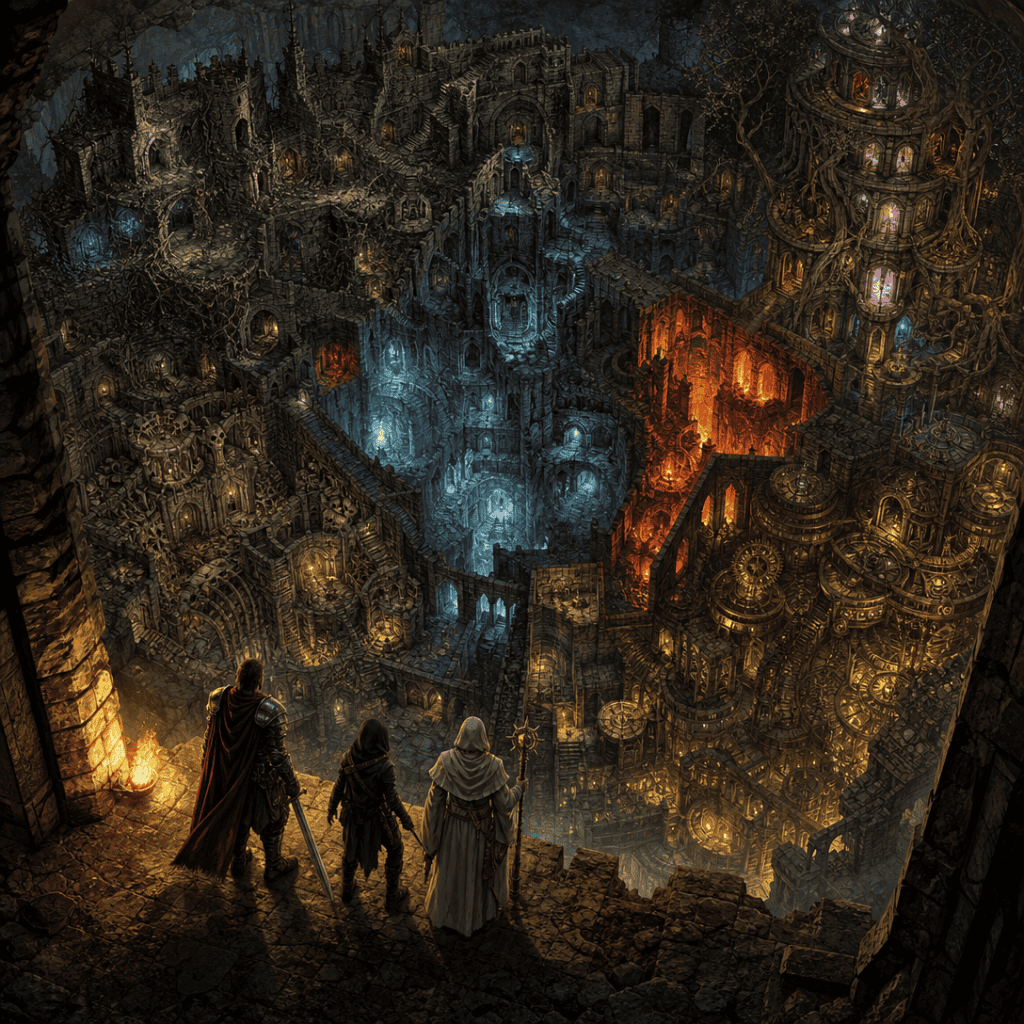
A megadungeon is a single dungeon large enough to sustain a whole campaign — dozens to hundreds of rooms across multiple themed levels or zones, designed for repeated visits rather than a single delve. Wizards of the Coast’s Waterdeep: Dungeon of the Mad Mage spans 23 levels; the original Undermountain and old-school classics like Rappan Athuk and Barrowmaze run to hundreds of keyed rooms each.
The form goes back to the beginning of the hobby. Gary Gygax’s Castle Greyhawk and Dave Arneson’s Blackmoor were both megadungeons, and the Old-School Renaissance revived the format with titles like Stonehell and Barrowmaze. What separates a megadungeon from an ordinary dungeon is not just size. It is that the dungeon is a persistent world with its own factions, ecology, and secrets, meant to be explored over time rather than cleared in a night.
| One-shot dungeon | Megadungeon | |
|---|---|---|
| Size | 5–15 rooms | 50–1,000+ rooms |
| Sessions | One | Five to dozens |
| Structure | Often linear | Non-linear, looping, multi-route |
| Prep | Read it once | Prep only the frontier each session |
| Progression | None needed | Milestone or gear track |
| Replay value | Low | High (restocking + reshuffling) |
How do you run a megadungeon without weeks of prep?
You prep the place, not the plot. Because a megadungeon is fully keyed — every room already written with its contents and read-aloud text — the Game Master’s job at the table is to referee exploration, not to author a story in advance. Prep the frontier your party is likely to reach next session, keep a random-encounter table within reach, and let player choices do the rest.
This is the counterintuitive part for GMs used to prepping one-shots: a bigger dungeon can mean less weekly work, not more, once it is written or bought pre-keyed. There is no branching narrative to plan, because the players write the route themselves. For small tables the load is lighter still — fewer characters means fewer subplots, faster combat, and a session that moves. If prep time is your real constraint, our guide to low-prep D&D adventures covers habits that carry straight over.
How do you keep a megadungeon fresh over months?
Three tools keep the same dungeon interesting session after session: a non-linear layout, restocking, and reactive factions. A linear corridor is forgotten the moment it is cleared; a looping, multi-route map invites choices, shortcuts, and second-guessing every time the party returns.
The design principle has a name. Justin Alexander’s essay “Jaquaying the Dungeon” (after designer Jennell Jaquays) lays out how loops, multiple entrances, and vertical connections turn a flat map into a space players genuinely navigate rather than march through. Add restocking — after an area is cleared, roll to repopulate it with wandering monsters, new factions, or shifting hazards — and the place the party left is not the one they return to. Living factions that pursue their own goals between visits do the same job. The dungeon changes while the players are away, and that change is the engine of replay.
How do you pace a megadungeon session?
Run exploration in dungeon turns — roughly ten minutes of in-world time each — and track the resources that create pressure: light, rations, and spell slots. A group deciding whether to push one more room or retreat to a safe camp is a group that is engaged. Aim to end each session on a natural beat: a cleared zone, a defeated boss, or a hard-won rest.
A reliable rhythm is the “delve”: the party descends, presses their luck against attrition, and pulls back to town or camp to recover before the next push. That loop gives every session a shape — a goal going in and a payoff coming out — instead of an open-ended wander. Two- to three-hour sessions typically clear a handful of rooms and one set-piece, so plan a stopping point rather than letting the night trail off mid-corridor.
How do you handle loot and progression in a megadungeon?
Put rewards in the rooms, not just on the bosses. The oldest problem in a dungeon crawl is giving players a reason to open a door they could safely walk past — so tie treasure, keys, and consumables to exploration itself. A simple keys-and-chests loop, where clearing a room earns a key and keys open the zone’s vaults, turns curiosity into its own payoff.
For progression, favor milestone levelling or a fixed gear track over counting experience across hundreds of rooms — the bookkeeping of awarding XP room by room is exactly the friction that stalls a long campaign. Cap any repeatable hazard or respawning encounter so a short-handed party cannot be ground down by attrition it can never out-earn. The goal is forward motion: every room should either advance the party or cost them something that matters.
How do you run a megadungeon for 2 or 3 players?
Megadungeons assume a full party of four to six, so a duo or trio needs real adjustment: cut the number of enemies per encounter rather than their difficulty, cap burst damage so no single hit drops a full-health hero, guarantee a gear track so the party never stalls out under-equipped, and build in non-combat outs — stealth, negotiation, a door to run through. The small-group encounter-balancing math is the same skill you would use for any small-table adventure, applied at scale.
That adjustment work is real, though — and it is exactly what a purpose-built book removes. The 100-Room Citadel is a replayable 5e megadungeon tuned for two or three players at levels 2–3 from the first roll: 100 keyed rooms across five zones, a dice-driven room engine that reshuffles the dungeon every session, 36 original monsters (none able to drop a full-health hero in one blow), and more than 100 top-down battle maps, so there is nothing to draw and nothing to rebalance. It is the megadungeon built for exactly the small table this whole guide is about.
What are the most common megadungeon mistakes?
The failures are predictable, and nearly all of them are structural rather than creative:
- A linear map. One route means no choices, and the crawl becomes a hallway.
- Prepping everything up front. You will burn out before session one. Prep the frontier only.
- Empty rooms with no reward. If exploration does not pay, players stop exploring.
- No stopping points. Sessions that trail off mid-corridor kill momentum.
- Ignoring party size. Running full-party encounter math at a two-player table gets characters killed.
Key Takeaways
- A megadungeon is a single dungeon big enough to be a whole campaign — designed for repeated visits, not one delve.
- Run the place, not a plot: keep it keyed, prep only the frontier, and let players choose the route.
- Non-linear layout, restocking, and reactive factions are what keep it fresh for months.
- Pace in dungeon turns, track light and resources, and end each session on a clear beat.
- Tie rewards to exploration, and use milestone or gear-track progression to avoid XP bookkeeping.
- Small groups need real tuning: fewer enemies, capped burst damage, a guaranteed gear track, and non-combat outs.
Frequently Asked Questions
How many rooms is a megadungeon? There is no fixed threshold, but most run from around fifty rooms to several hundred. Undermountain and Rappan Athuk exceed a thousand across all their levels; a hundred keyed rooms is plenty to carry a multi-month campaign.
How long does a megadungeon campaign take? Anywhere from a handful of sessions to years, depending on size and how thoroughly the party explores. A focused hundred-room dungeon runs about five sessions for a small group; a giant like Dungeon of the Mad Mage can anchor a campaign for a year or more.
Can you run a megadungeon with two players? Yes — with adjustment, or with a book designed for it. Cut enemy numbers, cap burst damage, and guarantee a gear track, or run one built for small tables from the start so the tuning is already done.
Do you need to prep the whole megadungeon before starting? No, and you should not try. Read the overall structure once, then prep only the area your party is likely to reach next. The rest waits, keyed and ready, until they get there.
About Anvil N Ink Publishing
Anvil N Ink Publishing makes zero-prep, 5e-compatible adventures for two and three players — one-shots, solo RPGs, and now a full megadungeon. The 100-Room Citadel is our hundredth title and our biggest: a replayable megadungeon that opens a different castle every session and keeps a small group climbing for months. New to running big dungeons? Start with our guide to running a D&D one-shot, or browse the full catalog of small-group adventures for 2–3 players.
The best megadungeon is the one your table actually finishes — and the ones that get finished are the ones built to stay fresh, session after session, without burning out the Game Master who runs them.