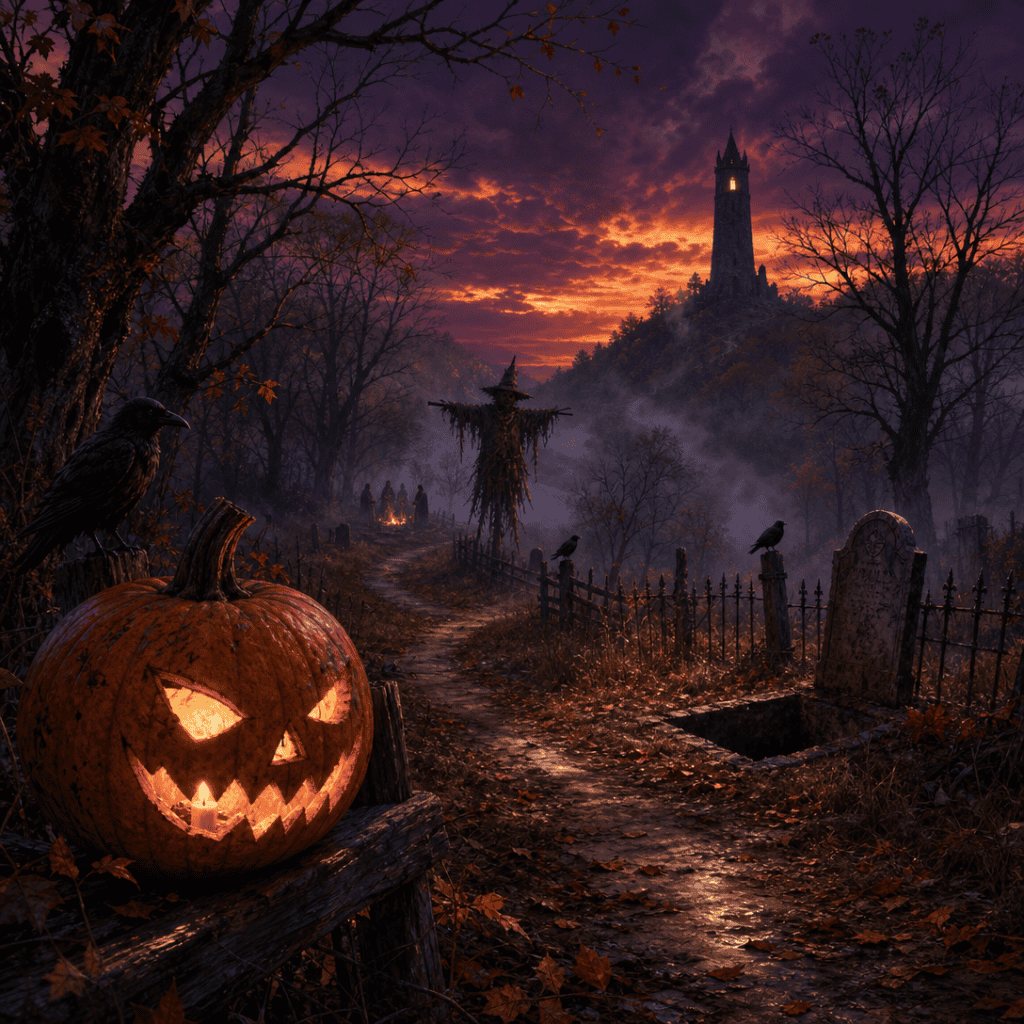

A 5-week Halloween D&D arc is the format where the table commits to a connected horror series across the month of October — five sessions, each escalating the dread, building toward a climactic finale on or near Halloween itself. Done well, the format produces one of the most memorable runs a small group can have. Done poorly, it’s five disconnected one-shots in a row. This guide walks through the arc session by session, covers the connective tissue that holds the series together, and identifies the published five-book series built specifically for this format.
Prefer a single spooky night to a full arc? See our guide to Halloween DND one-shots — top picks first, then the full lineup by theme.
Why a 5-Week Arc Works for Halloween
Most D&D Halloween content is single-session — one scary one-shot played the weekend before Halloween. This works, but it leaves dread on the table. Horror builds. A single session can’t escalate the way a five-session arc can. By the time the party reaches the finale, they’re not playing a session — they’re playing the consequences of four weeks of accumulated wrong.
Five weeks is the right length for several reasons. October has roughly five weekends, depending on the year — one session per weekend, with the finale falling on Halloween night itself. Five distinct horror subgenres (folk-uncanny, necromantic, paranoid, witch, finale) can be visited without repetition. The arc has a natural shape — a four-week climb followed by a Halloween-night finale. And the party has time to develop relationships with NPCs across the region, which makes the finale’s stakes real.
For 2-3 player tables, the format is especially powerful. Smaller parties build deeper connections to recurring NPCs. They remember names. They notice when characters die between sessions. The intimacy of a 2-3 player table, combined with a five-week dread curve, produces sessions players talk about for years.
The Arc Structure: Escalating Dread
The session order matters. Each week should feel slightly more dangerous, slightly more inexplicable than the last. The arc structure breaks down like this:
Week 1 — Local oddness. The party encounters something strange in a familiar setting (a farm, a field). Tone is uncanny but not hostile. Players walk away unsettled but successful.
Week 2 — Beneath the surface. The party investigates something the local community has been hiding. Tone is folk-horror grim. Combat starts to matter. Bodies are involved.
Week 3 — The pattern emerges. The party realizes the events of weeks 1 and 2 are connected. Something larger is moving. Tone is paranoid. The community itself becomes suspicious.
Week 4 — The architects. The party encounters the figures behind the pattern. Tone is direct-confrontation horror — these are intelligent enemies, not just monsters. Negotiation is on the table.
Week 5 — The climax. Everything from weeks 1-4 converges. The party either wins, loses, or wins at cost. Tone is high-stakes finale. Halloween night.
This isn’t four standalone sessions and a finale. Each session contains breadcrumbs for the next. By week 3, the party should be saying “wait — this is connected to what happened at the farm.”
Week 1: The Pumpkin Patch (Folk Uncanny)
The arc opens at a working pumpkin farm. The harvest is days away. Something is wrong with this year’s crop — pumpkins growing where none were planted, faces appearing on uncarved gourds, a particular pumpkin that no one will go near. The party arrives as outsiders (passing through, hired to help with harvest, friends of a local).
This session establishes the regional setting (the farms, the village, the surrounding country), the first NPCs the party will see again later, a small horror that resolves cleanly but leaves implications, and the first hint of the larger pattern (a name spoken once, a symbol seen once).
The session resolves with the immediate threat handled, but the party leaves with one specific question — usually about the village’s relationship with something old. That question becomes the spine of the arc.
The published title for this slot is The Great Pumpkin (Anvil N Ink — Shadows of Valdrus Book 1). Two hours, 2-3 players, level 2-3.
Week 2: The Crypt (Folk Horror, Necromancy)
The party — now familiar with the village — investigates something happening at the local cemetery or family crypt. Bodies are missing. Or moving. Or returning. The session is folk-horror in tone: the locals know more than they’re saying, the family with the crypt are not what they appear, and the necromancy involved is older than the village itself.
This session establishes the deeper history of the region (something has been happening here for a long time), a second set of NPCs the party will see again, the first hint that the events of week 1 weren’t isolated, and a name, a symbol, a date that recurs in week 3.
By the end, the party has solved an immediate problem but learned that something is patterned. The crypt’s contents are connected to the pumpkin patch’s wrongness in ways the party can almost — but not quite — articulate.
The published title for this slot is Below the Field (Shadows of Valdrus Book 2). Two hours, 2-3 players, level 3.
Week 3: The Scarecrow (Folk Horror, Field-Based Dread)
The party investigates rural disappearances. Travelers vanish on the road between villages. Their personal effects are found in the fields, neatly arranged. The scarecrows in those fields are new — and there are more of them every week. This session leans into folk horror: the community knows. The community has known for years. The community has reasons.
This session establishes the community’s complicity (a horror element distinct from external threat), the pattern the party has been noticing now becomes obvious, the architects behind everything are about to be named, and a specific antagonist appears for the first time, briefly.
By the end, the party has confirmed that the events are coordinated. Someone — or something — is doing this on purpose. The session ends with the party knowing where to go next, and the question is whether they’re prepared.
The published title for this slot is The Tall Man (Shadows of Valdrus Book 3). Two hours, 2-3 players, level 3.
Week 4: The Coven (Direct Confrontation)
The party tracks the architects to their meeting place — a coven of witches who have been orchestrating events across the region for generations. This session is direct: the party meets the antagonists, learns the why, and decides what to do about it. The witches are not unsympathetic. Their ritual is real. Their demands are coherent. The party can negotiate, fight, betray, or ally.
This session establishes the motive behind everything (which complicates the party’s options), the stakes of the finale (what happens if the ritual completes vs. fails), the personal cost of confrontation (an NPC the party has come to know is involved), and the exact site of the climax.
By the end, the party knows what they have to stop, where it’s happening, and when. The clock is now visible. They have one week before the finale.
The published title for this slot is The Three Sisters (Shadows of Valdrus Book 4). Two hours, 2-3 players, level 3-4.
Week 5: The Tower (Halloween Night Finale)
The finale. The party assaults — or infiltrates, or negotiates with — the central site where the season’s events culminate. Everything they’ve learned across four weeks pays off here. Every NPC they’ve met returns. Every choice they’ve made has weight. This session is longer (2.5-3 hours), more combat-heavy, and the only one in the arc with explicit win-or-lose stakes.
This session resolves the immediate threat (the ritual, the entity, the horror), the larger pattern (the regional history is closed, for now or forever), the personal stakes (NPCs the party knows live, die, or change), and the arc itself (the party walks away changed).
The published title for this slot is All Hallows’ Tower (Shadows of Valdrus Book 5). Two-and-a-half to three hours, 2-3 players, level 4.
Connecting Tissue Between Sessions
The five sessions only feel like an arc if you connect them deliberately. Three techniques:
Recurring NPCs. The blacksmith from week 1 is selling supplies in week 3. The priest from week 2 is missing in week 4. Names matter. When players hear a name in week 3 and remember the face from week 1, the world feels real.
Recurring symbols. A specific sigil appears in week 1 (carved into a pumpkin), week 2 (etched in the crypt), week 3 (sewn into a scarecrow’s chest). By week 4, the players see it and know — without being told — that they’re in the right place.
Recurring questions. Each session ends with the party not knowing one specific thing. That unknown carries to the next session. By week 5, the questions have stacked into a complete picture.
Don’t overdo it. Two or three threads is enough. Players should notice the connections, not be drowned in them.
Pacing the Dread Escalation
Across five sessions, the dread has to climb without exhausting the players. A few principles:
Give the players a win in week 1. They need to feel competent before they’re frightened. Week 1 ends with a clean victory, even if questions remain.
Introduce ambiguity in week 2. The party wins, but only partially. Some bodies are recovered, some aren’t. The crypt is sealed, but the seal isn’t permanent.
Loss starts in week 3. An NPC dies. A village burns. The party can’t save everyone. The dread is now real, not theoretical.
Week 4 is paranoia. The party is winning and losing simultaneously. The witches know more than they should. Information feels traded, not earned.
Week 5 is catharsis. Whatever happens, the arc closes. Players leave the table tired but satisfied.
If the dread plateaus or drops, the arc collapses. Each session must feel slightly worse than the last — even if the previous session ended with a win. Our D&D horror guide covers this in more depth, including why sustained maximum tension stops working after about three weeks.
Common Pitfalls in 5-Week Halloween Arcs
Treating it as five disconnected one-shots. The most common failure. Without recurring NPCs, recurring symbols, and recurring questions, the arc is just five Halloween-themed sessions. Players don’t experience escalation; they experience repetition.
Front-loading the horror. Showing the climax-level threat in week 1 leaves nowhere to go. The arc burns out by week 3.
Burning out the players. Five sessions in five weeks is intense. If the table is also playing other campaigns, schedule with care. Two-hour sessions, not four-hour sessions. Halloween night for the finale, not the week after.
Pre-planning every detail. The arc needs a spine, not a script. Leave room for the players to surprise you. The recurring NPCs you didn’t plan to revisit will become the ones the players remember most.
Skipping the buy-in conversation. Five-week horror arcs are heavier than standard campaigns. Talk to the players in advance. Confirm consent. Establish lines and veils. Players who opt in will commit; players who opt out will save you a failed arc.
The Published 5-Week Halloween D&D Series
The Shadows of Valdrus series is Anvil N Ink’s published five-book Halloween arc, designed specifically for this format:
- Book 1: The Great Pumpkin (week 1, level 2-3)
- Book 2: Below the Field (week 2, level 3)
- Book 3: The Tall Man (week 3, level 3)
- Book 4: The Three Sisters (week 4, level 3-4)
- Book 5: All Hallows’ Tower (week 5, level 4)
Each book is a standalone two-hour one-shot for 2-3 players, but the five together form a connected arc with recurring NPCs, regional continuity, and an escalating central plot. The complete bundle is available at the Shadows of Valdrus collection page.
Running just one night instead? Browse the top picks and the full themed lineup in our guide to Halloween DND one-shots. For a single-session how-to, see how to run a Halloween DND one-shot.
For supporting design articles on individual session formats, see D&D Pumpkin Patch Horror (week 1), D&D Crypt Crawl (week 2), and D&D Scarecrow Folk Horror (week 3). For broader horror design, see the D&D Horror One-Shot Guide and our guide to scary DND monsters, and for the gothic tone that often opens these arcs, D&D Gothic Horror One-Shot.
Frequently Asked Questions
How long does each session in a 5-week Halloween D&D arc run?
Two hours per session for weeks 1-4. Two-and-a-half to three hours for the finale. Sessions that run longer dilute the urgency; sessions that run shorter don’t have room for atmospheric build.
Can I run a 5-week Halloween arc with 2 players?
Yes. The Shadows of Valdrus series is designed for 2-3 players specifically. Smaller parties actually benefit from the recurring-NPC structure — fewer competing voices means deeper engagement with the world. For more small-party picks, see Halloween DND one-shots for 2 players.
What level should the arc start at?
Level 2-3. The party gains a level between weeks 2-3 and again between weeks 4-5. By the finale, they’re level 4. Higher starting levels trivialize the early folk-horror tone; lower starting levels make the finale lethal.
Can I run the sessions out of order?
The published Shadows of Valdrus series is designed to be played in order — recurring NPCs, escalating stakes, and connective plot threads all assume sequential play. Running individual books standalone works fine, but the arc effect requires the full sequence.
What if a player misses a session?
Treat the missing character as having been pursuing a side thread offscreen. They return next session with one piece of information the party doesn’t have. This makes the absence narrative rather than a problem.
Where can I find the published 5-week Halloween D&D series?
The Shadows of Valdrus collection on anvilnink.com is the bundled five-book series. Individual books are also available separately.
Run a 5-Week Halloween Arc This October
The five-week Halloween arc is the format that takes the holiday seriously. One night of horror is a one-shot; five weeks of escalating dread is an experience players talk about for years. With recurring NPCs, recurring symbols, and a deliberate dread curve, the arc delivers everything a single Halloween session can’t.
Read the full Shadows of Valdrus series — Anvil N Ink’s published five-book Halloween D&D arc for 2-3 players. Five connected sessions, levels 2-4, designed for the four weekends of October and Halloween night.
The first pumpkin appears in week 1. The tower falls in week 5. The road between them is what makes the season.