
By Anvil N Ink Publishing · 8 min read
Anvil N Ink published this title, so the breakdown below is upfront about both its strengths and its weaknesses.
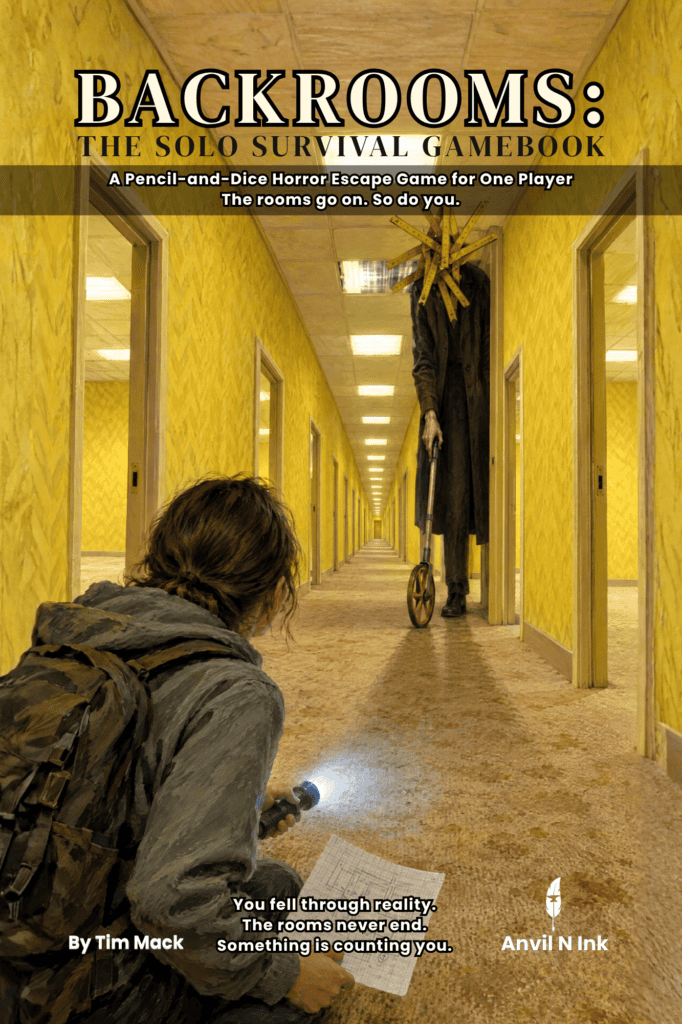
Backrooms game fans finally have one that lives on paper. Backrooms: The Solo Survival Gamebook is a pencil-and-dice horror escape game for one player. You draw an endless maze room by room, hunt for the way out and dodge the thing following you. No Game Master, no prep, about 20 to 40 minutes per level, six levels to escape.
The Backrooms started as one unsettling photo of an empty yellow office and grew into one of the internet’s favorite horror settings: endless rooms, humming lights, and the creeping sense that you are not alone. Most Backrooms games are video games. We wanted one you could play at a kitchen table with a notebook, the same way our Deep Delving solo dungeon crawler turned a dungeon into a pencil-and-paper campaign. The result is a solo gamebook where the map you draw is both your only tool and the thing the Backrooms attack.
How the Backrooms game plays out
You are a Wanderer who leaned on a wall that was not quite there and fell through into Level 0, the Yellow Rooms. You start in one square room with two numbered doors. Every turn you take one action: Move through a door, Search a room, Force a new door, or Noclip through a wall at the cost of your Sanity. Each new room is rolled on simple tables: its shape, how many doors it has, the number on each door and what is inside it. Some rooms are just wallpaper and damp carpet. Others hold an office chair that turns to face you by itself, or a note from someone who got further than you.
Searching finds Signs. The first Sign gives you an Exit Number, the second an Exit Condition (a room with four doors, a room at least six squares from where you started, and so on), and the third tells you the way out is close. The Exit Room is a new room you reach through a door bearing your Exit Number that meets the condition. Both are rolled fresh every run, so the way out is never in the same place twice.
Every action raises the Hum. At Hum 6 the book tells you which door number is about to vanish. At Hum 9 the level shifts and every door with that number is erased from your map. Losing Sanity makes you forget: rooms get crossed off for good, door numbers fade to question marks, and the route you were counting on is gone.
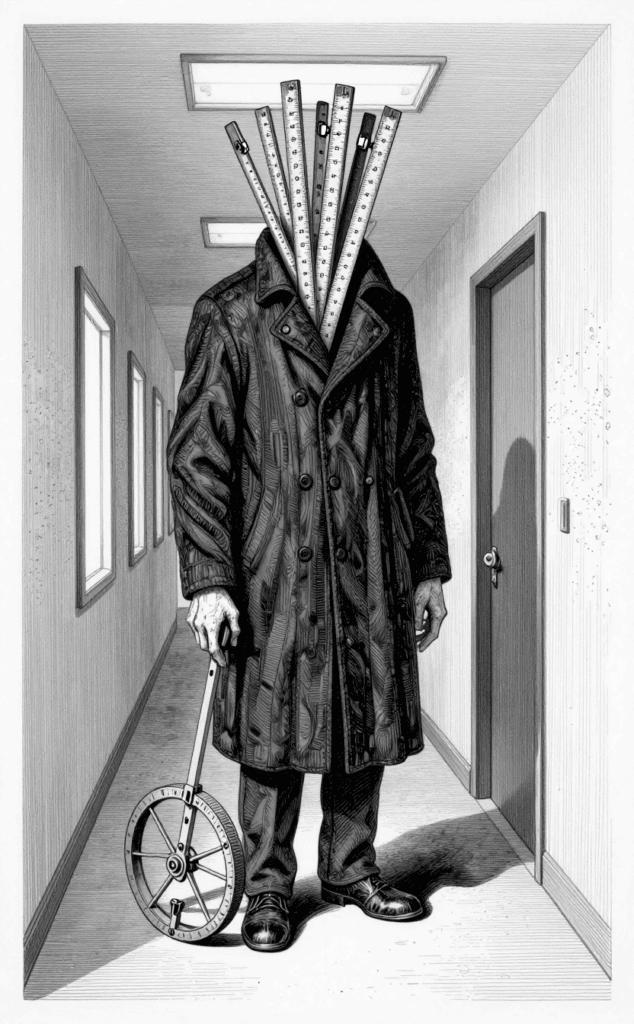
Each level adds its own law and its own entity. Level 0 has the Headcount, a towering thing with a head of wooden folding rulers that measures every room you enter. Level 1, the Drowned Offices, has a rising Flood Line and the Swimmer, a long pale shape under the water. Level 2, the Unfinished Hotel, renumbers doors when you walk back and sends Housekeeping, an empty uniform, to tidy you up. Level 3, the Dark Arrangement, hides door numbers until you walk through them while the Listener waits behind the ceiling speakers. Level 4, the Bathhouse, makes you drowsy in warm water under the gaze of the Lifeguard. Level 5, the Long House, is played on your own Level 0 map, with the Headcount at full strength.
When the entity reaches you, you Hide, Run or Face it, and every choice costs Supplies, Sanity or doors. When a Wanderer dies, they leave a Last Note and the next Wanderer starts in the same room on the same map. Run out of Wanderers and the Backrooms keep you. A map with no doors left and no wall to break through is Sealed forever.
There are four endings. Escape with your mind intact and you step out of an ordinary front door into an early morning street (Home). Escape on your last thread of Sanity and you fall through onto wet grass, missing pieces of what happened (The Long Way). Escape with your final Wanderer and you walk out carrying the notes and Supplies of everyone who fell before you (Carried Out). Or you sit down on the stairs of the Long House, just for a minute, and the Headcount makes one more mark on the doorframe.
What makes this Backrooms game different
Your map is the enemy
Most solo games use the map as a record. Here the Backrooms edit it. Shifts erase doors, Forgetting crosses off rooms and blanks numbers, and the Hotel rewrites door numbers behind you. You are always deciding whether to push into new rooms or protect the route you have.
One map, many Wanderers
Death is not a reset. Your next Wanderer inherits the map, the crossed-off rooms and the dead Wanderer’s body, which can be searched for Supplies. A Last Note can be crossed out once for a bonus on a roll. Later levels even reference the Last Notes and Exit Numbers of the Wanderers you lost.
Every run is different
Each level has a Floor Rules table that changes how that run plays, the exit moves every time, and Guests from the level above can wander in. Four difficulty modes, from Easy to Nightmare, change the number of Wanderers, the dice target and how fast the Backrooms shift.
What’s included
- A complete, standalone game in 159 pages with its own 2d6 rules
- Six levels, each with a Level Law, Floor Rules, Search and Event tables, room dressing and exit conditions
- Five entities, each with a full-page black-and-white illustration
- 135 numbered entries: set pieces, found notes, encounters and four endings
- Legacy rules for fallen Wanderers and four difficulty modes
- A two-page Quick Start, a full worked example and a quick reference
- Photocopiable Wanderer Log, Campaign Record and Sealed Maps sheets, plus a map grid for every level
Want to build Backrooms maps of your own? Try Ink Hammer, our in-house map-making program.
Who is this for?
One player. You do not need any roleplaying experience or any other rulebook: two six-sided dice, a pencil, an eraser and the grid pages are enough. It suits fans of the Backrooms and liminal spaces who want something to do with that feeling, solo players who enjoy map-drawing games, and anyone who likes a short horror session that is different every time. If you already play solo games like our MINDSCOURGE solo horror RPG, this is a lighter, faster game with a stronger focus on the map.
How long does it take to play?
A single level takes about 20 to 40 minutes, so one level fits a lunch break. A full escape runs all six levels and usually takes several sessions, especially if you lose a Wanderer or two along the way. You can also play any single level on its own as a short one-off.
Strengths and weaknesses
Strengths. The core loop is quick to learn and tense from the first room. Watching the Hum climb toward a Shift while you are one door from the exit is the best moment in the game. The six levels genuinely play differently, the shared map makes a death feel like part of the story rather than a game over, and the random exits keep replays fresh.
Weaknesses. There is real bookkeeping: Sanity, Supplies, Hum, Distance, Signs and a level track all change constantly, and your first level will involve a lot of page flipping. Reckless play is punished hard, so players who like to sprint and run from every encounter will lose Wanderers fast on Normal. Some exit conditions can take a while to satisfy once you have all three Signs. This is a game about mood and tension rather than combat, so anyone looking for fights will not find them here. Content note: isolation, drowning imagery, and a Sanity system built around forgetting and losing yourself.
How it compares
| Title | Players | Rules | Tone |
|---|---|---|---|
| Backrooms: The Solo Survival Gamebook | 1 | Own 2d6 system | Liminal horror, map survival |
| MINDSCOURGE | 1 | Solo RPG | Psychic horror |
| Deep Delving II | 1-2 | Own d20 system | Dungeon crawl |
| Half-Pint | 1 | Solo RPG | Burglary, light-hearted |
A taste of the writing
You are standing in a square room with yellow wallpaper and two doors. You did not see the doors a moment ago. You know this because you have already turned around twice. The fluorescent lights hum. The carpet squelches when you shift your weight. Somewhere far away, something small and dry goes tick.
Where to buy
Get the paperback on Amazon ($12.99), the Kindle ebook ($4.99), or the PDF and EPUB on Payhip ($4.99). Looking for more games to play alone? See our list of the best solo RPGs.
Key takeaways
- A Backrooms game for one player, played with a pencil, two dice and a grid
- Six levels, each with its own law and its own entity
- The map you draw is erased, forgotten and rewritten as you play
- Dead Wanderers leave the map, a body and a Last Note for the next one
- About 20 to 40 minutes per level, four endings, four difficulty modes
- Expect bookkeeping, and expect bold play to be punished
Frequently asked questions
Do I need any other rulebook?
No. The book is a complete, standalone game with its own rules. You need two six-sided dice, a pencil and the grid pages inside.
Is this based on the Backrooms movie?
No. It draws on the open internet idea of the Backrooms, endless empty rooms you fall into by accident. The levels and entities are original to this book.
Can two people play?
It is built for one player. Two people can share one map and take turns deciding, but the rules assume a single Wanderer at a time.
How hard is it?
Normal is meant to be beaten with care, usually after losing a Wanderer or two. Easy gives you four Wanderers, and Nightmare gives you one life with harder rolls.
About Anvil N Ink Publishing
Anvil N Ink Publishing makes ready-to-play tabletop adventures, solo games and guides for players who want great sessions without hours of prep. Most of our books are written for fifth edition Dungeons & Dragons, and our solo line includes the Deep Delving II solo dungeon crawl.
Pick up your pencil: this Backrooms game is waiting, and the rooms go on.
Get Your Copy
Choose your preferred format