
By Anvil N Ink Publishing · 8 min read
Anvil N Ink published this title, so the breakdown below is upfront about both its strengths and its weaknesses.
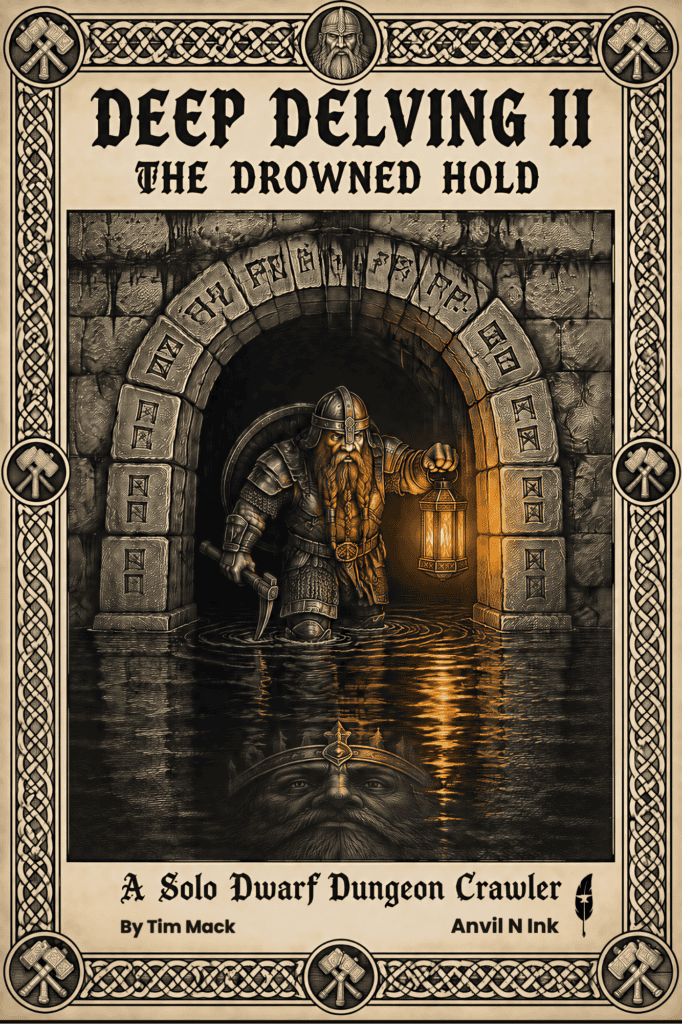
Deep Delving II: The Drowned Hold is a solo dungeon crawl for one player, or two playing together, set in a dwarf hold that drowned a hundred years ago. It needs one d20, a pencil and graph paper, no Game Master and no prep. A delve takes about 30 minutes, and a full campaign runs 25 to 30 delves.
The first Deep Delving is our best-selling solo game, and it was built for a single run. This sequel turns that run into a campaign. It is a standalone book with its own rules, so you do not need the first one, but everything it does is built around one question the first book never asked: what happens to the hold when your dwarf dies?
How the story unfolds
Khazad Varn was the oldest and proudest hold of the dwarves. A hundred years ago a duergar army broke into its deepest forges, and King Varn the Ninth, unable to drive them out, broke the Floodgate Seal and let the underground river in. The water drowned the duergar, the forges, the king’s own guard and the king himself, and it filled the hold to the front door.
This spring the floodgates began to fail. The dwarves of the mountain have built a camp at the great door, the Lanternhall, and they pay good gold for ore brought up from below. Each of the four levels is held shut by a Warden. Kill it and its floodgate opens, the water drops to the next level, and that level belongs to the dwarves again.
The Wardens get stranger as you go down. Old Bogtooth is a pike the size of a mine cart, lying against the first floodgate like a stopper in a bottle. Forgemaster Hallek is the duergar army’s master smith, who sealed himself in his forge with a century of coal and bolted the second gate shut from his side. The Cistern Mother was the High Cantor, who sang to hold the water back and drowned singing, and the water kept her song. At the bottom, on his throne in the Heart of Varn, waits the Drowned King himself.
Here is the twist, which the book reveals a piece at a time through 20 fragments found in the dark. The duergar did not break in. Varn opened the deep door to them himself, trading them halls that were not his to give in exchange for their forge-craft. When they took more than he offered, he drowned them, and his own people with them, so no one would ever learn what he had done. The lower halls were never cleared. He has kept the last gate shut for a century because if the water goes down, the hold will find the bodies and know. When he finally falls, his last words are “Tell them I was sorry,” and the river runs out of the Heart of Varn.
What makes this solo dungeon crawl different
The lantern is the clock
Your lantern holds 10 oil and burns one per room. When it runs dry you are in the Dark: -2 to attack, and every hazard gets harder. Every delve is the same decision made over and over: push one more room for a richer seam, or climb back to the light with what you carry. Retreat in the Dark and you may have to drop half your ore to get out.
The Floodgate Clock and the Wardens
Every room you explore on a level ticks a box on that level’s Floodgate Clock. Twelve boxes find the Warden’s Gate, every time. Bosses no longer hide behind lucky rolls. Each Warden also changes when it drops below half: Bogtooth frenzies into double bites, Hallek quenches his skin to iron, the Cistern Mother drowns every light in the hall, and the Drowned King starts healing faster than most dwarves can hit.
Death ends a dwarf, not the campaign
When a dwarf dies, the next one picks up an heirloom and goes down again. Gold you put into the Hold fund survives. At the Lanternhall you restore six Hold rooms, the Forge, Map Room, Brewery, Shrine, Vault and Great Hall, and each one helps every dwarf who comes after. A Roll of the Fallen keeps the names. A dwarf who reclaims the whole hold without ever dying has made an Iron Run, and the book tells you to mark it and tell someone.
What’s included in Deep Delving II
The book runs to 112 pages.
- Five dwarf archetypes, the Ironbreaker, Pathfinder, Runecaster, Tunneler and Brewmaster, each with a signature ability
- Four drowned levels, each with 10 monsters, 6 hazards, its own ore and a two-phase Warden fight
- Deep Horrors you build from tables, a d20 table of special events, and Hollin the Peddler, a one-eyed gnome who somehow always gets there first
- The Lanternhall shop: four tiers of weapons and armor, five brews, and stat training
- Legacy rules, the 20-fragment Delver’s Journal, and four difficulty modes from Easy to Drowned
- Full two-player rules with duo moves such as Shield Wall and Rope Line
- A complete example delve, a quick reference, and full-page character sheet, Floodgate and Hold tracker and delve map
What about maps?
There are no battle maps in this one, by design. You draw every room on graph paper as you roll it, and the book’s map key gives you symbols for stairs, fights, ore, rests, events and the Warden’s Gate. If you want to see a finished delve the way your dwarf saw it, by lantern light with black water around the boots, you can rebuild it room for room.
We build the battle maps for our adventures in Ink Hammer, our in-house map-making program.
Who is this solo dungeon crawl for?
First, solo players who want a campaign rather than a single session. The first Deep Delving was a run you could finish in an evening; this is a notebook you keep for a month. If you are new to playing alone, our guide to playing D&D solo is a good place to start.
Second, pairs. Two players share the hold, monster HP doubles, and each monster attacks each standing dwarf. A downed partner gets back up at 1 HP if the other wins within three rounds, and Rope Line can haul them out of a room alive. It works well for couples or two friends who want a co-op crawl with nobody stuck running it.
Third, fans of fifth edition who like the shape of a dungeon crawl but want something lighter. The rules are its own simple d20 system, with three stats instead of six, and the monster names will be familiar.
How long does it take to play?
A single delve takes about 30 minutes: a few rooms, a fight or two, and a decision about when to turn back. A full campaign on Normal runs 25 to 30 delves. The book says most players reclaim the whole hold with their fourth dwarf, give or take one, and that roughly one campaign in five is won by its first dwarf. Easy mode is for learning; Hard and Drowned are for players who want to lose a lot of dwarves. Play one delve on a lunch break or five in a night.
Strengths and weaknesses
The biggest strength is the pull of the campaign. The lantern makes every delve tense on its own, and the Hold rooms make every delve matter to the next one, so losing a dwarf stings without feeling wasted. The second strength is the story. It arrives in small pieces, a chalk note here and a ghost repeating one sentence there, and it lands hard at the bottom. The difficulty modes were tuned against thousands of simulated campaigns, so Normal plays fair.
The weaknesses are real. This is a resource-tracking game: oil, HP, draughts, ore, gold, Floodgate boxes and Hold funds all live on paper, and players who want pure story will find the bookkeeping heavy. Combat is a d20 exchange with specials rather than tactical positioning, so a run of bad rolls can end a dwarf with little you could have done. The two-player rules are complete, but the game was designed solo first, and a pair will spend more time on bookkeeping than a solo player. There are no battle maps or grid fights. And the story is about a king who drowned his own people, with a duergar child’s drawing and a cistern full of drowned singers along the way: it is told gently, but it is a sad book.
How it compares
The other solo titles below are all Anvil N Ink games for one player.
| Game | Players | Tone | Best for players who want |
|---|---|---|---|
| Deep Delving II: The Drowned Hold | 1, or 2 co-op | Dark fantasy, grief | A long campaign with legacy dwarves and four boss fights |
| Deep Delving | 1 | Classic dungeon crawl | A quick solo run through the mines in one evening |
| Half-Pint | 1 | Light, roguish | A halfling burglar’s career over seventy-five nights |
| MINDSCOURGE | 1 | Psychic horror | A descent where losing your mind is worse than dying |
A taste of the writing
The read-aloud text sets the scene in a few lines. Here is how the book opens:
For a hundred years the great door of Khazad Varn stood under black water. This spring the water dropped below the lintel, and the first lantern in a century went through. It came back with copper ore, a kobold’s ear and a story about a fish the size of a mine cart. Now the Lanternhall is full of dwarves who want to go next.
Where to buy Deep Delving II
Deep Delving II: The Drowned Hold is available now as a DRM-free PDF and EPUB on Payhip for $4.99, with a zip of the interior art included. It is also on Amazon as a Kindle ebook for $4.99 and a paperback for $12.99. For more games like it, see our roundup of the best solo dungeon crawler RPGs.
Key takeaways
- Deep Delving II is a solo dungeon crawl for one player or two in co-op, with no Game Master and zero prep
- One d20, a pencil and graph paper; about 30 minutes a delve, 25 to 30 delves a campaign
- A lantern that burns one oil per room turns every delve into a push-or-retreat decision
- Four Wardens with second phases, found by a Floodgate Clock instead of lucky rolls
- Legacy play: dead dwarves pass on heirlooms, and restored Hold rooms help every dwarf after
- A 20-fragment story reveals what the Drowned King really did
- Standalone: you do not need the first Deep Delving
Frequently asked questions
Do I need the first Deep Delving?
No. Deep Delving II is a complete standalone game. If you played the first one, the core will feel familiar, and you can bring your old dwarf’s name and archetype down with you, but not their gear.
Can two people play?
Yes. Two-player rules are built in, with doubled monster HP, duo moves and rules for a downed partner. The rest of the book works the same for one player or two.
Is it compatible with fifth edition?
It uses its own light d20 rules rather than fifth edition character sheets, so you do not need any other rulebook. Many monster names come from the System Reference Document 5.2, and fifth edition players will pick it up quickly.
What dice do I need?
Only a d20. A few rules call for a d4, d6, d8 or d10, and the book shows how to roll each one with the d20 if you do not have them.
About Anvil N Ink Publishing
Anvil N Ink Publishing makes Dungeons & Dragons style adventures and solo games, built to play in a single sitting with zero prep. The solo line now runs from a halfling burglar to a mind flayer horror to two generations of dwarves. For another way to play alone, read our review of Half-Pint, or browse the full catalog at anvilnink.com.
Light your lantern and follow the water down: Deep Delving II is the solo dungeon crawl for anyone who wants their dwarves remembered.
Get Your Copy
Choose your preferred format