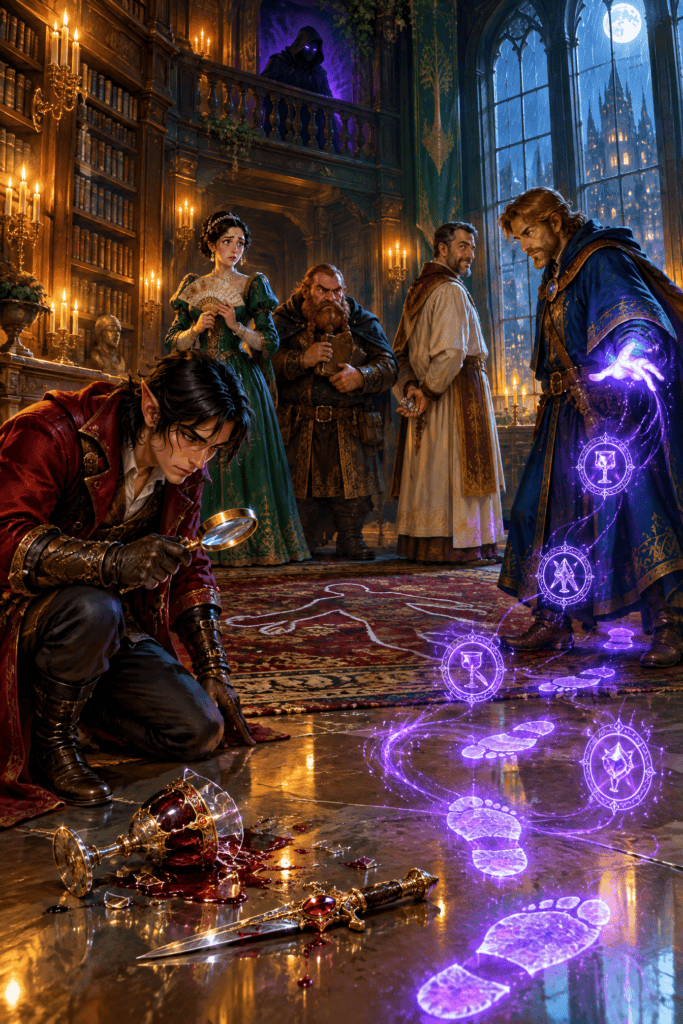

The best D&D murder mystery one-shots give a small table a real case to crack in one session: a body, a handful of suspects, clues that hold up, and a reveal worth arguing over. This collection ranks nine ready-to-run mystery and investigation one-shots from Anvil N Ink. Every one is built for 2-3 players with zero prep, and every one is available in paperback on Amazon or as an instant PDF on Payhip.
Mysteries are the hardest genre to improvise and the easiest to break. One missed clue and the session stalls. Every adventure below is built on redundant clues, so the party always has a path forward no matter which door they open first. If you want the craft behind that, our guide to running a D&D mystery without railroading covers the Three-Clue Rule and scene-based design. This page is the list of cases to run tonight.
Which D&D mystery one-shot should you run?
Pick by the kind of case. A classic whodunit plays very differently from a noir job or a monster hunt where the killer could be anyone at the table.
| # | Adventure | The case | Best for | Get it |
|---|---|---|---|---|
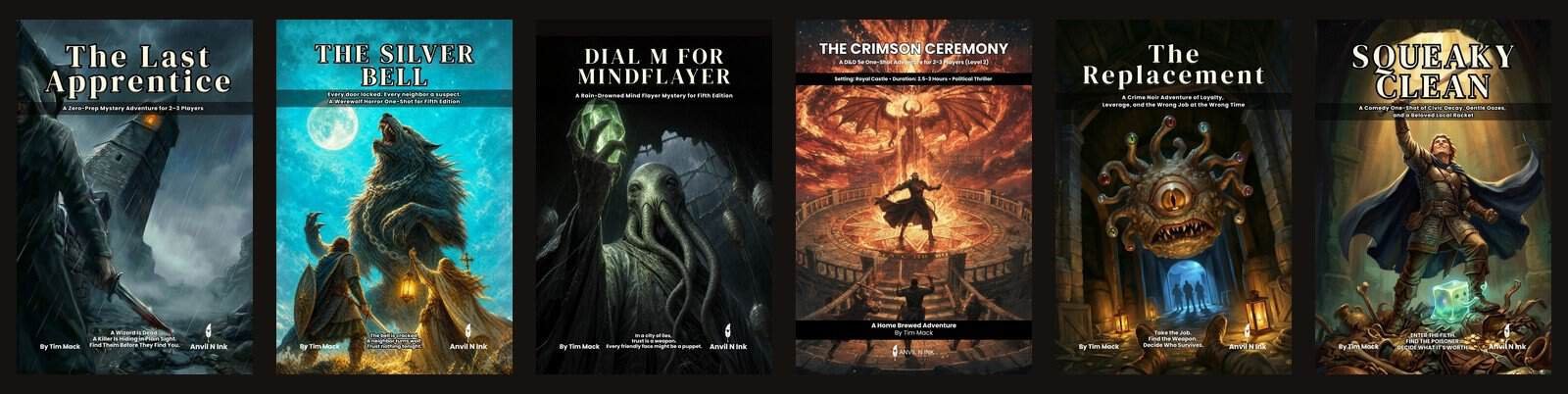
| 1 | The Last Apprentice | Classic whodunit: three suspects, a three-clue investigation, a killer in plain sight | Your first D&D murder mystery | Paperback · PDF |
| 2 | The Silver Bell | A locked village, five suspects, and a werewolf that heals every wound but silver | Monster-hunt mysteries | Paperback · PDF |
| 3 | Dial M for Mindflayer | Rain-drowned noir where every friendly face might be a puppet | Social deduction and paranoia | Paperback · PDF |
| 4 | The Crimson Ceremony | A political thriller where the clues you find scale the final fight | Roleplay-heavy tables | Paperback · PDF |
| 5 | The Replacement | Crime noir: your employer is a beholder and the last crew is already dead | Hardboiled players who like four endings | Paperback · PDF |
| 6 | Squeaky Clean | A comedy murder mystery with a gelatinous cube at the center | Laughs with a real whodunit | Paperback · PDF |
| 7 | Mothman | A cryptid mystery where the monster everyone fears is trying to save them | Omens, dread and a twist | Paperback · PDF |
| 8 | The First Frost | A Krampus midwinter mystery with three endings your table chooses | A December mystery night | Paperback · PDF |
| 9 | Inherit the Defense | A comedic courtroom case: defend a crime lord innocent of murder but guilty of worse | Lawyers, liars and table debate | Paperback · PDF |
Every pick runs for 2-3 players in a single 2-3 hour session, with pre-written clues, suspects and contingencies.
The best place to start: The Last Apprentice
If your table has never run a D&D murder mystery, start with The Last Apprentice. It has three suspects, a clean three-clue investigation, and a killer hiding in plain sight. It teaches the rhythm of a mystery (search, question, theorize, accuse) without punishing a party that misses a clue.
Get The Last Apprentice on Amazon →
Build your own mysteries: the Mystery Adventure Toolkit
Want to write your own cases? The Mystery Adventure Toolkit gives you the Three-Clue Rule framework, GUMSHOE-inspired investigation design, and three complete mysteries with redundant clue structures, plus templates for building more.
Paperback on Amazon · PDF on Payhip
What makes a good D&D murder mystery one-shot?
Redundancy. For every conclusion the party needs to reach, a good mystery offers at least three clues that point to it: a witness, a document, a piece of physical evidence. Any one is enough to move forward. If the party finds all three, the case feels airtight.
The best mystery one-shots also give each suspect a real secret, so even the red herrings feel like progress, and they tie the investigation to the climax. In The Crimson Ceremony, for example, every clue the party finds makes the final fight easier. A ticking clock keeps the questioning from turning into a pixel hunt. For the full method, see our D&D mystery adventure guide.
Why do mysteries work so well for 2-3 players?
Small tables remember more and argue better. With two or three players, everyone hears every clue and every NPC statement, so the clue design actually works as intended. Deduction becomes collaborative instead of a contest between the loudest voices, and the “eureka” moment lands for the whole table at once. For more small-table advice, see the best D&D one-shots for 2 players.
Key takeaways
- The best D&D murder mystery one-shots pack a full investigation into one 5e session for 2-3 players, with zero prep.
- Start with The Last Apprentice for a classic whodunit, or The Silver Bell for a monster-hunt mystery.
- Pick by the kind of case: noir (Dial M for Mindflayer, The Replacement), comedy (Squeaky Clean, Inherit the Defense), or seasonal (The First Frost).
- Good mysteries use at least three clues per conclusion, so one missed roll never stalls the session.
- Every title is available in paperback on Amazon and as an instant PDF on Payhip.
Frequently asked questions
What is the best D&D murder mystery one-shot? For a first mystery, The Last Apprentice. It has three suspects, a three-clue investigation and a fair reveal. For a monster-hunt twist, The Silver Bell, where one of five villagers is a werewolf.
Can you run a D&D mystery with two players? Yes, and two players is often the best size. Every adventure here is built for 2-3 players, with clues that do not depend on any single character’s skills.
How long does a mystery one-shot take? Each one is designed for a single 2-3 hour session. Built-in deadlines keep the investigation moving toward a confrontation.
What if my players miss the key clue? They will not get stuck. Each adventure gives every critical conclusion several ways in, plus written fallbacks for when the party goes off-script.
Is there a funny D&D murder mystery? Yes. Squeaky Clean is a comedy whodunit built around a gelatinous cube, and Inherit the Defense is a comedic courtroom case.
More one-shot collections
Looking for a different genre? See the best D&D heist one-shots, the best D&D horror one-shots, or every 5e one-shot we publish, sorted by genre.